
First Spring day in Beijing

Still I did a bit of ice skating and many others also had the same idea: let's do it before the ice gets too thin. Even the group of men were around swimming in the ice water. This is amazing. They do not just dive in and get out again, but they really swim a few strokes and stay for minutes in the water. So I asked: "What's the trick? Some Chinese Medicine again?" A lot of laughter. I guess, there is no trick. They are just really tough. If things go well, I will finally get the container at the end of this week. The winter clothes which are in there I might not even need any more this year. It took then about 3 months to ship the freight from Hong Kong to Beijing. It is not the shipping itself which takes this time, but the procedures around it. Bureaucracy is a very sophisticated system here, as there are so many people who have to find employment in it. But once you figure out the process, things go surprisingly smooth. Of course the HR Department should take care of such things. But like with any HR Department, "should take care" is all you can expect.
The only small disadvantage of temperatures above zero is that you have to watch out on the street where you step. People tend to spit on the ground here, after cleaning their throats in a dramatic manner. And what was a little frozen ice patch before, is now - well, you know what it is. I know it is based on 5000 years of culture and this needs respect and tolerance. No problem. But better watch your feet.
Lomography
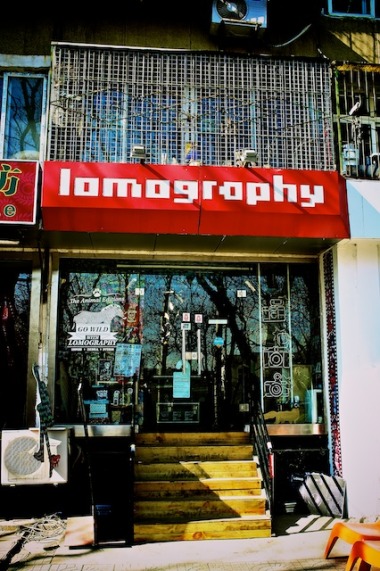
Diana was always a camera you could do things with, which you could not do with other cameras. And the reason was: it was so cheap, that if you crash it, it does not matter. I even fixed it to a kite get a bird's view. The shutter I operated by a pendulum mechanism which just made click on a certain angle (which corresponded to the pre-calculated flight height). Then I put it into a sewage pipe and used it for my own kind of underwater photography. I have to say though, that there is not much to see in the lakes and ponds of the Westerwald. What else can be said about Diana? Well, just that it was a really bad camera - 35 years ago. It is really not much different from a Camera Obscura, just that it has a lens and not just a hole. And I guess it is simply put one of the world's worst cameras.
Now, something called Lomography has become a fashion and Diana (and her sisters) are reborn. Strange for me, because every mobile phone can take better pictures than a "Lomo". In the online shop, you have the choice between many different models in the range between about US$ 50 up to over US$ 100. People meet for Lomo-Events and pin their photos to walls and talking pictures with it seems a cult. In the Lomography shop which I found today were a few girls which only had frames for glasses on their noses. This is also a strange fashion I have now often seen in Asia. I suggested that if did not forget to put glasses in their frames, their might actually be able to see how bad their pictures are. But they just giggled. Never mind. I think it is actually think it is nice they have a hobby like that and I regretted a minute later that I said something so nasty.
I took the picture of the shop above and post edited it with a cross color algorithm and then a preset function called "Toy Camera". But it is still not what a Diana would make it look like. Today's Dianas I have seen are actually not made in Russia, but in China. Would be nice if the good old (and I mean literally "good old") Voiglaenders also could make it back like this. And when I think about all the old Chinese camera brands which are actually so much better then a Lomograph, then there are quite a few nice things which can be done to get them alive again.
798 Art Zone
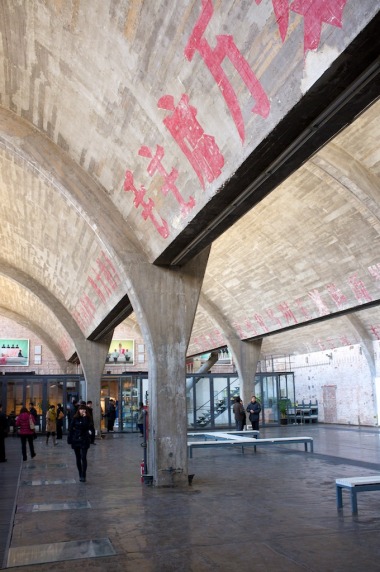
This was also the time when first artists were moving in looking for cheap space. In 1995 also the Chinese Academy of Fine Arts moved workshops there and a nucleus for a growing cluster of artists was laid. In 2004 it was achieved that the destruction of the buildings was halted and a bill passed to develop the site into an Arts District. As a consequence the owner of the buildings did not renew lease contracts to have the chance driving out tenants and redevelop the land in a more profitable modern format. In 2007 though it was decided to keep and refurbish the Art Zone.
Today it is a lively place full of galleries, studios, workshops, design centres, cafes and restaurants. It is amazing what amount of space and hardware is available. Here is where you find everything from pretty nice galleries to Mao Kitch. There is not one list of galleries available online. So, the best thing is to go there and have a look.
Ice skating to the office
The Chinese new year started with a sunny Sunday. And as it was a working Sunday, I took the opportunity to commute to the office on my ice skates. This was a very nice commute, down the canal to Sanlitun in the morning. The water level has been dropping and the ice is cracky, but thick and safe. Only at some inlets it is melting. And at one point there is a hole which people use to (believe it or not) go swimming. At night going home, I did not skate, because I could not see the cracks in the dark and also I might have fallen into one of these holes. Many companies have started work today, even it is a Sunday. Together with having a working Saturday the week before, many had 7 days public holidays in a row. But the Sunday was not a quiet one, as everybody tried to get a headstart. From tomorrow, the calendar is packed and I expect a bit of a stormy week also, because we have quite high visitors. So, in terms of blog entries I might excuse myself for a few days.
Enhanced flavors causing me a headache?
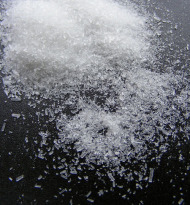
MSG is also used in many convenience foods, where it has to be declared as ingredient (E621). Again, the last time I was eating something like convenience food, were Military Combat Rations in the 1980s. But also back then my exposure to MSG must have been low, because I usually traded out the main dish against the chocolate, cigarettes and condoms with fellow soldiers. These were accepted for payment of goods and services from our US allies and increased my wellbeing and social position in the barracks. Once, using this currency, I even bought a fully loaded Smith & Wesson Cal. 0.38 Revolver from an American soldier. Well, talking about brain damage: he must have had a lot of MSG.
Perhaps my low exposure, is why I am more sensitive to MSG. But it is also possible, that my current discomfort has nothing to do with MSG at all and it is just the oil used or ... who knows? It is always tempting in Beijing, just to pop in a restaurant. But of course there is not much control on the ingredients.
Beijing in Spring Festival
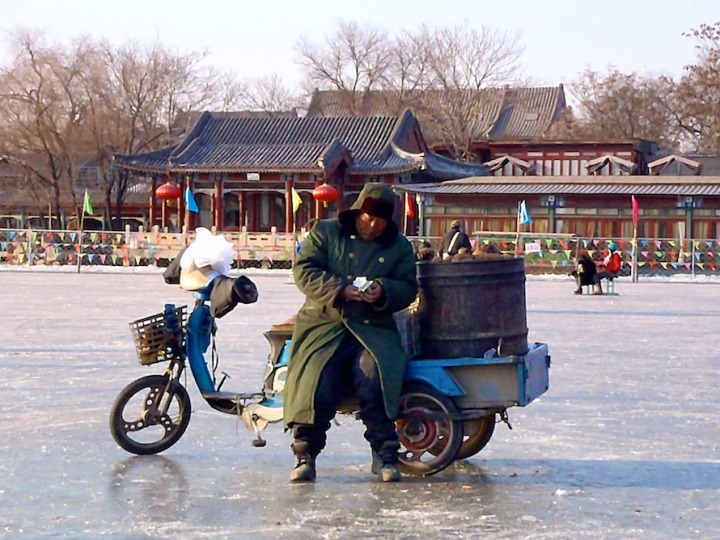
Of course, I would not be in China, if not everywhere small little businesses open to cater into all kinds of holiday demands. From the man with the mobile sweet patato bakery who is counting his money on the frozen lake where he sells his snacks to the ice skaters (see photo on the left), to extra capacities in taking family portraits in the China Photo Studio. Not to mention the huts selling the fireworks which turn the nights in Beijing into a self (un-)organized light show which is unmatched anywhere. I was wondering how safe it is when the firework's salesman is smoking sitting on a few tons of gunpowder. But you think it is "cool" just to smoke in a non-smoking area in Hong Kong and chase away the little policeman? That's nothing against sitting smoking on a pile of gunpowder chatting with the policeman on how the family is doing. Happy new year, health luck and prosperity for the Year of the Dragon.
In Memoriam Kodak
Today I had to submit my social security registration to Chinese authorities and was asked for a photo of a size that I did not have available. So I dropped by a Kodak shop. Done. As Kodak just filed bankruptcy, this might be one of the last memories, I might have of this formerly grand company. I was brought up on Kodak Ektachrome and always when my pocket money allowed me to buy one instead of Agfa, I did so. Better to take a photo less, but then it has to be perfect. I spent years in the darkroom and the first time I switched from Ilford paper and chemicals to a color process, it was Kodak too. Most of my old family pictures are Kodak prints and films also. The company is really an amazing case of a "Fallen Angel". They even invented the digital camera, and then did not develop it further and capitalized on it. Even the 50 Mega Pixel Sensor in the low range Hasselblad (which is still high above my range) is made by Kodak. Hard to understand for me why all Kodak digital cameras I have seen are so bad. Of course, I know that in big companies people can stand on each other's feet. But they really must know better. And sure, there can be also really bad strategic decisions. So often the "old guys" sleep on their brilliance and fall into the hands of "new guys" who only claim to know how the future looks like and do complete nonsense. Did this also happen to Kodak? After Voigtlaender, Borgwart, Hanomag, Zuendapp and Much another one of my favorite companies disappeared. On the other hand there is for example Leica more vivid than ever. But all I know about the Business Case Kodak is just speculation. It is just such a shame.
Still more crafts than arts

Because of this handicap I am looking at fine arts and Chinese painting first. But I have to say that the traditional pieces are not very impressive any more and the new ones are not impressing me yet. Of course the connoisseur will say I am ignorant, but in terms of traditional paintings I quickly had enough of bamboo, karst landscapes, cherry blossom, fish, horse and intellectuals hanging out in a countryside pavilion. Not that they are not well painted. But why do they have to paint the same things hundreds of thousands of times? Modern painters seem mostly to cash out on being pseudo critical on the Cultural Revolution time. Always just so much that they do not get into real trouble, but enough to ask for a price premium. Some of them make it even as "professional pseudo-dissidents" into the charts of Western museums, like Ai Weiwei. Most people even have forgotten how bad his artwork actually is, but only remember him as an "intellectual rebel" instead of somebody who was prosecuted for omitting enormous tax payments. Well, sure as an intellectual he does not know what his accountant does. Come on Weiwei! Sounds to me like virgins giving birth to the son of god etc. Who believes such a story?
I also looked at photography. But most new things I see are not better than the Ikea Posters we had hanging in the the common kitchen of the student's dormitory in the 80s. Just that they did not have Photoshop back then. I was wondering why in Photography competitions Chinese photographers mostly excell in fashion and commercial photography. And the answer seems that the lack of talent is so severe that any potential artist is quickly absorbed into a career which is more that of a graphic designer. Reminds me of two or three years ago, I was pointed by a friend to a picture in the Ooi Botos Gallery in Hong Kong, because it was showing a black Audi A6, which was easy to be seen as a government fleet car beyond a mass of puppets lying on the floor. Not that I would be interested, but I was told Audi might be (which it wasn't). The photographer, Chenman, is now a celebrated fashion photographer - no more, no less. The old master's kept paining ever the same bamboo over and over again, and today's photographers mass produce the ever same fashion shots.
However, if there is one place in China, where talent is concentrating, then it is Beijing. And as competition is slowly picking up, I expect that the next wave has to be better.
South Georgia Heritage Trust

The solution brought forward by the South Georgia Heritage Trust is to poison the rat population by dropping baits from 2 helicopters. The plan takes advantage of the current glacier structure which did not allow the rats yet to spread over all the land. But as the glaciers are withdrawing as an effect of global warming, there is high time to kill every single rat on the island before these natural barriers leak and provide an unfrozen land connecttion for the rats to spread further.
The projects has two Bolkow-105-Helicopters in service and you might imagine the cost involved in this kind of habitat restoration. This is why the South Geogrgia Heritage Trust is grateful for any financial aids. More information and also the chance to donate online, you find on their website.
The Flowers of War by Zhang Yimou

The story of this movie is set in the Nanjing of 1937 during the brutal invasion and occupation by Japanese troops. As this was definitely one of history's most savage crimes against humanity and one of the deepest traumas in China's collective memory, any story in this setting will shake emotions strongly. So does the Flowers of War. An American vagabond called John Miller (played by Christian Bale) makes it through the chaos of the battles into a fictive Catholic church. Here he ends up taking responsibility for the girls of the convent school an orphan boy and 12 prostitutes taking also shelter there. The disreputable John Miller takes on the priest robe and role towards the Japanese to protect the girls. The narrator is one of the school girls (Zhang Xinyi). In the middle of a brutal setting, unfolds a love story of the protagonist with one of the prostitutes (Ni Ni) which finds its end in them standing in for the convict girls being most violently forced to "serve" the Japanese soldiers in one of their parties while the girls can escape out of the city. If anybody needs an illustration why Iris Chang titled her book The Rape of Nanking, then after having seen this movie, it is terribly obvious.
Of course any movie set in the centre of the massacre of Nanking (now Nanjing) is shaking any audience emotions. But I found it pressing too crudely on the love and hate "buttons". For me the movie is definitely falling short against the movies City of Life and Death by Lu Chuan, Nanking by Bill Guttentag and Dan Sturmann and also against John Rabe by Florian Gallenberger. I did not have the chance yet to read Yan Geling's novel. But I am looking forward to read it when I find a good translation and compare it with the very different story in the same setting called Love in a Fallen City by Zhang Ailing.
Perhaps it is that Zhang Yimou did not develop a deeper impression against the brutal background, that it also seemed to me on first sight like an anti-Japanese propaganda movie. The movie seems playing on sentimental patriotism and daemonizing the Japanese enemy. But sure, given the historical background there is also not much on the Japanese side which would allow a balanced view. The second thought I had that perhaps it is just another successful attempt of Zhang Yimou maximizing the box office revenue of his movies. After having started as a brilliant director, The Flowers of War again follow a soap opera recipe and the movie is for that disappointing. It could make Zhang Yimou the Andrew Lloyd Webber of Chinese cinema. And I will still go and watch his movies, but just as I watch a musical. Not more, not less. Just not sure whether Chinese cinema really needs a "Hollywood".
Beijing China Photostudio Ltd.

Graceful Capital and pleasant neighbourhood

Farewell to my island in the South China Sea
Then when I checked into the service apartment late at night, I was greeted with: "You are booked to check in tomorrow". So I looked at my watch: "Okay, wait 30 minutes, then it is tomorrow". We all laughed and finally: "No problem ... Welcome to Beijing".
Iguazu Falls

The Iguazu Falls are an interesting place to visit for all those which have been also bored by the Niagra Falls. The Iguazu ("Big Water") Falls are set in a secondary subtropical rainforest and by that itself are much more part of the natural environment. The Brazilian side is more panoramic, the Argentinian more intense. You can reach over to Devil's Throat via gangways and of course it is quite splashing to take a boat at the foot which takes you extremely close to the fall (bring a dry bag for you things). You can reach Iguazu by plane. If Aerolineas Argentina gives their standard announcement that the flight is canceled or delayed because of weather, it might in this case even be true. The clouds can be hanging really low above the rainforest here. And when I broke through, it was just a few hundred feet above it - with patches of fog dense on the forest canopy. Even in detail the vegetation is different from the Amazon, by the landing scene I was reminded of Fizzgeraldo by Werner Herzog.
Iguazu was the last stop before of my five year academic sabbatical. From here it takes 18 hours by bus (because flight canceled due to a volcano eruption) plus 15 hours plus 13 hours flights with no significant break in between. Then applying for a Chinese F-Visa (one of the very few F-Words I use), and finally hitting a bed. Then packing up and moving to Beijing. Life itself can be extreme sport already.
Drake Passage
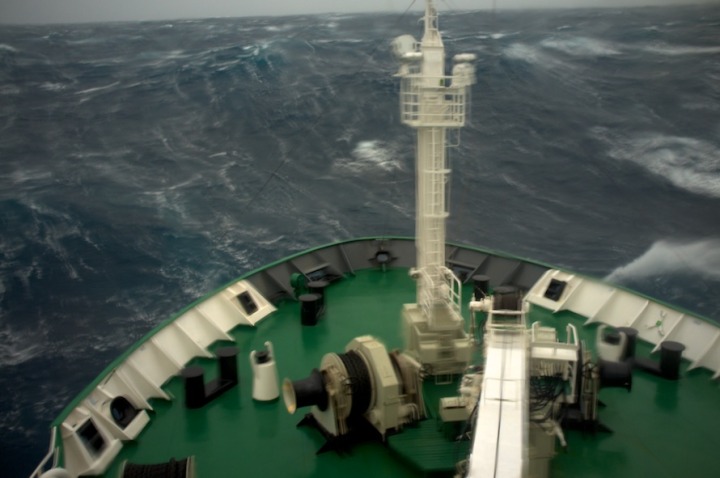
In 1578, Sir Francis Drake was blown by Northerly gales off the Magellan Strait into open waters South of Tierra del Fuego and discovered this as a passage from the Atlantic to the Pacific. Today it is named after him the Drake Passage and it reaches from Cape Horn towards the Antarctic Peninsula. Passing Cape Horn has the most hazardous reputation and with the development global trading routes, it is often referred to as the "sailor's graveyard". In good weather it can be very calm - and the sailors joke calling it the "Drake Lake". What amazed me is that there is no marine weather forecast available here. The only thing you get is a fax showing the isobars and a few temperatures. The rest you have to do yourself. I remember that when I studied in 1987 in the Meteorological Institute in Cologne University, this was already used as an exercise to show us students how weather forecasts were done in the past. Our depression (this is how low pressure fields are called scientifically) system moved North and then struck us with a number 10 storm just South of Cape Horn. That's then called the "Drake Shake" and when there are icebergs you call it "Drake Shake on the Rocks".
When passing the horn, Dave who was historian on board, took the PA system to recite the English translation of Sara Vial's poem that is beside an albatross statue on the Cape to remember the sailors who died here:
I, the albatross that awaits for you at the end of the world...
I, the forgotten soul of the sailors lost that crossed Cape Horn from all the seas of the world.
But die they did not
in the fierce waves,
for today towards eternity
in my wings they soar
in the last crevice
of the Antarctic winds
Sara Vial, Cape Horn 1992
Antarctica

When I made Antarctica the examination continent of my choice in 1988, it was because I did not have to bother with people. I only got interested in people later, but back then I preferred the simplicity of a seismogram. Of course studying Antarctica for a while like this, my perception became that all people must be explorers. And as the people I met on the streets around me in Cologne were not explorers, I concluded that there is something wrong with them. Only years later, I figured out that there was actually something wrong with me. In Werner Herzog's fascinating movie "Begegnungen am Ende der Welt" (Encounters at the End of the World), he visits Antarctica exactly to find out what people are there. An idea I would not have. In an interview by Herzog with a linguist who worked in a greenhouse on the Ross Ice Shelf (a place where you may not expect a linguist to find work), he put it in the way that it is a natural consequence that people with similay wavelength mingle in Antarctica: all those who do not have a grip on the planet, slide down and meet somewhere around the South Pole.

There are two feasible ways to travel to Antarctica: one is to fly in with a military plane from New Zealand to the Ross Ice Shelf, the other is to cross the Drake Passage by ship and enter from the "North". Of course what I call "North" now is not more North than any other coastal location of the continent, because the South Pole is just about in the middle - so in any direction you move away from the Pole, you move North. But the "North" I mean, is according to the convention to point the Antarctic Map upwards into the direction of 0 Degrees. As the Ross Ice Shelf requires more time and is less disverse in terms of landscape, the entrance over the Antarctic Peninsula is the better choice this time.
We boarded the Russian research vessel Akademik Ioffe on November 8th. The ship belongs to the Shirnov Institute of Oceanography in Kaliningrad and is built for the purpose of "silent listening". It is a 117 meters, 6600 GRT ece strengthened vessel with two diesel engines at 7000 bhp and thrusters which manoeuvring in narrow and difficult conditions. It makes a maximum of 15 knots and has a cruizing speed of 13.5 knots. Water and fuel storage define an endurance of 60 days in polar waters. The major interest of the researchers using this ship is to observe underwater wildlife together with its sister ship the Akademik Sergey Vavilov. For this it is equipped with 15 kHz and 45 kHz echo-sounders, which have enormous antennas in the mud room. Russia is very famous for having a good overview on what is moving below the surface of the oceans and wildlife is for sure very interesting.

The first landing was on Half Moon Island on November 12th and there were a few things which became instantaneously clear. First of all, this is a beautiful place, which is so amazing that no photographer, no painter and not even a poet may capture it. Secondly, this season is early spring in Antarctica and one of the earliest expeditions of this kind which is made there. This means the ice makes it not easy to find landing sites for the Zodiacs and sudden changes in weather can pack in a landing point very fast and you have to take off from another place again. The wind can pick up fast too and even the temperatures are moderate minus degrees, the wind chill can be a bit biting. Not just for people, but also for the camera, the ice landscape is an exposure nightmare. The Aperture priority setting simply did not figure out what to do with the light and I had to take all pictures in full manual and overexpose all pictures by 1 to 2 stops. Penguins are cute little guys, but that's about it. On Half Moon Island they were Chinstrap Penguins ducking down in the snow storm. Only later, when I saw an old recipie of Penguin breast with peanut butter in the British station Port Lockroy, my interest in Penguins rose again. But there were other birds, which I found fascinating. One of them is the Albatros. I am sure this is done already, but if I would have to construct planes, I would study the Albatross very carefully. It is for me a miracle of efficiency how these birds can follow the ship for days in the roughest weather conditions with no landing. And it seems so effortless.

The journey went further South passing through Orleans Strait into more protected waters. Still the surge can be freightening in a Zodiac, specially when you consider that falling into the -2 Degree Celsius salt water only leaves minutes to survive. I was told that the life vests are here called "mark vests", because you don't survive anyway, but they make it easier to find the bodies. Just going around a rock, can mean that the wind picks up so strongly that you have to suddenly withdraw. In our case around once the Akademik Ioffe left its location to pick up a Zodiac. The visibility was so low, that the ship was just gone. Now, these Zodiacs are the best boats in the world and have a 60 horsepower engine. So we were safe at all time, with radio connection to the bridge and an experienced expedition leader coordinating the move. But how must people like Shakelton and his crew have felt in their wooden nutshells? I found it still memorable to sit on a "rubber duck" in Antarctic waters, bouncing on the waves, and no ship in sight.

A breathtaking experience was when the Captain closed the bridge and prepared the ship to enter an island. Of course a ship can not enter an island I thought. But in this case it was "Deception Island", which looks like an island, but is a collapsed caldera which can be entered by a narrow opening. Inside the caldera are the remains of a whaling station and on shore there are hot springs. I was not aware of the extend of the whaling industry and how large was actually the dependency on whale oil which was used in oil lamps. In the long Antarctic hours I wanted to read Moby Dick again, but found that I did not have it on my Kindle. For a moment I thought of using my Iridium Satellite phone as a model and to download the book. This would have been the first copy of Moby Dick which would have reached Antarctica via space. And probably it would have also been the most expensive copy, so I dismissed the idea and downloaded it when back in terrestrial network coverage.
So far all landings were on islands North the Antarctic Peninsula. Then on November 16th I set my foot the first time on the Antarctic continent. I wanted to make it a memorable moment and before stepping out of the Zodiac I thought: "A big step for me, but a small step for mankind". It took me 25 years from the University textbook to finally come out here and have a look. And this time I only landed where the old explorers actually started their journeys, nearly a century ago. Antarctica is often called the earth's last wilderness. I remember as a student I was upset that no resource exploration is allowed here under the Antarctic Treaty. This meant no jobs down here. Back then I thought: "What's so special about these dull and boring penguins?"
Today I am grateful that Antarctica's beauty and fragile ecosystem has been protected. And I hope the world's hunger for resources does not change this. Well, not sure whether I am getting more wise or just old. This time I have no more 25 years to come back.

The beginning of this journey is "The End of the World"
Patagonia
"Il n'y a plus que la Patagonie, qui convienne a mon immense tristess ...", writes Blaise Cendrars in Prose du Transsiberien. I wanted to know more about the geography and people, which turned Bruce Chatwin from a journalist into a a fine writer. There, in his book on his journeys down in the most Southern Part of the Andes, it says: "Patagonia! ... She is a hard mistress. She casts her spell, An enchantress! She folds you in her arms and never lets go."

Patagonia is a desert of thorns, bushes, steppe, Megellanic and Valdivian forests, ice fields and glaciers - which is shared between Argentina and Chile. It is a volcanic area with Ceratous rocks and Teriarty granite, cut deep in my rivers and with long sand and gravel fields in meandering streams. El Calafate, even it is still a large settlement for Patagonian standards, already is a village community. And it is not just because of the visitors still passing by here that most clothes you can buy are outdoor gear. There is simply indoor life expect the dinner table and the bed in El Calafate. And people are so strait forward that it took me sometimes some effort to remember to be still in South America.
Patagonia is the last place on Earth, which was reached by human migration. Wherever you walk, you will go for hours. But time goes slow in Patagonia. Nothing matters, but being warm, fed and knowing directions. Like this you hike through crystal clear air and drink from crystal clear rivers. The guest house outside El Chalten, where the railheads to Mount McKinroy start, was powered by the river nerby. Drilled into my mind since childhood to switch off the light when leaving the room, here it was just a bit of clear water running a turbine alongside the house. The Patagonian Ice Field is feeding countless glaciers pushing their bright blue compressed ice masses down into the low land. They end in moraines, or break off in lakes. Many of them are still stable, luckily - despite global warming. It is like nothing from the "other world" can touch you here.
I know many people, when they think about where to retire, they think about a place with mild weather and good medical services. I am actually thinking about Patagonia. As I quoted before: "... She folds you in her arms and never lets go." This is one of the most fascinating landscapes I have seen so far. If I ever have the chance for a new sabbatical to write a book, then I might write it here.
Buenos Aires
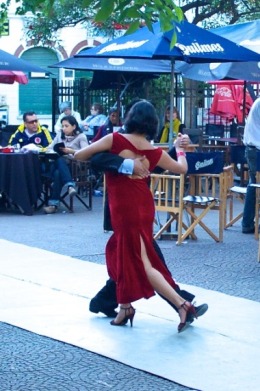
I remember that we went for dinner and paid quite a price for a steak. I wondered that if this is expensive for us, then how do the Argentineans pay for their steak? Weeks later they rose up. There were street riots, looting of shops and people died in street fights. Then Argentina un-pegged the Peso from the US$ while I was sitting in a tango bar in Buenos Aires. The currency literally collapsed and the country declared default on their debts.
Now, more than 10 years later I returned to Buenos Aires as a stop over to Patagonia. It is one of my favorite cities. The artistic and creative output is ranked as one of the word's highest. Who ever knows how to do such rankings?