Why does the world have Rice Cookers?

After having cooked or steamed rice for decades without any problems in a pot, I recently was surprised that many Chinese I talk to don't know how to do that. They need a rice cooker. These are electric appliances, which do absolutely nothing else, than what you do in a normal cooking pot. Some of them have some digital functions and beep around and flash some LEDs. Mainly they just control temperature and time. Some of them also allow steaming. But still on first sight rice cookers seemed to me as completely obsolete.

But I was wrong. Rice cookers in China reach back to a time in which many people were still cooking on a coal fire - actually, many still do this today. As this was the only fire place which can heat a Wok to cook other things than rice, it was convenient to have a self sustained rice cooker, which could do the job in any corner where there is an electric plug. Also, many more modern electric and gas stoves actually only have 2 fires, and not 4. So, again a rice cooker helps a lot to keep these for cooking other dishes than rice.  

Rice cookers go back to 1937 where they were used for mobile kitchens in the Japanese Army. In 1945 Mitsubishi brought the first civil electric rice cooker to the market and in the 1950s Toshiba followed with the first fully automated rice cookers. 

Interesting. But having a gas stove with 4 fires, I stay with my pot for now. 


Whiteout on Mount Hallasan

It has been more than half a year since I last visited Jeju (the island off shore the Southern tip of Korean Peninsula), back then testing my new hiking boots. This time on Mount Hallasan, no ice was on the summit, and just a normal pair of shoes were enough for the 1600 meter ascent. But this week the peak of the mountain kept itself mostly hidden in clouds. After leaving the forest, you cross a beautiful alpine landscape with a unique fauna and flora - many species indigiounous. Strong winds were driving patches of clouds over it and left a quick change of bright sunlight and whiteout. I was told that this is the environment surrounding immortals in Chinese believes. I always feel high mountains have something immortal, no matter of light. Perhaps, it is because we are closer to the sky.

DSCF9379.jpg

Jeju is a sizable volcanic island, with Mount Hallasan as the major shield volcano. But there are many more volcanoes, tuff craters and lava tubes. A paradise for volcanologists. The coasts are mainly steep and rocky, and the few natural beaches are black sanded. The water of the natural springs tastes of different minerals, depending on the very specific location. Luckily Chinese tourists are absorbed by the Casino and the shopping malls and other attractions close to the airport, which preserves the rest of the places from their impact.

From Jeju's East coast there is a ferry connection to U-Do island, which takes about 30 minutes. It is a car ferry, which also carries the trucks transporting out the garlic harvest, which is a major crop there, and a fixture in Korean cuisine. Arriving U-Do you can rent a motor cycle and circumcise the island in less than an hour. U-Do is offshore-offshore Korea, and by this reminded me of Lamma Island, which was my home in the South China sea for five years, before I moved to Beijing. I know that for many people "offshore" is mainly related to a special kind of Financial Service industry which is making use of special rules away from major jurisdictions. But for me, "offshore" is a lifestyle away from the buzz of big governments and consumerism. It can be found on islands, in forests, on mountains and even in some cities - probably not in Beijing though. 

DSCF9268.jpg
DSCF9325.jpg

Helga Besler (1939-2012)

When I recently visited my Alma Mater in Cologne, I had to learn that Prof. Dr. Helga Besler passed away in spring 2012, aged 73. I knew she was Emeritus, and we still wrote for many years, but the last ones I lost track of her. She did not use e-mails, because she always said, it's bad for her eyes, and the last letters stayed unanswered. I blamed this routinely to the postal service, and did not even think her time could have been over.

​Helga was one of the most influential people in my life and I worked for her as a teaching assistant at the Department for African Research of The University of Cologne, before she encouraged me, even without meeting all requirements of a formal graduation, to go overseas and work as a scientist in the Mining Industry. She supervised first my thesis attempt of using Monte Carlo Models to simulate structures of karst caves and determine their age by that. I choose the topic and approach myself, never had ever tried it, and it was an ultimate failure. Then she supervised my second attempt, in which I validated and refined mathematical models for airborne particulate dispersion, which finally succeeded in 1992 and received the Dr. Prill Prize. I learned from Helga how to conduct research, stay on top of scientific knowledge and how to conduct expeditions to the planet's most remote places. 

There is much more to say about Helga's scientific heritage, expeditions and how she mastered her way as a woman in a domain of men. But this will be the topic of a colloquium in summer at the University of Cologne. Helga was for me more than a Professor, but a mentor in my (very) wild days. And she shaped my view on how Professors should be, and ultimately how I am as a Professor myself. 

​I well remember the last thing we did together in the mid 90s. Based on the experience I gathered during my PhD, we wanted to use radar data to better understand precipitation processes in the Northern Sahara. For that we needed access to the Egyptian air defense radar logs. We never received this (of course), but the negotiation with Egyptian military attaches and high ranking air force officers, was quite an experience. Thinking back to these situations, being surrounded by fierce Arabian men who did not take our "science story", but thought we are Israelian spys, I have to  say that my first real lecture in leadership I received from a woman. 

​Helga Besler in Namibia.

​Helga Besler in Namibia.

My home is my castle

Last week took the chance to go down the Rhine by boat from Oberwesel and visit the forest I grew up in. The region now became World Cultural Heritage. It is not just the country of castles, knights and witches, but also the setting for many Germanic myths of gods and heroes. I enjoyed the quietness, fresh air and flair and the feeling of being home.

DSC03235.jpg

Mango unchained

Like in many other South-East-Asian counties April 13th was the beginning of the traditional New year: Songkran. ​Like the Chinese New Year, it was in the past was based on an astronomical calculation which varied each year. But now it has a fixed date. People go to the temples and it was an interesting tour to Ayutthaya, about 1.5 hours drive North of Bangkok. The most obvious part of the party is though that everybody is throwing water at everybody. Nobody who is not at least equipped with a water gun, bucket or a hose. People roam around on pick up trucks and perform heated water battles in the streets, and it is really great fun. 

DSC03081.jpg
DSC03162.jpg

Ayutthaya was the capital of the Ayutthaya Kingdom which was founded by King Ramathibodi in 1350 AC and destroyed by the Burmese Army in 1767. The ruins are accessible in different sites, but also many relicts are slowly taken by modern life. It is a very impressing place to go to and reminds of Angkor and Siem Reap. You may download the GPX-file by clicking here. Map plots of the way to go there and the main sites to visit, please find below.

Bangkok to Ayutthaya.jpg
Ayutthaya.jpg

Singapore

Willian Gibson traveled to Singapore in 1993, to explore whether the future of technology would be coming the small city state south of Malaysia . He summarized his impressions in the Wired Magazine in an article under the title: "Disneyland with Death Penalty". He starts: "It's like an entire country run by Jeffrey Katzenberg," the producer had said, "under the motto 'Be happy or I'll kill you.'"

Yes, Singapore is a strict place. But perhaps Mr. Gibson, at the time he wrote his article, never really experienced how to live in chaos and corruption. It is definitely not making you more progressive. I admire Singapore for firstly for surviving at all, and for becoming a prosperous place to live for everybody who wants to contribute. On the other hand it has no tolerance to people who do not want to contribute or disturb the system which has proofed to be successful. This is why, I was told, there is a lack of "creative destruction". I know what this term is meant to say. But most destruction I have seen, was simply destructive - and not creative at all. This is why I understand, a place like Singapore is only experimenting carefully with it.

DSC02810.jpg

​I enjoyed escaping Beijing for a few days, breathe clean air, eating un-poisoned food and meeting nice people. Like in Hong Kong, most people who come to Singapore have an interesting story to tell and experiences to exchange. And also like in Hong Kong, the local people, are very much occupied by making money - and that's it. Singapore in contrast to Hong Kong, has not beed a refugee for people escaping from Chinese Communism. It has attracted people by the model itself and offering an alternative not just contrasting one big oppressive neighbor. There are many other differences between Singapore and Hong Kong and the closer you look at it that the often made comparison between these two places is comparing apples and oranges.  

I was also looking at Singapore from the perspective of moving there myself one day. And of course, I am just at the beginning of my exploration of terms, but it is definitely on my short list.

DSC02748.jpg

Honey Walk

Unfortunately, I had to cancel this year's Easter egg hunt. I always thought that it would be a hide and seek game with the eggs. But now I learned that it is really called "egg hunt". Imagine the sound of horns in far, dogs running though the woods, horses, gunfire - and this time we are after eggs. Sounds a bit like Monty Phython to me. But anyway since I am in Beijing, the whole world sounds like Monty Phython. So why not that one also?  Not sure, whether it is also a comedy, that North Korea declared yesterday to be in "state of war" with South Korea. Kim Jong Un, commonly known here as "Prince Fatty", is quite a clown though. Let's hope it is just another of his jokes, and we just don't get his humor.

Yesterday I had a nice walk with friends in the mountains West of the Great Nation's Capital. Still a bit overrun, because it is too easy to reach. But it was good to be above the smog for a while. Passed bye a honey farm. The peach trees are not blossoming yet, but was told that end of May the honey here is best. Not really organic. Amazing the bees don't die in the cocktail of smog and pesticides. Must be a special breed. Unrefined honey is said to be good for the immune system. These bees at least must have a "super immune system". So, this honey must be really good. I tried. It's sweet. And yes, it is unrefined. It really is.

If you like to go along the trails, you can download the GPS track by clicking here (in GPX-Format).


DSC02701.jpg
Freguance Hill.jpg

Commencement

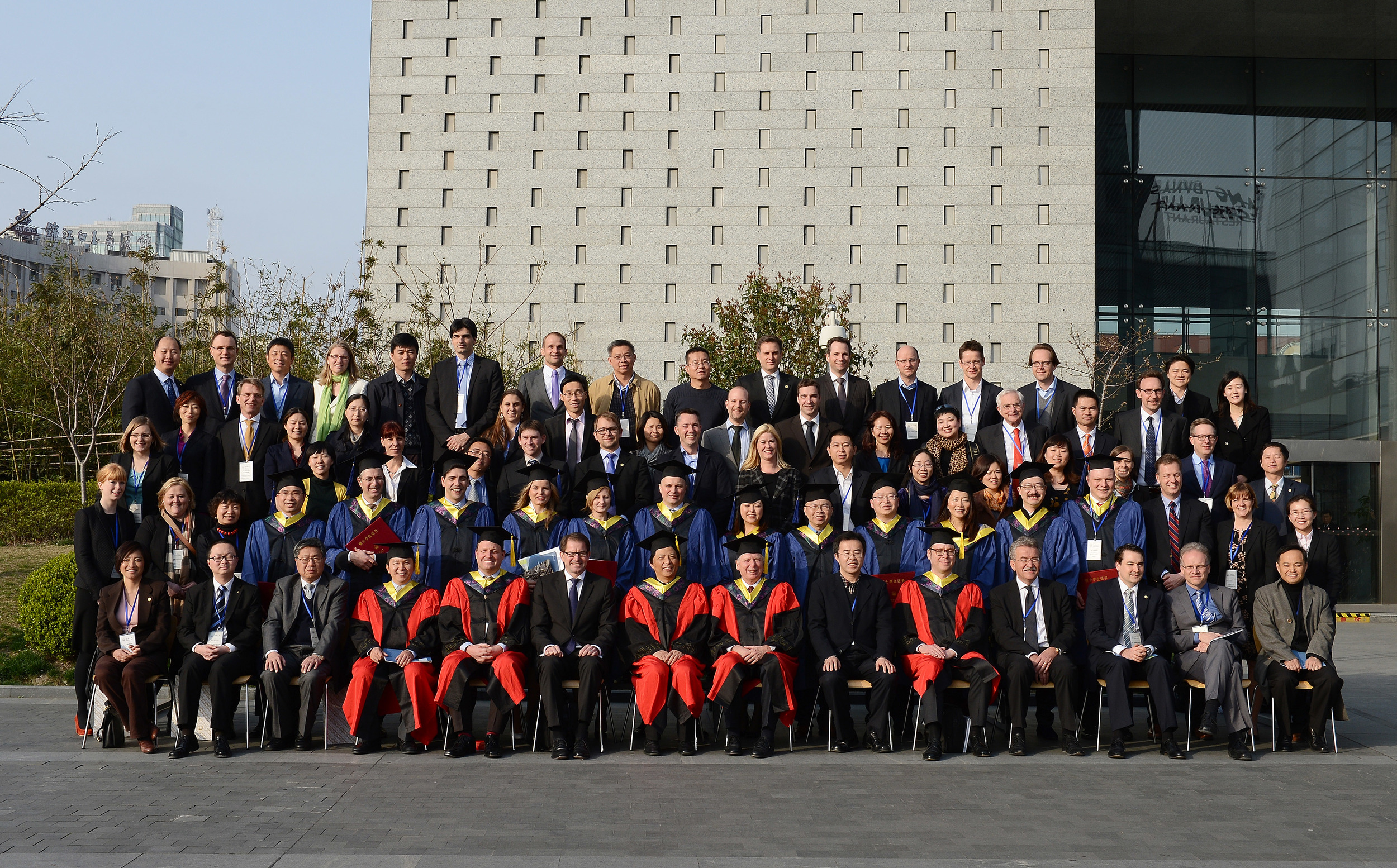
Yesterday was their day. The first 14 students of the Tongji-Mannheim EMBA graduated, and proudly received their degrees handed over by the Ambassador of the Federal Republic of Germany and high ranking faculty of Tongi and Mannheim University. Now our young programme has the first alumni. And this core is going to grow quickly. I have been with this programme from its moment of birth until the first Commencement now and it became an initiative close to my heart, but empowered by the brain. We are getting quite some recognition now, not just on a University level, but also by major corporations. As a very unique alternative to "American Style" EMBAs we have even been covered on a channel of the Chinese Central Television yesterday. It is a diverse and academically rigorous English taught programme made and delivered in Germany and China. It was often described yesterday as a bridge connecting the two economic epicenters in Asia and Europe. But it is of course not about Nations, but about minds and people coming together. My congratulations to the graduates, all the best to the current students, welcome to the newly enrolled participants and thanks to all those who made this happen and support it. I am personally looking forward to contribute on the academic and management side, as much as my schedule allows it. Our "alumni management system", might be simple so far, but it is effective: for example you can just give me a call.

20130315 Tongji.JPG

Letter to a small lady

IMG_7279.jpg

I knew it. Some children are not stupid. Yesterday, I had a conversation with a young lady which started to compile her own little "constitution". She was given a set of Golden Rules by her teacher, but there were major points she did not agree being valid for her. She wanted to define her own rules. But as the topic is complicated and she acknowledged not to have seen much yet, she decided to issue a tender to friends and family and request their proposals. I was really buffed by this approach. And of course, I decided to submit my contribution. I remember reading Earl of Philip Dormer Stanhope Chesterfield's Letters to His Son on the Art of Becoming in Man of the World and a Gentleman. But they were written in the years 1753 and 1754 and I was wondering for a  whether today, in the world of Hello Kitty, it is still appropriate to talk seriously to a child. I still decided to give it a try. She requested me to put down a set of Golden Rules for her, preferably also things which she does not want to learn the hard way. And I really had to laugh when I heard that. Proposals should be not longer than one page A4 by today's deadline. So, this is what I wrote.

Rules for a small lady

  1. Your purpose is defined by you; not by society, family, and teachers.
  2. Thinking is free and without borders. The driving force is curiosity. Expression is part of thinking. There are no taboos of thought. Stay away from ideologies, superstition and religions.
  3. Ask questions. The truth is the assumption that has the highest explanatory power. Never lie. Know what you talk about, but don’t always say all you know.
  4. Your freedom may expand as large, as it does not limit the freedom of others. This includes your freedom of speech.
  5. Independence enables your freedom of choice, and defines the size of your world. Only depend on those you trust. Have the means and abilities to defend your independence.
  6. Be trustworthy but don’t trust easily.
  7. You are responsible for yourself and for those whom you made trusting you.
  8. The smallest unit of society is the individual. You have the freedom of choice of your community. You have the duty to contribute to society. The human dignity is untouchable. You have the duty to defend anybody against repression, injustice, exploitation, violence and environmental degradation.
  9. Do not take full advantage.
  10. Manners are important to interface with your community and a symbol of your own dignity. Be graceful. Never be a sucker. Never know the underdressed.
  11. You can choose freely who you respect. Do not obey orders without questioning them. Seniority, formal positions, rank, and power are not principles that you have to follow.
  12. Health is the foundation of your life. Do exercise and sleep as much as you need.  Walk on foot every distance under 2 km. Do not use escalators or elevators. Never eat things that grandma would not have recognized as food. Also don't eat things where you can't pronounce the ingredients without hesitation. Avoid restaurants, in which you don’t know the cook.
  13. Take your time. Do things right. It is better to be effective than efficient. Low efficiency makes hectic, high efficiency makes stupid.
  14. Money is a resource enabling to do things and not the other way round. Don’t sell your life for no purpose. Do not waste resources, no matter whose they are.

Going 33 km on one charge - no range anxiety

We constantly have discussions, which is the best way to move in Beijing. Quickly the topic comes to electric scooters or e-bikes, which are becoming more and more popular. And then comes the question, everybody answers differently: "How far can you go with one charge?"

Today, I did not talk about it. I did it. I went out to drain my bike to the last electron. It is a hybrid, which can be driven fully electric or as a supported bicycle - a so-called "Pedelec". The advantage to a scooter is, that you can extend range by pushing into the pedals and also, should the battery be really empty once, you can at least still get home. The manufacturer does not give information on the battery capacity or the power of the engine. Just the salesman said something like 25 km. So I expected this to be Chinese 25 km, which then should equal about, let's say 12 km.

I started with a full charge of the about 6 months old lithium ion battery and rode off into the haze through the Hutongs of Beijing, passing Tianamen Square and back to Dongzhimen.

DSCF9219.jpg

Me, my clothes and water bottle made 90 kg payload. There was not much wind and temperature was around 20 Degree Celsius (that defines the battery capacity, which is lower at low temperatures). The route taken was quite flat and speed was sometimes limited by the traffic. As a result, the range was a surprising 33.2 km on electric drive. Then the engine suddenly fainted and I only had to make a few hundred meters on a conventional bicycle. Looking at the GPS track below (red line in the map), there is one outlier in the measurement which goes up to 120 km/h, which is of course an error. You can go quite continously at around 20 km/h and the average moving speed is with 13 km/h about what you can make with a car in Beijing. Quite good. Impressed.

20130308 Max e-bike Beijing.jpg

Little journey to the West

One advantage of Beijing is, that you can easily get out. The Megcity has mountains in the North and West, which mark a sharp boundary between 1950s style coal power plants and a beautiful natural landscape. You might want to avoid tourist destinations, but still use public transport. And actually, this is quite well possible.   

For example take the subway to Ping Guo Yuan (=Apple Garden, but don't be confused when you don't see any apple tree). It is the last stop of Line 1 in the West. Then walk 300 meters further West, until you see the bus stop for line 892. The bus service starts at 7:00 o'clock in the morning and runs very frequently. Stay on the bus for about 2 hours and get off at at the Fa Cheng bus stop, at N40 00.113 E115 47.949. This is a good starting point for a hike over the mountains and the decent to Jian Yuntai (N39 56.132 E115 51.110), for the bus 929 back to Ping Guo Yan station. The whole hike will take you around 7 hours. The last bus at Jian Juntai leaves at 17:40. If you miss that, you are (!) in trouble, as this is just a remote village which has no (!) other transportation.

The route gives a beautiful outlook over the mountains. There are nearly no people up there. The villagers do not grow nuts or fruits like in other rural regions around Beijing. Still the terraces along the slopes witness an agricultural past here.   The trails are just kept open by a few hikers per year and you need a thorn proof jacket. Strictly stay on the trails, which are occasionally steep and going along fringes. Hikers here use 435.000 MHz and  437.900 MHz. 

20130302 West Beijing Hike.jpg

For your GPS you may download the trail by clicking here in gpx-format. 

20130302 West Beijing Mountain Hike.jpg

You have mail?

I am lucky that I have a brilliant service at hand: the China Post. I have rarely seen anything as efficient, reliable and cheap. Try to buy stamps for the price of an iPad. You can send mail for the rest of your days. Sure, the lady behind the counter never smiles. But she brings anything on the way. And if there is no way, she will find one. Then she will still not smile. Smiling costs extra. She has a big heart, so why having a big smile?

My private mail is not going over an electronic "server". It is on paper, addressed with a real location and cleared with stamps. It goes though the hands of real people like the lady behind the counter. It will land on a parking space in the morning where it will be thrown on different piles for local delivery. At any weather. In will be in trains, on Jinbeis and on bicycles, and it will reach you (mostly). Of course I need to know your real address to write to you. But that's what real people have, don't they?

DSC02418.jpg

Vive la tristesse (Watch out for the other side of the street)

The one day when the wind started to blow from the North-West is over. Now Beijing is again under South-Westerly slow wind pushing air pollution in the basin. It is a sad picture: can't see far, people vomit on the street and others wearing face masks. Looked at the energy mix of China today. No surprise. Chinese were often fighting for the "right to pollute", as if more pollution would mean more "development". Remembering well the Chinese delegation to the Copenhagen Climate Summit, where they literally were "pissing everybody off" with their arrogance. Not that not also other cities in the developed world were polluted. But treating pollution as a must to become wealthy is a bit missing the point. Nice that copying is a core competence. But must not copy also the mistakes, right? At least not the very obvious ones.

Perhaps I am just a decadent capitalist, who is a bourgeois wimp. Breathing might be even counter-revolutionary. Sorry, if it is. Please then take me just as one of these silly foreigners who does not understand Chinese "Culture". But when I leave the door, it takes me a few moments of holding breath, not to throw up. Everybody moves slowly. Only a few still do exercise. Face masks are sold out. All you can now order online are fake cotton masks which have only the effect of keeping your nose warm.

I guess, when the Chinese New Year is coming it will be possible to cut down emissions finally, as many will leave the city to go home. Perhaps also the wind will fresh up and change direction. Many Chinese cities now have been set targets to achieve PM 2.5 targets of 35. Sounds like utopia, as now we are constantly around 500. The worst time was 700-1000. It might be just a Communist style target again, like being 99.9% being one opinion, or 100% forgetting June 4th, 1989. Wondering why for a while authoritarian regimes have been seen as the ones who "get things done" and contrasting Western democracies as "debating clubs". Right now here, they can not even operate the restrictions of a normal Smog-Alarm. Not even to talk about implementing the rules which they already have. Congratulations for achieving what you asked for in Copenhagen. Enjoy.

DSC02446.jpg

The solution for pollution is dillusion

Last night I came out of a movie theater in Chaoyang District and could barely pierce through the smog to see the other side of the street. Breathing was literally painful, my eyes were itchy and it was hard not to cough. It has been like this for more than a week now in Beijing. Even in Chinese wording this was called "hazardous". While I walked through the stuck traffic back home, with no taxi to jump on, I suddenly noticed that I can not see the next building ahead, but I actually can see the stars when I raise my head. The smog was just a very shallow layer above the ground. Just a little bit of wind and it would be gone. Then around midnight the mosquito shatters outside the window started rattling in a breeze. With this I fell asleep and knew, when I wake up, the sky will be blue again. Finally!

20130124 Sun and wind in beijing.JPG

Tasting the air of Beijing

As development comes first, and China took the path of making itself the World's Factory, it also turned itself into the world's trash can. Last week the result was a smog layer covering large parts of the country's East. Most monitoring stations went off the scales, and you could actually taste the air instead of smelling it. Environmental laws are strict in China, but there is not much implementation. 

Beijing's three core virtues are corruption, pollution and congestion. And all three have something to do with each other. Living is not cheap in Beijing, but life is. This is a very stable atmosphere to trap emissions and a large incentive to cover things in a foggy environment. Air pollution in Beijing is not a meteorological problem.

DSC02408.jpg

My 47th Birthday

Today I turned 47 years old. I have changed slightly since the photo below was taken in 1966 in Germany. This is the only picture of me being naked on the Internet (I hope). Unfortunately, I caught a fever today. But recovered over a Beijing Duck, Black Forest Cake and Bordeaux wine in the evening. How much more of a East-West and cultural fusion can it be? Great!

EPSON002.JPG

Last chance to see

Currently I am thinking about categories and the structure of a new photo website, which presumably comes life in mid 2013. It will be running parallel to this blog, but with a specialized dedication to photography. One of the categories I set up already has the title "Last chance to see", and is of course inspired by the book of Douglas Adams having the same name.

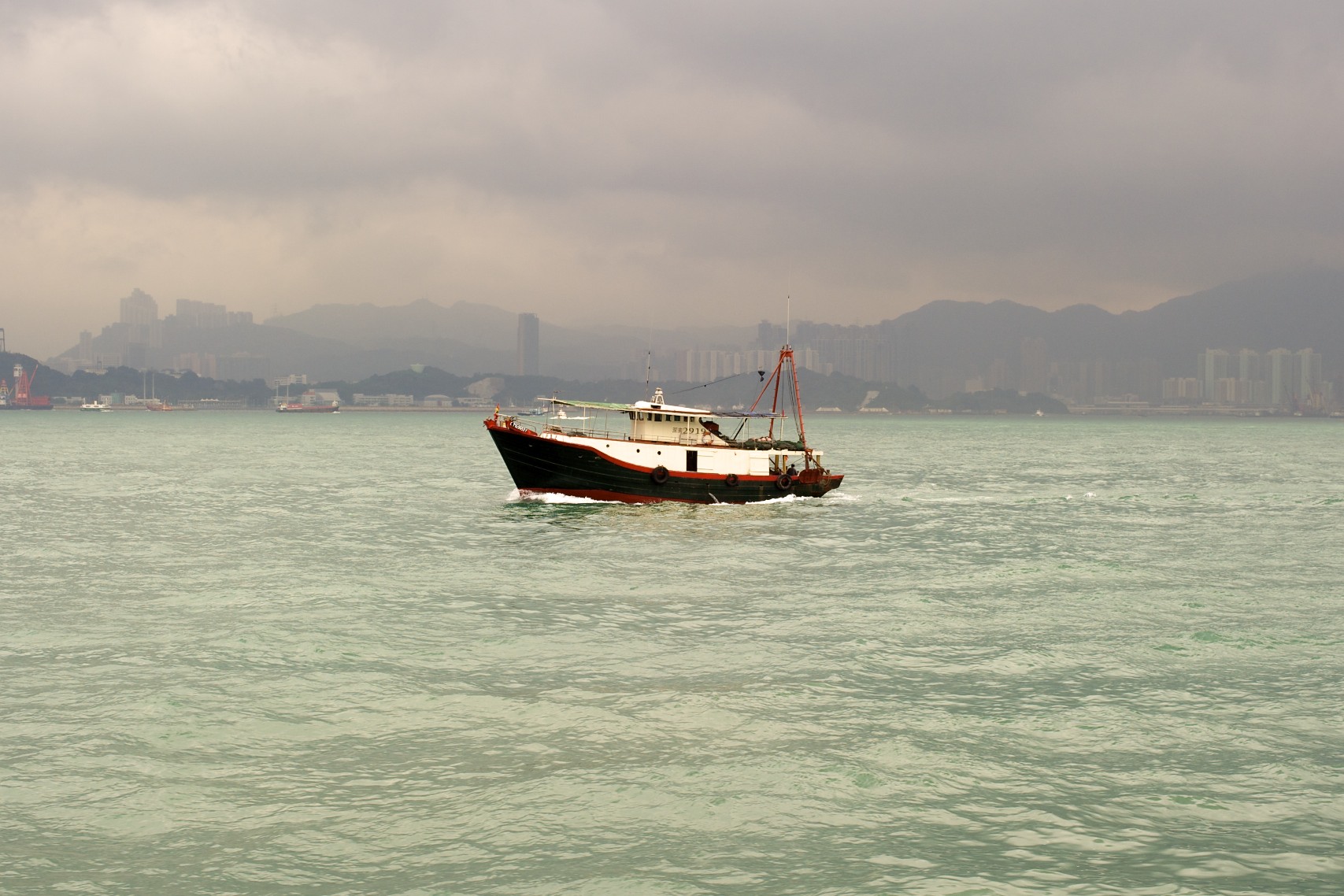
I was re-insured that it is good to take pictures of things, scenes and people which might disappear. So much does in Mainland China, but also elsewhere. On January 1st I opened the South China Morning Post and read, that from that day trawler fishing in Hong Kong waters is banned. This is for good reason, as it depletes the fish population, is indiscriminate and damages the seabed. But still I will miss the trawlers, which for me have been such a typical sight in Hong Kong. For years I watched them passing bye my window when I looked up from my desk, and I got used to the deep sound of their diesel engines. They were often a good object for a photo and I was not aware that when I take them, I record an endangered species of boat and profession.

On the fast ferry from Hong Kong to Macao on December 29th, I still saw many passing the outer island Cheung Chau. At that moment, I was not aware, that this was another "last chance to see".

DSC_5090.jpg