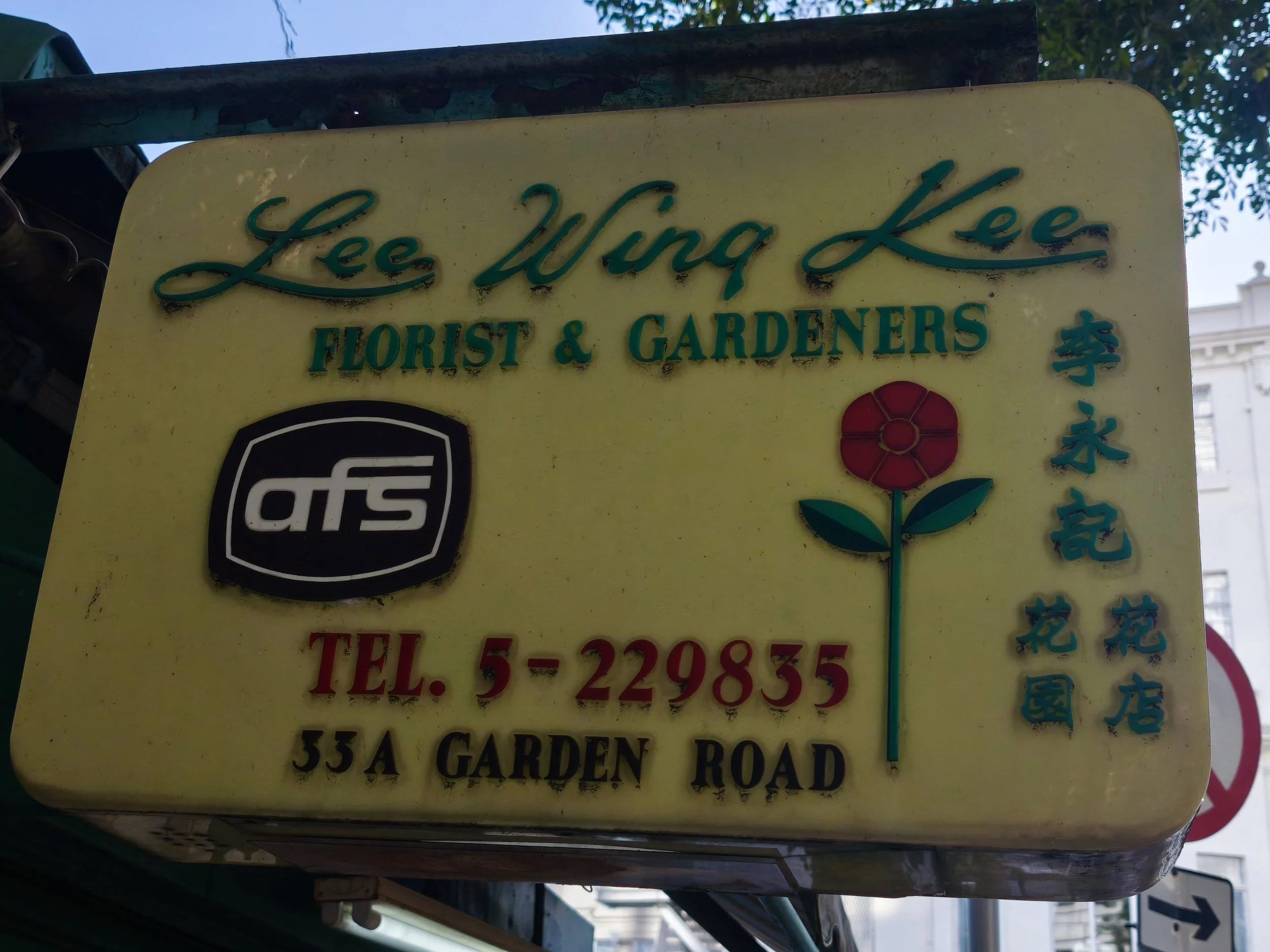
It is nearly time for me to leave Hong Kong and I am passing by my favorite flower shop on my last walk from The Helena May to University Campus this year. I have been meaning to write about it for years. It hangs off the side of the Peak Tram station on Garden Road, a green-painted kiosk no bigger than a garage, with a yellow lightbox sign that still gives the telephone number as 5-229835. That is the old six-digit format for Hong Kong Island; a 2 was added in 1995, and before that the 5 was simply merged into the number. Nobody has touched the sign since. Nobody has touched much of anything since, which is part of the point.
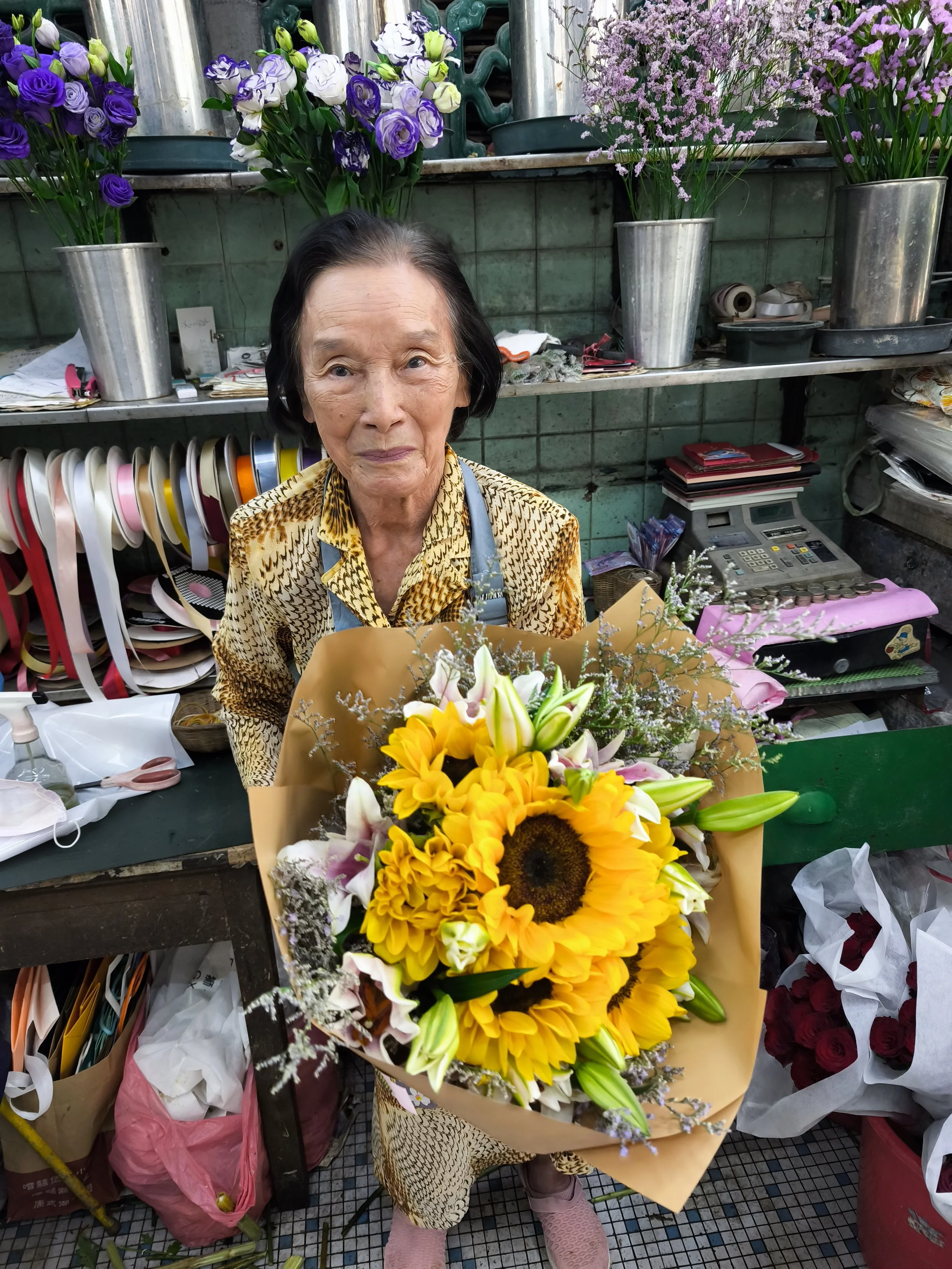
Recently, I was invited to dinner by a private banker and long-time friend, the kind of host who appreciates not just the flowers but the story behind them. This time I am staying at the Helena May, I walked down the hill and bought the bouquet in the photograph: sunflowers, lilies still in bud, a cloud of statice, wrapped in kraft paper. Mrs Lee assembled it in about four minutes without once consulting me, and it was exactly right. Lee Wing Kee has been doing this for a very long time.
How long is a matter of some debate, even within the family. When the shop went to court in 2010 over a strip of land in front of the Helena May, where it had stood its pot plants for as long as anyone could remember, the filing gave 1899 as the founding year. When the South China Morning Post interviewed the proprietor, a Mr M T Lee, in 2002, he said the business went back 120 years, to his great-great-grandfather. Either way, the Peak Tram, which opened in 1888, is the younger neighbour.
What the ancestor founded was not a shop at all. It was a garden, roughly 4,000 square metres of it, on the slope between Victoria Barracks and Government House. The family likes to think Garden Road is named after it. The historians say the road is named after the Botanic Garden higher up, the 兵頭花園, and the historians are probably right. But it is a nice thought, and I would not take it away from them. “Gardeners” on the sign is therefore literal, not decorative: for the better part of a century the Lis grew what they sold.
Then the city caught up with them. By the 1950s the garden had shrunk to the point that Mr Lee's father was buying stock on Fa Yuen Street in Mong Kok, the flower market, and in the 1960s the remaining land was resumed for Cotton Tree Drive, the uphill carriageway that now runs parallel to Garden Road. The garden disappeared under tarmac. The shop moved into its present two-storey cupboard, with the Peak Tram workers' rest room in the basement, and that is where it has stayed. If you look at the photographs of the lower terminus on the Gwulo archive from 1957 and 1958, there is a purpose-built flower stall exactly where the kiosk is today, with a woman behind the buckets. The same stall, two generations earlier.
The interesting part of the story is how a kiosk survives for sixty years on some of the most expensive land on earth. The answer, as far as anyone will say, is Government House. The governors' wives bought their flowers here. Sir Edward Youde was a regular; when he died in Beijing in 1986, Lee Wing Kee supplied the white roses for his coffin and did not send a bill. David Wilson liked pink roses, Chris Patten lilies. And in 1973, apparently at the time Lady MacLehose was a customer, the Lands Department attached a supplement to the Peak Tram's lease obliging the company to rent the plot that included the flower shop and to sublet it to the Lis for no more than HK$565 a year until the tram lease runs out in 2039. The tram's management, the story goes, decided not to charge rent at all. Nothing is written down, or if it is, nobody has seen it. The family has concluded that their luck is tied to the walls, and that even repainting them would be unwise. That is why the paint peels.
I find this arrangement more moving than any heritage plaque. It is survival by relationship rather than by contract, an understanding between a nursery family, a colonial household and a funicular railway, outlasting all three of the institutions that made it. Hong Kong is supposed to be the city that tears down everything. It is also a city where a HK$565 lease can hold off a skyline.
I like flower shops the way I like libraries, museums and wet markets: they are places where supply meets demand with some dignity left in the transaction. I acutally happen to own the world's largest garden. Wherever I arrive for a longer stay, I buy a plant for the service apartment or the hotel room, something that could survive in the local environment rather than something that would merely look nice on the desk. At the end of the stay I find a hidden spot, plant it, and note the GPS coordinates in my journal. Over the years the garden has spread across six continents, from Wellington over Shanghai to Toronto, and contains everything from a cactus to a few trees that are by now over 30 years old. I have never gone back to check on most of them, and I don't intend to. A garden you cannot visit is a garden that cannot disappoint you. I was sometimes thinking to punch the coordinates into a Geographic information system and put it on the Web. But with so much strangeness in relation to the internet these days, it would be a pity somebody just can go there and cut things down. So, it stays a secret garden.
Lee Wing Kee's garden went under Cotton Tree Drive. Mine is scattered from Wellington to Toronto. Both, I suppose, are ways of claiming a bit of ground in places that do not really belong to you. The difference is that theirs still sells flowers at eight in the morning, seven days a week, at 33A Garden Road.