
Hong Kong is getting a Plan, while others lost it
This time I came in from Germany via Beijing, not over the North Pole from Toronto. The timing was deliberate, not just in a professional context. I always try to arrive when the Bauhinia starts to blossom. Bauhinia × blakeana is a sterile hybrid, found on the shore near Pok Fu Lam in the 1880s and propagated ever since by cuttings. Every tree in the city is a clone of that one find. It is the flower on the flag, and it opens in the weeks after National Day, which is as good a calendar as anything astronomical …
This time I came in from Germany via Beijing, not over the North Pole from Toronto. The timing was deliberate, not just in a professional context. I always try to arrive when the Bauhinia starts to blossom. Bauhinia × blakeana is a sterile hybrid, found on the shore near Pok Fu Lam in the 1880s and propagated ever since by cuttings. Every tree in the city is a clone of that one find. It is the flower on the flag, and it opens in the weeks after National Day, which is as good a calendar as anything astronomical.
I stayed at The Helena May on Garden Road, which is a declared monument now, and still a women’s club, founded in 1916, that tolerates a few male associates in the annex, as long as they are gentlemen and receive a reference from one of the ladies in the front building. There is no lobby music, no key card, no “guest experience”. There is a library, a reading room, a garden and a function room, also used for ballet exercise. It is off the beaten track in the only way that still counts in Hong Kong: nobody is trying to sell you anything.
The mood in the city is good. I want to say this first, because it is not what you read in Europe. The economic woes after Covid are still visible if you look: shutters in Causeway Bay, office towers with floors for lease, restaurants that changed hands twice since my last visit. But people are not gloomy about it. First of all, Hong Kongers know how to succeed against all odds. And the positive effects of the integration into Guangdong is proceeding, and you can feel it on the ground. The Northern Metropolis is no longer a brochure, cross-border traffic is back to where it was and beyond, and half my former colleagues now spend their weekends in Shenzhen because it is cheaper and, frankly, more fun. The Greater Bay Area was for years a slogan. It is becoming a commute.
And Hong Kong now has a plan. For the first time in its history the SAR has drafted its own Five-Year Plan (2026–2030), aligned with the national 15th Five-Year Plan. The consultation ran over the summer and drew more than 16,000 submissions; the plan itself arrived this autumn alongside the Policy Address. Europeans tend to flinch at the words “five-year plan”. They forget that every large corporation has one. At Volkswagen we called it the Planungsrunde, and it was no less political. Frankly, Germany, France and others would also need a plan – not to mention the US. Perhaps they should come over and learn how to do it. What strikes me about Hong Kong’s version is not the ambition for the city itself, which is considerable, but that it defines Hong Kong’s contribution to the rest of China. It says what the city is for. Try to find that out in Berlin.
I taught again at the HKU MBA, and I enjoyed the students enormously. The job market is tough at the moment, for graduates here as everywhere, and I tailored the lectures accordingly: more application and while fully immersing in Artificial Intelligence, also build on and develop human strengths. But employability was only half of it. I wanted them to see that in a tough market the better option is not just to find a job, but to create them, in China and the world.
I also went back to Lamma Island, my previous home. My South China Sea indicator: the number of ships anchored and in maintenance behind the cover of the outer islands tells you more about the world economy than most quarterly reports. The instrument still works. There is a lot of steel sitting idle out there, waiting for cargo that is not coming yet. I take that as a reading, not a verdict.
I saw a lot of friends. Not all, unfortunately. Time flew, the weeks were full, and some people you only realise you missed when you are already at the airport. That is Hong Kong: the city is small and compact, with an amazing infrastructure. You can make up to 6 meetings a day. But still hard to fit all into a few weeks of calendar.
From here I fly on to the Middle East. I am watching the results of the elections in Israel, held yesterday, and of the US midterms next week, and I hope, against experience, that they might induce some impulses for peace in the region and elsewhere. But even more carefully I watch where and when military assets are moving towards the region, as far as that is public information (you can’t hide an aircraft carrier). Deeds are a better guide than words. The current US president is either trying to confuse everybody or is confused himself. I honestly cannot tell, and I am not sure it matters. Of course we need to take him, his cartoonish cabinet and aides, as well has some of his fellow autocrats rather serious. Like “a monkey playing with a hand grenade” (обезьяна, играющая с ручной гранатой) as they say in Russian.

Amalienhöhe - the mine that swallowed its own village
The Grube Dr. Geier above Waldalgesheim is not a ruin in the picturesque sense. It is an abandoned baroque palace that happened to be a manganese mine, and I spent this afternoon walking around it. Two symmetrical wings, a gate house, a court of honour, an octagonal basin in front of the machine hall that was really a cooling pond. Weeds in the joints, a burnt-out section from a fire in 2003, corrugated iron over windows. What is most conspicuous is what is missing: the 50-metre steel headframe that stood at the centre of every photograph of this place until January 2014 …
The Grube Dr. Geier above Waldalgesheim is not a ruin in the picturesque sense. It is an abandoned baroque palace that happened to be a manganese mine, and I spent this afternoon walking around it. Two symmetrical wings, a gate house, a court of honour, an octagonal basin in front of the machine hall that was really a cooling pond. Weeds in the joints, a burnt-out section from a fire in 2003, corrugated iron over windows. What is most conspicuous is what is missing: the 50-metre steel headframe that stood at the centre of every photograph of this place until January 2014.
The Darmstadt firm Markwort & Seibert laid the complex out from 1916 onwards - in the middle of the First World War, while bread was rationed - with the buildings arranged almost axially around the courtyard, the director's house and the hostel flanking the entrance. The most elaborate building held a dining hall with a stage. Miners here ate above ground, in a room with a theatre in it. I know of no other German ore mine that decided that was a priority.
Much of what I know about what this place did to the village did not come out of an archive. Outside Waldalgesheim there are small lakes where people fish, and on the bench there you can find ladies from the care home "Carpe Diem", which opened on Neustraße a few years ago. They are in their eighties and nineties. Their fathers and grandfathers worked this hill. Where something in what follows has no document behind it, it usually has one of them.
The man on the gate is harder to see clearly than the buildings. Heinrich Claudius Geier, born in Mainz in 1834, son of a builder, Corps student in Darmstadt, Catholic, married, architect and entrepreneur by trade. Between 1881 and 1887 he sat in the Second Chamber of the Grand Duchy of Hesse for the National Liberals - the party of industry, railways and tariffs. On 15 March 1883, while still a sitting deputy, he received the mining concession. Two years later he was drilling on the Amalienhöhe, and at about eighteen metres he hit ore. Where the "Dr." in front of his name came from I could not establish; the biographical record calls him an architect. Nor could I find out who Amalie was, or Elise, whose name is on the neighbouring field the company later bought. He died in 1896 (or 1898), and his heirs turned the family firm into a "Gewerkschaft Braunsteinbergwerke Doktor Geier", divided into a thousand shares. That is roughly the whole man as the archives have kept him: a well-connected liberal with an eye for a seam and, on the evidence of the courtyard, a taste for architecture that outlived him by a century.
What made the hill valuable was steel. Manganese binds sulphur and oxygen; without it the Thomas process does not give you good steel, and without good steel you do not get rails, ships or guns. In August 1914 Germany was cut off from foreign ore in a single stroke, and a modest Hunsrück mine became a strategic asset. Work stopped briefly and resumed by October. Russian prisoners of war were put to work here. The Reich paid half the cost of sinking the new shaft on the Stöckert from 1916. In 1917 the mine produced around 240,000 tons — its record, never matched again.
The logistics are the part I find most beautiful, in the engineer's sense of the word. Waldalgesheim sits some six kilometres from the Rhine with a forested ridge in between, which is a nuisance if you are moving heavy rock. So in 1912 they strung a 7.6-kilometre aerial ropeway through the Binger Wald down to a loading point at the river near Trechtingshausen, good for sixty tons an hour. Buckets of ore floating over the treetops, all day, until 1967. From 1914 they also drove a tunnel - the Rheinstollen, 3,300 metres, finished only in 1924 because of the war - which drained the workings and carried ore out towards Bingerbrück. That puts the mouth of the works almost exactly at the stretch of river I wrote about earlier this summer, the choke point below the Binger Loch. The same few hundred metres of water that decide today whether a chemical plant gets its feedstock decided a century ago whether a blast furnace got its manganese. The Rhine does not change its role. Only the cargo does.
The price was paid by the village. From 1908 the damage was unmistakable: cracks, sinking streets, hollows filling with rainwater. Nobody here talks about earthquakes in the geological sense, and I found no seismic record - but people talk about the ground moving. A settlement of a few centimetres does not announce itself politely; when a roof falls in a chamber two hundred metres down, the house above it feels a jolt, plaster lets go, a door stops closing. One of the ladies described a house that was sound on the Tuesday and condemned by the Friday. Another said her grandfather had a field where one of the fishing lakes is now, and said it without drama, the way you would mention a road that got widened. From around 1910 the company built 124 replacement houses south of the old core, and roughly sixty more between 1916 and 1920, by the same architects who were building the palace on the hill. Whole streets were given up. Both churches had to go. The Protestant congregation closed its old church in June 1937 and consecrated a new one on 27 March 1938, carrying the organ and the spire across to the new site like relatives moving a grave.
And here the two halves of the story meet. In April 1938 - within weeks of that consecration - the Oberbergamt moved the "Sicherheitspfeiler" further south. The safety pillar is the block of rock a mine is forbidden to touch because a village stands on it. It was moved because Hermann Göring's Four-Year Plan wanted the ore, and it was moved again in 1941. Landowners who refused to sign were brought round by pressure from the state and the church, and by the threat of expropriation. That is what rearmament looked like at parish scale: not a rally, but a line on a mine surveyor's map shifted a few hundred metres, and a community agreeing, under duress and with compensation, to let the ground beneath its new houses be taken as well. Output reached about 160,000 tons in 1944, the highest since the first war. Work stopped in March 1945.
It stopped because the Americans arrived. The Hunsrück was not defended in any meaningful sense. Through mid-March, exhausted German columns of fifteen or twenty men trudged east through Bingen towards a Rhine whose bridges their own engineers were blowing up behind them — the Hindenburg bridge on 15/16 March, others in the days after, one detonation strong enough to take out windows across the town. American infantry was in Bingerbrück on the afternoon of 18 March. Once the party officials had gone, white sheets went out of the windows. There is an account from a village up on the plateau of teenagers finding a store of Panzerfäuste and tipping the ammunition into a water hole in the meadows before the soldiers came, with their parents running down into the valley to fetch them home. That is the Hunsrück's version of the end of the war: not resistance, not liberation in any triumphal sense, but enormous relief at not being fought over, mixed with how quickly the flags changed colour. On the night of 22 March, thirty kilometres upstream at Nierstein, Patton put a few hundred men across the Rhine in rubber boats without a preliminary bombardment, a day before Montgomery's set-piece crossing at Wesel, and the river stopped being a front. Of the three ladies, one did not talk about the war at all, which is also a way of talking about it.
The mine outlived the regime by twenty-six years and was killed by metallurgy. When no significant manganese reserves could be opened up after about 1952, the company switched to dolomite, first delivered in 1959, peaking at some 350,000 tons in 1969. Then the steelworks moved from the Siemens-Martin furnace to the LD converter, which did not need it. Demand collapsed. On 31 December 1971 the last shift came up - sixty-three men underground, seventy-seven above, thirty-two in the offices. The deepest shaft had reached 267 metres. One of the ladies remembered her father coming up filthy and singing, which is the only detail anyone offered me that sounded like nostalgia.
After that, the long undignified afterlife: a visitor mine for three years, then tenants, then the 2003 fire, then owners with plans and no money. The headframe rusted until it was condemned. In December 2013 the water tank and roof came off and the frame began to lean towards the houses. In January 2014 they put a steel cable on it and pulled it down deliberately; it fell into the ore bunker and the machine hall and hurt nobody. Since 2002 the whole ensemble has been a protected monument inside the UNESCO Upper Middle Rhine Valley - a World Heritage site with its landmark lying on the ground.
Mining places are always three things at once. Hope: a man drills a hole in a hill in 1885 and a village gets wages, a theatre and 184 new houses. Despair: the same village watches its church crack and signs away the rock under its feet because a Reichsmarschall wants more steel. Tragedy: the tonnages that mattered most were dug in 1917 and 1944, and everyone knew what they were for.
Standing in the courtyard, what strikes you is how little of this the buildings admit to. They were designed to look like a residence, and they still do. The most durable thing the mine produced is not in the courtyard at all. It is the shape of the ground: eight million tons taken out, the surface let down onto the void, and a set of lakes that nobody planned and that now hold protected wetland and a fishing club. The hill also gave up a Celtic princess in gold, dug out of the same ground by a farmer in 1869 and important enough that a whole style of European art is named after this village. Two extractions, two thousand years apart, and only one of them left a hole.

Wet markets - where the food chain crosses the social fabric
I don’t know what’s super in a Supermarket or what is convenient in a Convenience Store. If you fancy convenience then you have the Tabaccino for a bottle of Cynar and a pack of Gauloises Caporal late at night - for breakfast! I personally don’t smoke, but had intimate insight into the breakfast triology: café, cigarette, caca. That’s convenience! The whole thing about the retail of necessities, is that a supply meets a demand in style. And that’s about the opposite of any modern retail format …
I don’t know what’s super in a Supermarket or what is convenient in a Convenience Store. If you fancy convenience then you have the Tabaccino for a bottle of Cynar and a pack of Gauloises Caporal late at night - for breakfast! I personally don’t smoke, but had intimate insight into the breakfast triology: café, cigarette, caca. That’s convenience! The whole thing about the retail of necessities, is that a supply meets a demand in style. And that’s about the opposite of any modern retail format. So, wherever new place I go, I first locate the police station, then the post office, the fuel station and then: the wet market, the Wochenmarkt, the pazar, the souk, the mercado, the 街市. Not the boutique farmers' market where some hippie sells you a US$ 15 jar of artisanal hope, but the place where a woman cooking for a family buys five kilos of onions and argues about the price. These markets are not folklore. They are engineering. Their architecture is a thermodynamic answer to a local question, and once you see the question, the buildings, the cuisine and the social rules all fall into place.
Start with the word, because it is more revealing than people think. "Wet market" is not an ancient term at all. It came into common use in Singapore in the early 1970s, when the government needed a word for what a supermarket was not. The "wet" is not moral, it is literal: melting ice, hosed floors, produce sprayed to stop it wilting. And the distinction from the "dry market" is a formal administrative category, not a metaphor. In Oaxaca, the Mercado Margarita Maza de Juárez is split by the municipality into a zona húmeda and a zona seca. Wet is where things rot; dry is where they do not. The whole typology of these places begins from that one variable, and my working test for whether a market is real is equally simple: look for offal, feet, heads and bones. A market where nobody buys a pig's trotter is not a market, it is a hobby.
The intellectual frame I keep returning to is one I have written about before in a different context: Johann Heinrich von Thünen's ring model of 1842. Agricultural intensity declines with distance from the market, and the degree of processing rises with the cost of getting there. You keep the milk close and you make the cheese far away. What von Thünen did not spell out, because he did not need to, is that the market itself is the piece of infrastructure where this becomes visible, and that its physical form is set by the perishability of what arrives. If the ambient air does the refrigeration for you, you need no building at all. If the ambient air is your enemy, you need a roof with a chimney effect, or a great deal of ice, or a compressor. Everything else - the governance, the haggling, the cuisine - is downstream of that. Having been a consultant some time in my life, on this basis I would propose six types.
The first is the ambient freezer, and it is the one that converted me to the idea that climate writes the architecture. In Harbin, the Hongzhuan Street morning market (红专街早市) runs for 487 metres with roughly 300 stalls, on a site it has occupied since 2003, and in January it operates at around −25 °C with the goods laid out on open trestle tables. Nothing is refrigerated because everything already is. You buy 冻梨, the frozen pear that has gone black and glassy, and frozen persimmons, and fish stacked like cordwood. The municipal authority's contribution to market integrity was to distribute 70 tamper-proof electronic scales to the traders, which tells you something charming about where the actual risk lies. Push further north and the logic intensifies. At the Krestyansky market in Yakutsk, established in 1995 on about two hectares, the winter trading floor works at −40 to −50 °C; frozen fish stand vertically in their crates; buyers inspect the gills for blood as proof the fish was frozen alive on the ice; the nelma for stroganina goes for over 2,000 roubles a kilo; and the vendors keep their card terminals in polystyrene boxes with heating pads, because the electronics freeze before the fish does. This is my favourite detail in the entire subject. The payment system is the perishable good.
And then Greenland, which pushes the type to its logical end. The brætter — the "boards" — are open-air fresh markets where hunters sell directly, and the largest, Kalaaliaraq in Nuuk, was founded in 1958 on the model of a Danish market square, demolished in 2018 and rebuilt with 271 m² indoors and 46 m² of covered outdoor space. What is sold is seal, whale, reindeer, muskox, halibut, wolffish. The regulatory history is the interesting part: until a dispensation in September 2018, only fresh meat could legally be sold there, and the change permitting dried, salted, smoked and frozen product was explicitly argued as a step towards Greenlandic self-sufficiency. Meanwhile trichinella inspection for seal and polar bear was still not mandatory as of 2017, after an infection cluster in 2016 from polar bear meat bought at a brætter. The Arctic gives you a free cold chain and charges you in parasites.
The exact mirror image is the tropical ice economy, where the market is a continuous battle against its own climate and the infrastructure is water and ice. Khlong Toei in Bangkok covers roughly 100,000 m² with about 1,500 stalls and never closes: 24 hours, 365 days. The fundamental technology on display is a man with a hose keeping fish alive on a bench. Hong Kong industrialised the same problem. The Food and Environmental Hygiene Department operates 74 markets with some 13,000 stalls, and the characteristic built form is the multi-storey municipal services building, which stacks the wet market on top of a cooked-food centre on top of a sports hall, as at Java Road since 1992. The old Wan Chai market of 1937 is a Grade III listed Streamline Moderne block, and its successor from 2008 is air-conditioned, with 50 stalls. The red lampshades hanging over the pork are a small, honest fraud that every Cantonese shopper understands. And since 2008, every live bird in Hong Kong must be slaughtered before 20:00, so that no live poultry remains overnight. This is an avian-influenza measure that quietly abolished a centuries-old trading rhythm. Singapore, having invented the vocabulary, also formalised the institution: the National Environment Agency runs 123 markets and hawker centres, allocates stalls by monthly open tender, and carries subsidised rents from S$160 to S$320 a month against open bids above S$1,200. My favourite piece of institutional memory from there: the reason officials hesitated to introduce frozen fish to these markets in the late 1970s was the fear that hawkers would thaw it and sell it as fresh. The category "wet" was born as an act of consumer protection.
The third type is the one Europeans think of as the market, and it is really a 19th-century public health project: the ventilated hall. Iron, glass, a high roof to let the heat rise, and above all an inspection regime. Berlin's Markthalle Neun opened on 1 October 1891 to a design by the city building officer Hermann Blankenstein with August Lindemann, about 3,500 m² with 300 stalls of four square metres each, a dedicated meat inspection centre, cooling in the cellar and gateways sized for horse-drawn delivery carts. That is not a nostalgic building, that is a food-safety machine. Barcelona took the idea furthest, because Ildefons Cerdà treated markets as municipal utilities to be distributed like schools and drains: today the Institut Municipal de Mercats runs 43 markets across 73 neighbourhoods with 8,000 traders, 65 million visits a year and about €1 billion of turnover, and the city put €133 million into modernising 25 of them between 2011 and 2015. The Mercat de la Concepció of 1888 by Antoni Rovira i Trias, iron and glass fabricated by La Maquinista Terrestre y Marítima, is 2,910 m² of exactly this logic. Porto's Bolhão of 1914 was reopened in 2022 after a €28 million rebuild in which the clever move was invisible: deliveries and cold rooms went into a new underground level so the historic hall could go back to breathing. At Matosinhos, the 1952 market by Fortunato Cabral and Cunha Leão deliberately put the fishmongers on the lower level for airflow and natural cooling. Turin's Porta Palazzo, at 51,000 m² the largest open-air market in Europe, with about a thousand traders and 100,000 visitors a week, sits above four subterranean levels of ghiacciaie — ice houses from 1922. Even the Soviet Union built to the same specification with different politics: Moscow's Danilovsky, a kolkhoz market since 1963, got a 14-petal reinforced concrete dome with a central oculus in 1986, by Felix Novikov and Gavriil Akulov, borrowing from the Druzhba arena of the 1980 Olympics. Nixon walked through the earlier version in 1959 and was handed fruit and pickles. In 2015 the Ginza Project bought it for 425 million roubles and promised 800 million for the reconstruction, which is how a collective-farm market becomes a food court.
The fourth type is the one my German readers will recognise in their bones: the periodic market, where the market is not a place but a time. German law is magnificently precise about this. § 67 of the Gewerbeordnung defines a Wochenmarkt as a regularly recurring, time-limited event at which a plurality of vendors offers foodstuffs, agricultural products and raw natural produce — and, in a clause of pure Teutonic exactitude, generally excludes alcoholic drinks unless the farmer produced them himself. There are more than 3,000 such markets in the country. The version I actually use is the Turkish markets which are artefacts of the Gastarbeiter economy and one of the few genuinely unpretentious things left in Germany. Istanbul runs the same principle at industrial scale: the Fatih Çarşamba Pazarı, over three hundred years old, fills seven main streets and seventeen side streets around the mosque with 4,811 stalls, tarpaulins strung between the buildings as a temporary roof, and when it closes at 21:00 the municipality sends in sixteen refuse trucks. The Moroccan countryside operates about 800 active weekly souks, of which 161 are in Marrakech-Safi alone, and they are named after their day: souk el-had for Sunday, souk el-tnine for Monday. Oaxaca's Central Valleys have run a rotation since long before Cortés: Etla on Wednesday, Zaachila on Thursday, Ocotlán on Friday, Tlacolula on Sunday, and in Tlacolula trueque, straight barter without currency, is still practised. This is a form of architecture that consists entirely of a calendar.
Behind all of these sits the fifth type, which the shopper never sees but which sets every price they pay: the wholesale leviathan. Mexico City's Central de Abasto, inaugurated in November 1982 to a design by Abraham Zabludovsky on 328 hectares of former chinampa land, moves around 30,000 tonnes a day and supplies roughly 80 per cent of the food consumed in the metropolitan area, with 70,000 people working inside a deformed hexagon 2,250 metres across. Seoul's Garak market, opened in June 1985 as Korea's first public wholesale market with auction-based trading, covers 542,920 m², handles about 7,300 tonnes a day and is now in the middle of a one-trillion-won modernisation aimed largely at tripling cold storage. Noryangjin auctions its fish between 01:00 and 03:00. Tokyo's Tsukiji opened in 1935 and closed in October 2018 in favour of the fully enclosed, temperature-controlled Toyosu; and in June 2020 Japan substantially deregulated the Wholesale Market Law of 1971, abandoning the 商物一致 principle that physical goods had to pass across the market floor. Casablanca's marché de gros, 24 hectares handling roughly half the country's wholesale produce, logged a record 1.7 million tonnes and 244,706 incoming trucks in 2025. Delhi's Azadpur Mandi, founded in 1977 on some eighty acres, turns over 12,000 to 15,000 tonnes daily and employs forty to fifty thousand people, including the palledars who carry hundred-kilo sacks through 40-degree heat wearing a pitthoo, a pad stitched from old gunny sacks. When India's farm laws of 2020 threatened to let buyers bypass the APMC mandi system, this was the machine people were fighting over. The haggle is retail; upstream it is a gavel, and the gavel is politics.
The sixth type is not defined by climate at all but by migration: the market as arrival infrastructure. Marseille's Noailles, the Marché des Capucins, formally founded as a food market in 1956 on the site of a Capuchin convent seized as national property in 1791, is where you buy preserved lemons at three to five euros a jar and fresh harissa graded by heat, and where the etiquette is absolute — you say bonjour, and you do not touch the produce, you point. Toronto's Kensington Market, 27 hectares and some 240 businesses, was the "Jewish Market" of the early twentieth century and had live chickens in sidewalk cages, slaughtered on demand, well into the post-war decades; today the traditional grocers are thinning while cannabis dispensaries multiply, and a community land trust is buying buildings to slow it down. Porta Palazzo, once the market of southern Italian migrants to Turin, is now largely run by traders from outside the EU and carries a sign reading Amare le differenze in several languages. The pattern is consistent enough to be a law: a stall is the cheapest available unit of self-employment, and a cuisine reaches a city through a market long before it reaches a restaurant.
What ties the six types together is that the kitchen writes the specification and the market is built to it, not the other way round. Cantonese steamed fish requires a fish that was alive twenty minutes earlier, which is why Hong Kong fought so hard over the live poultry rules and why the tanks are at the front of the stall. Oaxacan mole requires a wall of thirty kinds of dried chile, which no supermarket will ever carry. Kimjang, the Korean autumn kimchi-making that UNESCO lists as heritage, produces a November tonnage spike in napa cabbage, radish, coarse salt, chile and fermented seafood that the wholesale markets have to plan around. Stroganina requires −40 °C, full stop. Grüne Soße requires seven specific herbs in one bunch, which is precisely what the Frankfurt Kleinmarkthalle. There is a good academic argument here too. Chinese researchers have shown that "freshness" in these markets is not a property discovered in the goods but something actively constructed through sensory display, atmosphere and long-term trust between vendor and customer, and that the vendor's real competitive advantage is the ability to work several wholesalers at once and thereby shorten the chain. That is the honest answer to why the market survives against a supermarket that has better logistics, better lighting and better parking.
I do not want to write a sentimental piece, so let me be blunt about the two forces actually killing these places, neither of which is the supermarket alone. The first is gentrification, and it works by substitution rather than closure. La Boqueria in Barcelona now takes about 40,000 visitors a day and its fishmongers are being crowded out by chocolate-covered strawberries and paper cones of fried fish. Lisbon's Mercado da Ribeira, rebuilt in 1930 with a domed skylight the locals nicknamed the Mesquita do Nabo, gave half its floor in 2014 to the Time Out Market, which drew close to four million visitors in 2018 and is now the global template for turning a market into a curated food court. Markthalle Neun is the same story with better bread. Danilovsky is the same story with a Soviet dome. The tell is always the ratio of things you can cook to things you can only eat standing up. The second force is the state's hygiene regime, and here I refuse to be cynical, because the epidemiological case is real: the Lancet Planetary Health typology of wet markets identifies live animals, interspecies mixing, market size, hygiene and supply-chain length as the actual risk variables, and correctly separates the ordinary produce-and-butcher market from the wildlife market that the Western press spent 2020 conflating it with. Hong Kong's 20:00 slaughter rule is not bureaucratic vandalism. It is why the 1997 H5N1 event did not repeat.
The loss, when it comes, is not a loss of charm. It is a loss of price discovery, of redundancy in the food system and of the small producer's access to a customer. Thirty-nine per cent of Singaporeans surveyed had not set foot in a wet market in the previous year. The council of the 12th arrondissement of Paris spent early 2025 debating whether to let the open-air Marché d'Aligre sell meat and fish, in a market authorised by Louis XVI in 1777 and rebuilt in 1843, because turnover was falling. Japan's neighbourhood shotengai have produced enough closures to earn the name "shutter streets". And Vietnam ran the whole experiment to its conclusion: Hanoi announced in 2011 that it would replace nearly 350 wet markets with modern trade centres, the conversions failed because traders were pushed into inaccessible basements and simply went back to the pavement, and in August 2024 Decree 60/2024/NĐ-CP reversed the policy — public money now funds renovation rather than replacement, and even "naturally occurring" street markets are formally recognised. Of the eight and a half thousand markets in the country, over seven thousand are Class 3, under two hundred stalls, serving a single ward. It took the state thirteen years to work out that these were not a transitional stage on the way to somewhere better.
Which brings me back to why I bother, cheerfully carrying a bag through a puddle of fishwater on a Tuesday morning. In a supermarket I am a throughput problem. In a market I am asked what I intend to cook and then told that I have chosen wrong, which is a different and much better relationship. The vendor at Noailles selects the aubergines because he, not I, knows which crate came in this morning. The woman in Harbin hands me a frozen pear as if handing over a small dark planet. This is the last piece of retail infrastructure in the world where the transaction still contains an argument, and the argument is the point. I am now in Malta, which runs its own quietly elegant version of all six types at island scale. The wholesale Pitkalija at Ta' Qali is closed to the public and opens twice a week, where hundreds of farmers drop off thousands of kilos to be auctioned to supermarkets, grocers and hawkers through licensed pitkala middlemen; since the 2021 reform every green crate carries a barcode tying the produce to a price and a named farmer, and the Malta Food Agency now administers the Pitkalija, the Pixkerija fish market and the abattoir together. Alongside it the farmers' market at Ta' Qali opens on Tuesdays and Saturdays, and on Sundays the fish comes ashore at Marsaxlokk and is essentially gone by ten. Barcode traceability upstream, a periodic market downstream, and the sea setting the timetable.

Rhine kilometer 530 - Germany's shipping choke point
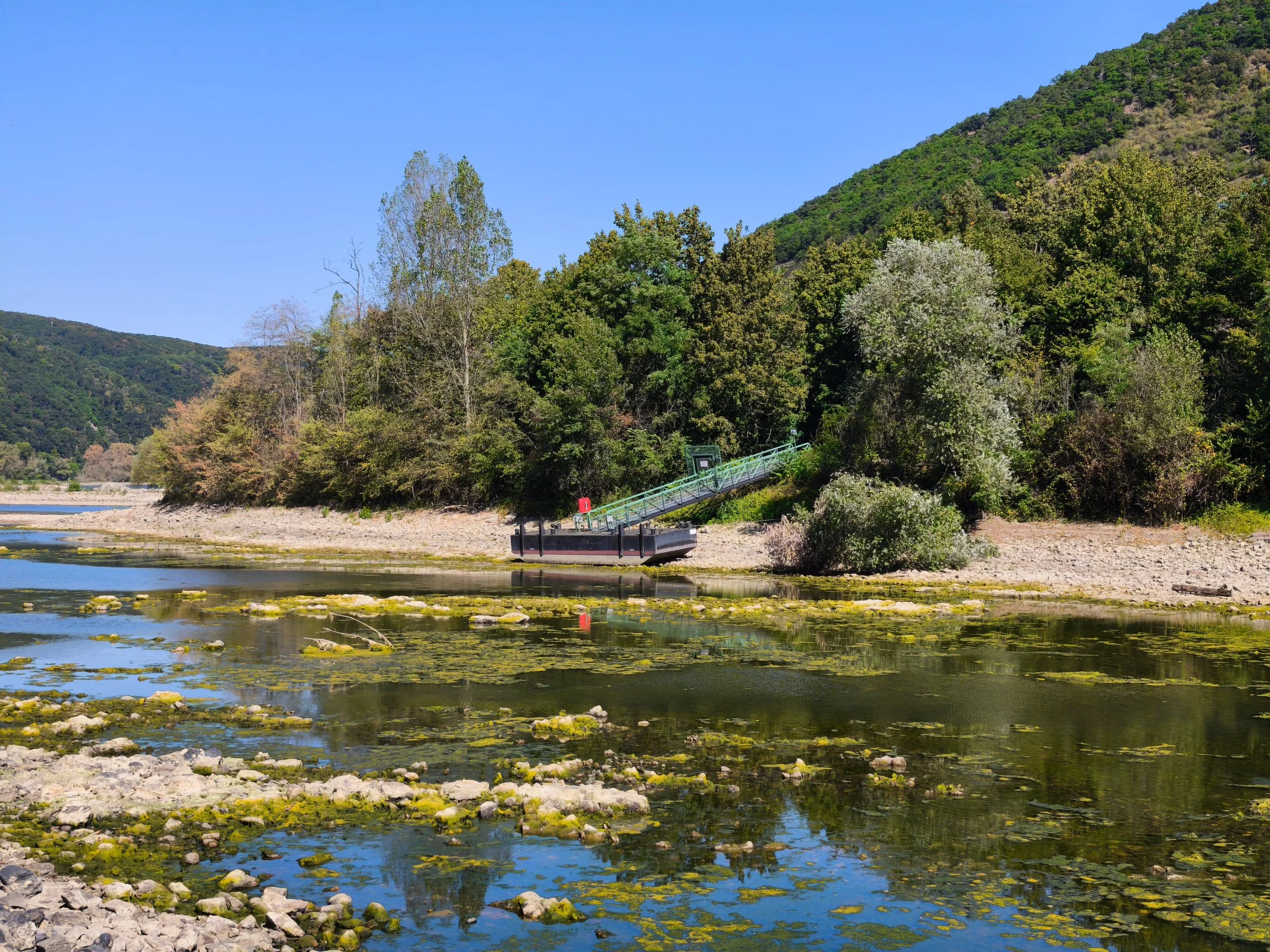
No ships can pass. When you drive down to the entrance of the Upper Middle Rhine Valley you see a very abnormal scene at Rhine kilometer 530.The “Mäuseturminsel” is not an island any more. You can walk over. Around the tower, where the current should be pressing hard against the quartzite, there is gravel, mud, dried algae and the smell of a river that has withdrawn. The Nahe River comes in behind you as a trickle …
No ships can pass. When you drive down to the entrance of the Upper Middle Rhine Valley you see a very abnormal scene at Rhine kilometre 530.The “Mäuseturminsel” is not an island any more. You can walk over. Around the tower, where the current should be pressing hard against the quartzite, there is gravel, mud, dried algae and the smell of a river that has withdrawn. The Nahe River comes in behind you as a trickle. Castle Ehrenfels sits up on the right-hand slope, looking down on something that no longer resembles the Rhine.
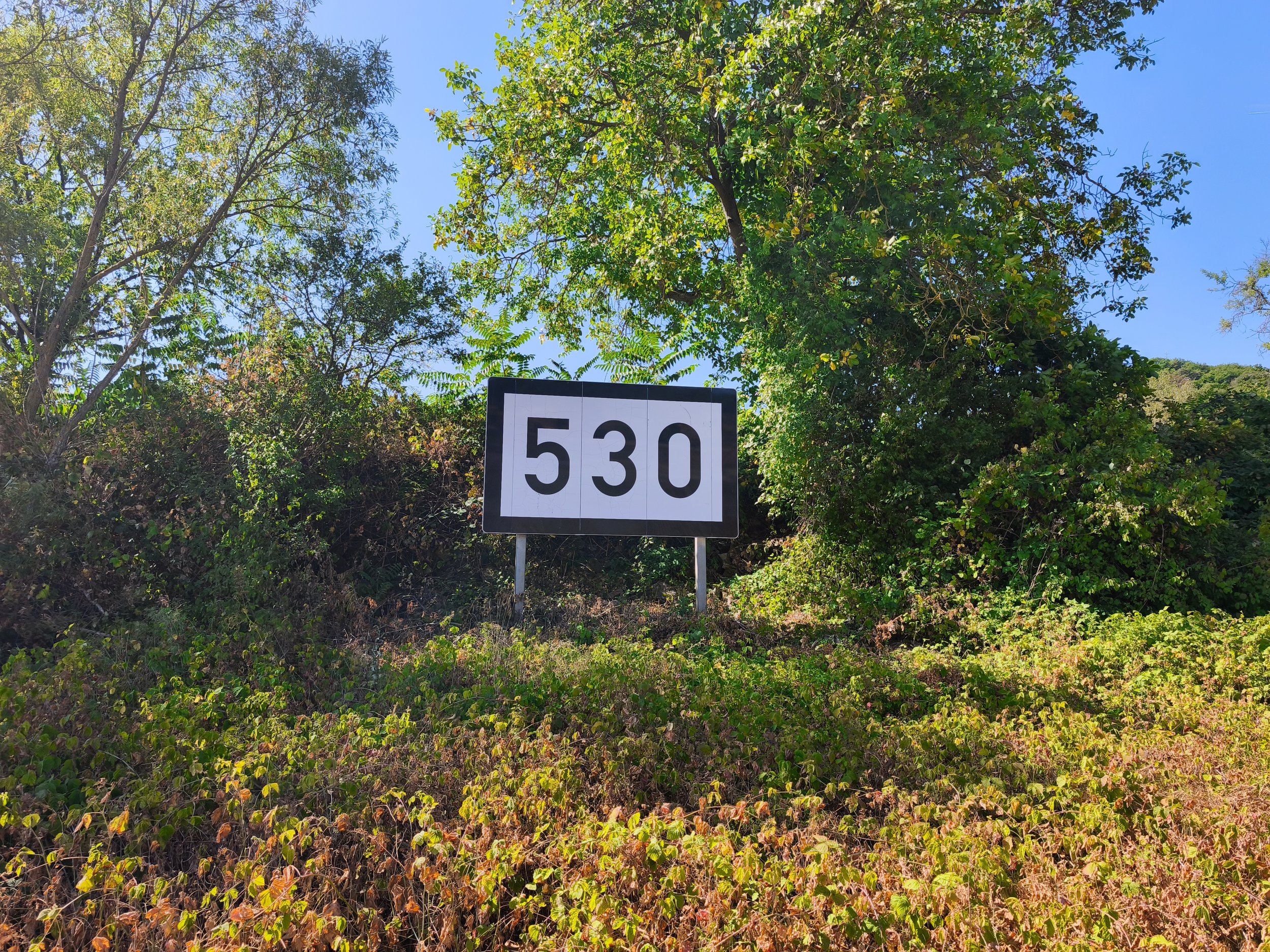
Down here we have the Hungersteine, the hunger stones: boulders in the river bed that historically appeared only in the driest years, and whose appearance was read as the announcement of famine. Now there is not even water around them any more. They are not emerging from the river. They are lying in a dry landscape, as if the river had been an idea someone once had about this valley.
The reference gauge for the whole system is Kaub, at Rhine kilometre 546, a village just downstream of the Loreley. When I queried the live measurement network of the German Federal Waterways and Shipping Administration this afternoon, Kaub stood at 14 centimetres. The mean water level here is 208 cm for 2010–2020, a mean low water of 65 cm, a reference low water (GlW) of 77 cm, and a lowest known water level of 25 cm, recorded on 22 October 2018. The record is now beaten by eleven centimetres — by nearly half. For comparison, the 2003 drought bottomed out at 35 cm and August 2022 at around 32 cm. The forecast for coming Friday is 4cm! One clarification, because the debate constantly confuses the two: a gauge reading is not a river depth but a height above a fixed local datum. At Kaub, 16 cm on the gauge corresponds to a computed fairway depth of about 129 cm. That is why ships are still moving at 14 cm - but nearly empty.
At Rhine kilometre 530, a reef of Taunusquarzit crosses the river: the Binger Riff, through which the Binger Loch was blasted. The rock is extraordinarily hard, which is why it produces the greatest relief in the entire Rhenish Massif, the Franzosenkopf standing more than 500 metres above the water. Upstream of the reef the Rhine behaves like a lake. From the reef the down the whole gorge until St. Goar the flow velocity doubles.
Human intervention here reads like a chronicle of industrial ambition. Before gunpowder, ships were unloaded and warped through by rope from the bank. The first blasting came in the 17th century; a channel not quite seven metres wide in 1830–1832 under the Prussian engineer Ferdinand van den Bergh; widening to some 14 metres in 1839–1841; the old Binger Loch to 30 metres in 1893–1894; and finally to 120 metres in 1966–1974. Works after 1961 reduced the drop at the reef from 80 to 40 centimetres over 300 metres. Before all of this, the reef was in all probability impassable at low water. Boatmen took off their hats and prayed; the church historian Christoph Nebgen speaks of a distinct Schifferfrömmigkeit. Zedler's Universallexikon of 1742 described "gewaltige Wellen" and a "fürchterliches Geräusche", and the 16th-century traveller Andreas Ryff called the place a Schlund, a maw - legend holding that whatever the Binger Loch swallowed was spat out again at the Loreley.
The Mäuseturm was built around 1300 as an additional watchtower in mid-river and appears in the toll records in 1298. Its name has nothing to do with mice: it comes from Middle High German musen, to watch, to lie in wait. The legend of Bishop Hatto devoured by mice is a 16th-century invention. Destroyed in the Thirty Years' War, the tower was restored in the 19th century to plans by the Cologne cathedral architect Ernst Friedrich Zwirner and then served as a signal tower for shipping — until the 1970s its masts regulated traffic through the narrows, and the Binger pilots rode with the vessels down to St. Goar. The Loreley is a 132-metre slate cliff at kilometre 555, at the narrowest and deepest point of the navigable Rhine between Basel and Rotterdam: the bed squeezed from 300 to 145 metres at the Betteck, and 160 metres wide at the rock itself. The danger was never the maiden with the golden comb. It was the Grünsgrund sandbank, with water pouring over rock ribs lying across the river on one side and flowing calmly on the other, the two currents meeting behind the bank and generating whirlpools that killed skippers with regularity.
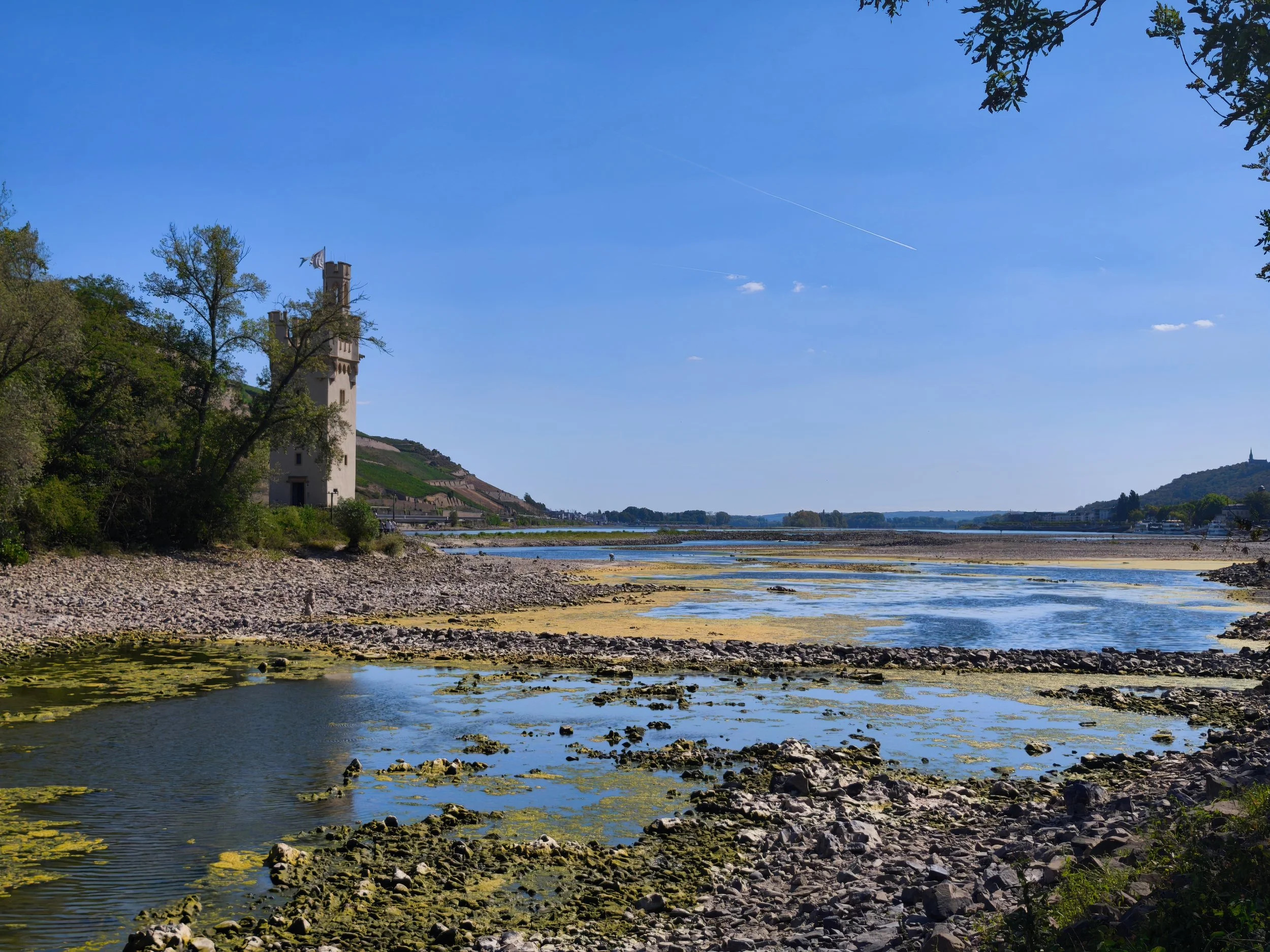
The economic effect of these low water is tremendous, because commercial shipping can no longer carry goods through the region, and the Rhine is therefore no longer continuously navigable and effectively split in two. Traffic continues from Amsterdam, Rotterdam and Antwerp into the northern German Rhine and the West German canal network, and separately in the south on Main, Moselle, Neckar and the Main-Danube Canal.
BASF is the sharpest way to see the structural problem. Ludwigshafen is the largest integrated chemical site in the world, and around 40 per cent of goods at the site move by ship. It sits at kilometre 425, upstream of the narrows; Rotterdam sits downstream. BASF is separated from the northern German industrial heartland and from the ARA ports by a rock barrier with insufficient water over it, and no viable land-side substitute at the necessary volume. The company is deploying more purpose-built low-water vessels and supporting key raw material supply by truck and rail, while acknowledging bottlenecks in individual cases. The pattern repeats along the corridor. Thyssenkrupp Steel Europe has suspended its own push-boat operations, chartered shallow-draft vessels and throttled blast furnace production as a precaution. Evonik at Marl is reducing transport volumes; Lanxess in Cologne can no longer reach certain loading points; Covestro reports effects at particular sites and Shell is diverting to rail, road and pipelines.
The Rhine is not a rain-fed river in the way the Elbe is. Its summer regime has always been carried by the Alps - by snowmelt, and in the hottest weeks by glacier melt. That buffer has historically kept the Middle Rhine navigable through August and September, and it is disappearing. And the ice is going. Alpine glaciers have lost more than half their volume since 1850; Swiss glaciers shed about a fifth of their volume in the decade after 2008 alone. The Rhine is loosing its hydrological buffer. Only about one third of the 2017 volume will remain at the end of this century; without it, roughly 5 per cent, confined to high altitudes. In dry summer months the Rhine level is already reckoned to fall by up to 30 centimetres for want of glacier water.
I have spent enough of my life around weather, water and logistics to know that single events prove nothing. But this is an event which is in synch with many other observations and clearly is reflected in geoscientific data. This river has been drained for centuries. After blasting and narrowing the riverbed, I could imagine there maybe a dam necessary one day to keep it navigable. There are many such examples in China and even at the Nile. That’s going to be interesting. Germans can’t even build a railway station on time and on budget. A dam like this would stretch it.

Show me your bookshops and I tell you who you are
Normally I write about exceptional bookshops and libraries, places with a soul. This time I want to do the opposite. I want to elaborate on observations in mass-market chains, the Thalias and WHSmiths of this world, precisely because they have no soul of their own. My hypothesis is, that they are mirrors of societies. A chain bookshop does not curate, it responds. Its assortment is optimized by category managers with sales data, and so the shelves are, in effect, a referendum. Nobody claims in a survey that they read pop-psychology paperbacks - but the till receipts don't lie …
Normally I write about exceptional bookshops and libraries, places with a soul. This time I want to do the opposite. I want to elaborate on observations in mass-market chains, the Thalias and WHSmiths of this world, precisely because they have no soul of their own. My hypothesis is, that they are mirrors of societies. A chain bookshop does not curate, it responds. Its assortment is optimized by category managers with sales data, and so the shelves are, in effect, a referendum. Nobody claims in a survey that they read pop-psychology paperbacks - but the till receipts don't lie. Economists call this a revealed preference. That’s why nobody likes McDonalds, but it's always packed. So, walk into the biggest bookshop chain of a country, look at what is stacked highest at the entrance, and you know what ails the population.
The idea came to me recently in a Thalia in Germany. Thalia runs about 400 stores in Germany and Austria and is doing well - expanding, even. But the front tables were a wall of self-help: nutrition compasses, inner-child healing, the 1%-method. And where the fiction started, much of it turned out to be self-help in disguise - novels engineered so that the protagonist learns, by page 280, to set boundaries and practice gratitude. Literature as a delivery mechanism for therapy. Add the Fitzek psycho-thrillers, which for two decades have been the most reliable German bestsellers, and you get a strange composite portrait: a country that wants to be frightened in a controlled setting and then repaired afterwards. Fear and repair, that is the German shelf. Angst and Ratgeber! Hugendubel? Same!
In London it is a different pathology. WHSmith, founded 1792, was for two centuries the definition of the British high-street bookseller. Today it is mainly a snack shop with a residue of books, and even that is over: in 2025 the company sold all 480 high-street stores to a private equity firm, which renamed them - I am not making this up - "TGJones", while WHSmith retreats into airports and railway stations, selling meal deals to people in transit. To be fair to the British, Waterstones has taken the opposite path and is thriving as an actual bookshop, and the UK fiction market just crossed £1 billion for the first time. But the reading base is eroding underneath: only half of British adults still read regularly, down from 58% a decade ago, and one in six struggles to read at all. What sells is Richard Osman — cozy crime, retirees solving murders between tea breaks — and "romantasy", which pushed fantasy sales up 41% in a year. Comfort and escape. A nation reading itself to sleep.
Triggered by these recent observations, I decided to expand the sample. Thirteen more countries, always the same method: find the dominant mass-market chain, look at what it actually sells, and hold it against what we know about the education and the mental state of the population.
But let’s start with a literature review on the subject itself. Marc Verboord published a study in Poetics comparing thirty-seven years of French, German and American bestseller lists, and found that the French lists reward literary consecration (prizes, critical acclaim) far more than the German and American ones, where market logic ruleoup of network scientists mined Goodreads data across countries and found that of all of Hofstede's cultural dimensions, only individualism significantly predicts national book preferences (Maity et al. 2021) — which fits my thesis nicely, since self-help is the literary genre of individualism par excellence. The Post45 Data Collective has assembled an International Bestsellers Dataset with nearly 8,000 entries from over forty countries, showing a converging global mainstream: Ferrante, Stephen King, Joël Dicker, Colleen Hoover everywhere. And the sociologists of self-help - Eva Illouz in Saving the Modern Soul, Micki McGee in Self-Help, Inc. - have long argued that the genre booms wherever economic security erodes and the self becomes a permanent construction site. The Economist put it best last December: read through a century of self-help books and you get "an archaeology of anxiety". So the method is sound.
Let me try to summarize my observations country by country. I am sure, this is all debatable. Also the selection is a little random. I would have love to include China, Russia and Iran for example, which appear to me being some of the world’s more educated places. But, even I lived in China for 12 years, I am struggling to overcome the language barrier and lack insight. Then other countries I left out, like for example the Netherlands, because it’s irrelvant, and will be drowned by rising sea levels anyways. But let me try with some others. As a disclaimer (!): I did not read most of the books I found in these shops. I merely took the cover text as an indicator.
Let’s start with France, which is the great exception, and the French know it. Fnac, Cultura, and - very French, this - the Espace Culturel inside the E.Leclerc hypermarkets bring books to the masses, protected by the Loi Lang of 1981, which fixes book prices and thereby keeps 3,000 independent bookshops alive as well. The bestseller lists still make room for the Prix Goncourt: Mauvignier's "La Maison vide" sold half a million copies, a demanding literary novel, unthinkable in Germany at that scale. French readers famously reject American-style self-improvement; the working assumption in Paris is that you are not broken and do not need fixing, a form of collective self-respect I find increasingly attractive. But look closer and the cabinet is not empty: the nonfiction charts are now topped by hard-right political essays - Sarkozy's prison diary, Bardella's programme - and the single bestselling author in France is Freida McFadden with domestic thrillers, nearly six million copies. A country that reads Goncourt winners, political pamphlets and Astérix (1.6 million copies in ten weeks) simultaneously is not anxious about itself as an individual. It is anxious about itself as a nation. The French have externalized their therapy into politics. And this is how they like it.
Spain has gone the other way entirely. Casa del Libro, the Planeta-owned chain, still keeps books at the core, and reading is actually rising — 65.5% now read in their free time, driven by young urban women. But what do they read? The national bestseller phenomenon is Marian Rojas Estapé, a psychiatrist whose "Cómo hacer que te pasen cosas buenas" has squatted on the lists for years, joined by "Hábitos atómicos", the Spanish edition of Atomic Habits. El País diagnosed its own bestseller lists as "selling common sense under the guise of science" - a country discovering therapeutic culture with the enthusiasm of the recently converted. Spain, one should remember, went from dictatorship to hypermodernity within one generation; perhaps the neuro-help boom is the sound of a society metabolizing that speed.
Italy is the most instructive case of the divergence between book market and reading nation. Giunti al Punto, Mondadori Store, and Feltrinelli operate together nearly a thousand outlets, yet ISTAT reports that only around 40% of Italians read even one book a year, with a brutal North-South divide. Adult literacy scores are among the lowest in the OECD. And the shelves? Italy's biggest homegrown bestseller of recent years is Erin Doom's "Fabbricante di lacrime" — the Tearsmith — a dark BookTok romance written pseudonymously. A country with the greatest literary patrimony in Europe, whose actual reading minority consumes imported emotional intensity.
Portugal I approached with sympathy, because Bertrand in Lisbon is the oldest operating bookshop in the world, founded 1732, before the earthquake, and the chain that carries its name still runs fifty stores that genuinely sell books. But the PIAAC adult skills survey delivered a shock: 42% of Portuguese adults have very low literacy, among the weakest results in the OECD - the long shadow of Salazar, who kept his population poor, pious and unschooled deep into the 1970s. The bestseller list at Fnac Portugal in 2025 was topped by "Astérix na Lusitânia", followed by Colleen Hoover, Freida McFadden, "Hábitos Atómicos", and - I found this genuinely touching - adult coloring books. A country that reads little, and when it reads, wants gentle humor about its own Roman past and pictures to fill in with crayons. That is not a diagnosis, that is a lullaby.
Then the Visegrád surprise, which upended my expectations completely. Poland's Empik - 386 stores, twelve million customers a year - is the Eastern European Thalia, heavily diluted with toys and gift items. Only 41% of Poles read a book a year. Yet Polish fifteen-year-olds score 489 in PISA reading, well above the OECD average and above Germany. And what the reading minority reads is crime, crime, crime - 27% name it their preferred genre, with the industrial-scale thriller author Remigiusz Mróz as the most-read writer, plus a new Witcher novel from Sapkowski. A country that performs excellently in school, reads little as adults, and when it reads, wants dark problems that get solved in the end. After a century of dark problems, one understands the appetite.
The Czech Republic is the quiet champion of the whole survey. Luxor and Knihy Dobrovský dominate the chains; the government abolished VAT on books entirely; 73% of Czechs read at least one book a year, averaging nearly ten books per person - the biggest bookworms in Europe, as they were already in Bohemian times when reading was resistance. And here is the remarkable thing: the 2025 bestseller lists are topped not by imports but by domestic authors - Patrik Hartl's "Manželství" (Marriage), a novel about the everyday struggles of an ordinary couple, and Alena Mornštajnová's historical fiction. A nation that reads about itself, in its own language, at scale. The Czech medicine cabinet contains mostly literature about ordinary Czech life. Diagnosis: comparatively healthy. Kafka would be suspicious, of course.
Austria is Germany with better jokes. Thalia leads there too, and the Fitzek thrillers and Stefanie Stahl's inner child ("Das Kind in dir muss Heimat finden" - the child in you must find home, a title that says everything about the German-speaking soul) sell just as they do in Hamburg. But the number one bestseller of 2024 was Thomas Stipsits' "Allerheiligen-Fiasko", a comic regional crime novel set in a Burgenland village. Austrians take the German anxiety package and add self-irony and a body in the vineyard. Meanwhile PIAAC shows Austrian adult literacy declining below the OECD average - but declining cheerfully, which counts for something. That’s where “peruse of happiness” gets you.
Switzerland reads like the country it is: 83% read at least one book a year, among the highest in Europe, and in 2024 seven of the ten bestselling novels at Orell Füssli were by Swiss authors - Christine Brand, Alex Capus, Martin Suter's heirs. The nonfiction chart, however, gives the game away: the top titles were Elke Heidenreich's "Altern" (Ageing) and Barbara Bleisch's "Mitte des Lebens" (Midlife). The safest, richest, most orderly country in the sample lies awake at night worrying about getting old. When all external risks are insured, mortality is the last uninsurable item. Even the Swiss cannot hedge that one - yet.
Hungary delivered the most political finding. Líra and Libri divide the market. Libri, which controls nearly half the book trade, was acquired by a foundation close to the Orbán government - the national medicine cabinet, nationalized. The market itself is shrinking, adult literacy scores are below OECD average, and what sells is imported escapism: Freida McFadden, Fourth Wing, dark romance - plus, tellingly, Edith Eger's "The Choice", a Holocaust survivor's book about inner freedom. A literary essay once described melancholy as "a Hungarian condition". The bestseller list agrees: a nation reading its way out of the room.
Across the Atlantic, Canada first. Indigo/Chapters - I know these stores well from my Toronto time - long ago rebranded itself as a "cultural department store": candles, throw blankets, wellness objects, and somewhere behind the scented section, books. The books themselves are Carley Fortune lake romances, romantasy, and above all Gabor Maté, the Vancouver physician whose trauma books ("The Myth of Normal") are a national institution. Canada has one of the highest adult literacy scores in the OECD, and it uses that literacy to read about trauma while purchasing a blanket. A gentle country gently worried about itself. It fits everything I have written about Canada before; I mean that affectionately.
The USA is more interesting than its caricature. Barnes & Noble, given up for dead a decade ago, is opening sixty stores a year under James Daunt - the same Englishman who saved Waterstones - by, of all radical strategies, putting books back where the gift items were. What sells is romantasy (Rebecca Yarros, Sarah J. Maas), manga (up 45% in unit sales), true crime, and self-help about anxiety and personal finance. Meanwhile the National Endowment for the Arts reports that only 48.5% of American adults read even one book a year, and adult literacy in PIAAC dropped twelve points since 2017, with roughly 28% of adults at or below the lowest proficiency level. The American shelf is a split-screen: a shrinking, highly engaged reading class escaping into dragon romance, and a majority that has left the building. The bookshops are recovering, the readership is in accelerated decline. That is not a paradox, it is a concentration.
Brazil wears its heart on the shelf like no other country. After the bankruptcies of Saraiva and Livraria Cultura, the chain Leitura from Belo Horizonte took over the mass market with 130 stores. And the PublishNews bestseller list is a document: "Café com Deus Pai" (Coffee with God the Father), a daily devotional, alongside Napoleon Hill's "Outwitting the Devil" - a self-help book from the 1930s, resurrected, and "The Power of Self-Responsibility". Faith, hustle, and self-responsibility, in a country where PISA reading scores stand at 410 and systemic problems are, let us say, abundant. When the state does not deliver, the individual contracts God and Napoleon Hill as consultants. It is the most coherent medicine cabinet in the sample, and the saddest.
And finally Argentina, which I saved for last because it breaks the pattern beautifully. Buenos Aires has more bookshops per capita than any city in the world - about 25 per 100,000 inhabitants. The chains, Yenny-El Ateneo and Cúspide, still sell books as books; El Ateneo Grand Splendid, in a converted theatre, is routinely called the most beautiful bookshop in the world. And the perennial national bestseller is Gabriel Rolón - a practicing psychoanalyst who fills theatres like a rock star, writing about happiness, loss and desire. Where Germany reads self-help to repair itself and Brazil reads it to survive, Argentina reads psychoanalysis as a spectator sport. A country in permanent economic crisis, with a PISA score of 401, that treats introspection as entertainment and Freud as a founding father. The economy fails; the inner life flourishes. There is a lesson in there somewhere, though a well-analyzed porteño would tell me the lesson is precisely that there is no lesson, only material for the next session.
What does the whole shelf say, then? Three things.
First, the global mass market is converging - Fourth Wing, Freida McFadden and Colleen Hoover appear on nearly every list above, the same way every airport has the same Starbucks. The distinguishing national signal has migrated to the nonfiction shelf: that is where a country tells you what it thinks is wrong with itself. Second, the self-help ratio is a fever thermometer, but it measures different fevers: in Germany the fear of not functioning, in Spain the vertigo of hypermodernity, in Brazil the absence of the state, in Argentina the joy of the examined life. The French, who read political pamphlets instead, have simply decided the problem is not them. And third - I owe myself this correction - I was wrong that Germany and the UK would be the dullest cases. They are the clearest ones. A German bookshop selling fear and repair, and a British bookshop chain that gave up on books to sell meal deals to people in transit, are not dull. They are the two most honest self-portraits in the entire gallery.
___
Picture: Public domain, Edward Hopper, "Compartment C, Car 293" (1938).

Revisiting “Arabian Sands”
I recently found myself at Daunt Books on Marylebone High Street, after a short visit to London Business School. An exchange student from the University of Hong Kong, brought me over, obviously knowing that my thinking is geographical and not by genre. If you have never been: the shop occupies an Edwardian building completed in 1912, originally the antiquarian bookseller Francis Edwards, and is said to be the first custom-built bookshop in the world. Long oak galleries, graceful skylights, William Morris prints. Under "Arabia" I picked up a copy of Wilfred Thesiger's Arabian Sands. I owned it once before, but I lent it to somebody years ago and, as it goes with lent books, never saw it again …
I recently found myself at Daunt Books on Marylebone High Street, after a short visit to London Business School. An exchange student from the University of Hong Kong, brought me over, obviously knowing that my thinking is geographical and not by genre. If you have never been: the shop occupies an Edwardian building completed in 1912, originally the antiquarian bookseller Francis Edwards, and is said to be the first custom-built bookshop in the world. Long oak galleries, graceful skylights, William Morris prints. Under "Arabia" I picked up a copy of Wilfred Thesiger's Arabian Sands. I owned it once before, but I lent it to somebody years ago and, as it goes with lent books, never saw it again. Books lent are books given; one should make peace with that. And with all that is happening in that region and in the world just now, it seemed the right time to read it again.
Arabian Sands, published by Longmans in 1959, is Thesiger's record of five years of travel in and around the Rub' al Khali - the Empty Quarter - between 1945 and 1950, including his two celebrated crossings of the largest sand desert on earth, some 650,000 square kilometres stretching across what is today Saudi Arabia, Oman, Yemen and the United Arab Emirates. The pretext for being there at all was, of all things, entomological. In 1945 the Middle East Anti-Locust Unit hired Thesiger to search for locust breeding grounds in southern Arabia. Locusts were the cover; the desert was the point. The first great crossing began in October 1946 from Salalah in Dhofar, over the Mughshin oasis and the terrifying dunes of the Uruq al Shaiba, to the Liwa oasis and Abu Dhabi, returning to Salalah in February 1947. The second, in the winter of 1947–’48, took the western sands from the well at Manwakh in Yemen northwards - a route that earned him a brief imprisonment at Sulayil, since Ibn Saud had explicitly not given permission for a European to wander through his kingdom. A telegram of apology got him released, and the party reached Abu Dhabi in March 1948, where Thesiger later spent weeks in the company of a young Sheikh Zayid bin Sultan, the future founding father of the UAE. Thesiger was not the first European across the Empty Quarter - Bertram Thomas had done it in 1930–31 and St John Philby in 1932 - but he was the last of the line, and he knew it. When the Imam of Oman refused him access to the Jebel Akhdar in 1950, the door to his Arabia closed for good.
What lifts the book far above the genre of heroic travel is that Thesiger himself insists the journeys did not matter. "For me, exploration was a personal venture," he writes. "I did not go to the Arabian desert to collect plants nor to make a map; such things were incidental." The real subject of Arabian Sands is the Bedu - above all his two young Rashid companions, Salim bin Kabina and Salim bin Ghabaisha, to whom the book is dedicated. Thesiger travelled as they travelled: by camel and on foot, often barefoot, on a pint of brackish water and a handful of dates a day, under the permanent threat of raiding parties and blood feuds. He was convinced that the desert distilled people to their essence - "the harder the life, the finer the person" was his creed - and his portrait of Bedu generosity, endurance and lighthearted gallantry is one of the most affectionate ever written by an outsider about another people. Fifty years after their travels, bin Ghabaisha still described him as "loyal, generous, and afraid of nothing." The prose itself is the opposite of romantic: terse, declarative, coolly observational, which is precisely why the emotional moments land so hard.
The man who wrote it was formed by an upbringing that no longer exists. Thesiger was born in 1910 in the British Legation in Addis Ababa, where his father was consul-general; his grand-uncle had been Viceroy of India. As a six-year-old he watched Ras Tafari's victorious army — swords, spears, lion's-mane headdresses — parade past the Legation, and he later said that day implanted "a craving for barbaric splendour, for savagery and colour" and a lifelong "distaste for the dull monotony of our modern world." Then the standard conveyor belt of his class: Eton, Magdalen College Oxford, a boxing Blue four years running and the captaincy of the Oxford team. At twenty-three he led an expedition through the murderous Danakil country of Abyssinia; afterwards came the Sudan Political Service in Darfur. The classically educated adventurer, in other words - a type the British system produced with strange reliability, and about which I have always been ambivalently fascinated. The education gave these men the frame; the empire gave them the map; character did the rest. Not to be misunderstood: I do not favor imperialism or colonialism in any form. But this time was the breeding ground for quite some gifted misfits.
Then came the war, and the desert acquired a different meaning. Thesiger's war record reads like a novelist's invention. He fought the Italians in Abyssinia under the eccentric Orde Wingate in Gideon Force, winning a DSO in 1941 for taking the fort of Agibar together with its garrison of 2,500 men. He served with SOE in Syria, where the enemy was Vichy France. And in 1942 David Stirling recruited him into the young Special Air Service, raiding German and Italian targets behind the lines in the Western Desert. So the trinity of enemies in his desert war - Germans, Italians, Vichy French - is accurate, though spread across three different units. It is worth pausing on the company he kept in that regiment. Its most lethal figure, Blair "Paddy" Mayne, was a Belfast-trained solicitor and Irish rugby player commanding the SAS was, in its way, another product of the same system that produced Thesiger - improvised, literate, and violent. That the fastidious, ascetic Thesiger and the tempestuous Mayne could serve under the same cap badge tells you something about how broad the church of the classically educated irregular really was.
The obvious comparison, which every reader of Arabian Sands makes and which Thesiger himself invited, is T. E. Lawrence. It was reading Lawrence's Revolt in the Desert - the 1927 abridgement of Seven Pillars of Wisdom — together with Bertram Thomas's Arabia Felix, that first turned Thesiger's imagination toward Arabia. The parallels are almost too neat: both Oxford-educated, both drawn to the Bedu as an ideal of unspoiled manhood, both awkward misfits in the drawing rooms of their own civilisation, both writers whose books outlived their deeds. But the contexts were entirely different, and so were the books. Lawrence was an instrument of policy: his desert war of 1916–18 was part of a grand strategy, and Seven Pillars is soaked in the guilt of a man who knew that the promises he carried to Faisal's Arabs were being traded away in the Sykes–Picot agreement even as he made them. His prose is grand, tortured, purple, endlessly introspective. Thesiger carried no promises and betrayed no one — or so he could tell himself. He had no political mission, no gold, no dynamite; his was a private quest, and his prose is correspondingly dry. Where Lawrence agonises, Thesiger simply records. And yet the quieter book contains, I think, the sharper self-indictment. Lawrence knew he was an agent of empire. Thesiger discovered, too late, that he was one anyway: "I realize that the maps I made helped others, with more material aims, to visit and corrupt a people whose spirit once lit the desert like a flame." The locust unit's wells and route surveys fed straight into the files of the oil companies — who, in the end, part-financed his travels in exchange for information. There is no innocent travel in a colonial age; there is only the choice of what to notice, and when.
The new Penguin Classics edition I bought carries an introduction by Rory Stewart, one of the few contemporary politicians I respect at all — chiefly because he is that rarest of things, a politician who knows the ground he talks about, having walked it. Stewart's own biography reads like a deliberate reenactment of the type: born in Hong Kong in 1973, where his mother, Sally Stewart, taught at the University of Hong Kong and his father was a senior intelligence officer; then the Dragon School, Eton, Balliol, the Black Watch, the Foreign Office. Between 2000 and 2002 he walked some six thousand miles across Iran, Pakistan, India, Nepal and — weeks after the fall of the Taliban — Afghanistan, staying in five hundred village houses, an experience that became The Places in Between. He then served as a deputy provincial governor in occupied Iraq, in the very marshlands Thesiger had made famous, before Westminster chewed him up: MP, minister, a doomed and honourable leadership run against Boris Johnson in 2019, expulsion, exit. He is well placed, in other words, to introduce Thesiger, and he does it without hagiography. Thesiger's writing, Stewart observes, "often echoed the reports of nineteenth-century British travellers on the North-west frontier: matter of fact, understated, replete with precise information, useful for Imperial projects." That is admiration with a blade in it, from a man who has thought harder than most about what Western engagement in these landscapes can and cannot achieve.
So what do I make of the book now, on second reading, with the Gulf transformed beyond anything even Thesiger's pessimism imagined? He would have hated what Abu Dhabi - a town of two thousand when he stayed there - has become; he said as much for the rest of his long life, which he spent mostly among the Samburu in northern Kenya before dying, knighted and famous, in a Surrey retirement home in 2003. And here one must be honest about the limits of the man. Thesiger's glorification of the past is not something that improves the world; it preserves, in amber, a way of life that only a few would enjoy and even fewer would survive. He enjoyed it - that is the crucial point, and the crucial privilege. He could choose hardship, and choose to leave it; bin Kabina and bin Ghabaisha could not choose the oil economy that overtook them. Thesiger saw this himself, in the book's most clear-eyed passage: the tragedy of the Bedu was "not the hardship of their lives, but the boredom and frustration they would feel when they renounced it" - and that "the choice would not be theirs: economic forces beyond their control would eventually drive them into the towns to hang about street-corners as 'unskilled labour'." Strip away the camels and this is a rather general statement about structural change, one that applies with uncomfortable precision to deindustrialising regions much closer to home. I have seen the same sentence written, in different words, about coal miners in the Ruhr and assembly-line workers in Wolfsburg.
That, in the end, is why Arabian Sands is worth rereading rather than merely admiring. Not for the heroics, which Thesiger himself waves away, and not for the nostalgia, which one should handle with tongs. It endures because it is an unrepeatable field report from the exact moment a subsistence world tipped into the hydrocarbon age, written by a man who was - knowingly and unknowingly - both witness and instrument of the tipping. "I craved for the past, resented the present, and dreaded the future," Thesiger admits. One does not have to share the sentiment to recognise its honesty. And honesty, in a travel book as in a politician, is rare enough to be treasured. I intend to keep this copy. This time, I am not lending it to anybody.

Thrilled, Humbled, Honored, and Open to Work: A Guide to the LinkedIn Absurdity
I do not have the privileges of memberships with Facebook, Instagram, Tiktok, you name them. LinkedIn is my last and only social media resort, because for some time it had something professional. But now and again I am very ambiguous about it’s usefulness. For some time now, I've observed a troubling trend among people I know - even close friends - where many are becoming increasingly insufferable online. This phenomenon has led me to wonder: what's driving this shift in temperament, particularly among otherwise rational professionals? …
I do not have the privileges of memberships with Facebook, Instagram, Tiktok, you name them. LinkedIn is my last and only social media resort, because for some time it had something professional. But now and again I am very ambiguous about its usefulness. For some time now, I've observed a troubling trend among people I know - even close friends - where many are becoming increasingly insufferable online. This phenomenon has led me to wonder: what's driving this shift in temperament, particularly among otherwise rational professionals?
The answer, it seems, lies in the relentless, soul-crushing machinery of LinkedIn itself, which has morphed into a bizarre parallel universe where every minor career update is treated like the receipt of a Nobel Prize.
The flight out of reality started quietly enough. At first, people merely updated their job titles. But soon, a strange new dialect emerged. A dialect built entirely on the foundations of manufactured authenticity and profound self-importance.
At the core of this linguistic dystopia is the "Thrilled, Honored and Humbled" post opening. If you spend any time on the platform, you've seen this blight on the ecosystem. "Humbled" gets trotted out whenever someone wants to brag about themselves but doesn't want to get caught bragging. As if the very purpose of LinkedIn isn't giving people a platform for self-promotion.
Just last week, I saw someone post that they were "honored and humbled" to speak to the German Chamber of Commerce and Industry. Honored? Maybe. But humbled? How low does one's self-esteem have to be that addressing a room full of mid-level managers discussing supply chain logistics is considered a humbling experience? If anything, dealing with the bureaucratic realities of Germany should leave one exhausted, not humbled. By definition, "humbled" and "proud" are opposites. You simply cannot be both at the same time. Choose one, please!
Then there is the "Open to Work" badge. The green ring of desperation. It is the corporate equivalent of standing on a street corner with a cardboard sign, only that you are tagging fifty recruiters who will never reply.
For those who wish to participate in this charade, I have compiled a step-by-step guide to the LinkedIn Bullshit Bingo. If you must post nonsense, you might as well do it with the required structural integrity.
Step 1) The Hook of False Modesty: Always begin with the H-words. "I am absolutely thrilled, honored, and deeply humbled to announce..." This immediately signals to the reader that what follows will be a profound exaggeration of a mundane event. Remember, you are not just taking a new job; you are embarking on a transformative journey of synergistic synergy.
Step 2) The Manufactured Epiphany: Your post cannot simply state facts. It must include a story of personal growth. Did you miss your train? Turn it into a lesson on "agile pivoting in the face of logistical adversity." Did you buy a coffee? Write three paragraphs on how the barista taught you about "B2C customer-centric touchpoints."
Step 3) The Jargon Salad: To sound professional, you must abandon all recognizable human speech. Sprinkle liberally with terms like thought leadership, disruptive innovation, paradigm shift, and leveraging synergies. Remember: you aren't "doing things differently"; you are "disrupting the legacy ecosystem."
Step 4) The Gratitude Dump: Tag no fewer than fifteen people. Thank your new boss, your old boss, the recruiter, your mentor, your supportive family, the janitor, and the concept of the universe itself. This ensures the algorithm will force your post onto the feeds of thousands of innocent bystanders.
Step 5) The Call to Engagement: End with a vacuous question designed solely to generate comments for better reach. "What are your thoughts on leveraging AI to optimize the Cappuccino-drinking experience with oat milk? Let me know in the comments below! 👇"

Toronto - a farewell visit. For now!
The flight out of Germany started in Frankfurt. This is a major airport, and like many of this category it is not designed for travel, but for transport. Everything is cargo here, including the people. There is no romance left in this operation, no sense that you are embarking on anything. You are being processed. And yet, against all statistical probability, I made it onto the plane out of Germany on time. This, I assure you, is an exception of historic proportions for German transport. Just a few days prior, …
The flight out of Germany started in Frankfurt. This is a major airport, and like many of this category it is not designed for travel, but for transport. Everything is cargo here, including the people. There is no romance left in this operation, no sense that you are embarking on anything. You are being processed. And yet, against all statistical probability, I made it onto the plane out of Germany on time. This, I assure you, is an exception of historic proportions for German transport. Just a few days prior, I took a train in this country that accumulated six hours of delay as if time itself had given up on the Deutsche Bahn and wandered off to find a more punctual civilization. So when the wheels lifted off the runway at Frankfurt, I felt something relieved to have left it behind. Looking down at the grey patchwork below, I couldn't help but think: the Marshall Plan was such a spectacular waste of money. You could have rebuilt a few decent countries for that amount.
I landed at Toronto Pearson, and the contrast was immediate. The immigration process was efficient and genuinely friendly, even though I had to answer a few questions. I don't always get stopped at immigration, but when I do, the officers seem to enjoy the conversation. Perhaps it is the passport stamps, perhaps it is the stories behind them. Perhaps they are even a little jealous. Either way, we parted on good terms, as we always do. I spent a few days in Etobicoke, taking bus trips downtown into the beating heart of Toronto. It felt unreal to be back, like walking through a dream you once had but never quite finished. The city was familiar and foreign at the same time. Seeing the CN Tower piercing the skyline, I always have to think of the 11th birthday of Lars up in the 360 revolving restaurant, the whole city rotating slowly beneath us like a giant clockwork model, looking down on the tiny propeller planes taxiing around Billy Bishop airport on the islands below.
One morning, I took the tram east to The Beaches, our old neighborhoods . One of the most beautiful places to live in Toronto, stretched along the shores of Lake Ontario like a postcard someone forgot to send. I had breakfast at the Beacher's Cafe, sitting where we had many Sunday family breakfasts and even more often Elena and Lars went to have pancakes and play chess. Afterwards, I walked down to the Leuty Lifeguard Station, and then through Kew Gardens, where the trees have grown taller and the benches have been repainted but the light still falls the same way it always did. I stopped by the dog park, and for a moment where Eddie back then made friends among local huskies.
From Etobicoke, I moved to Scarborough, on the other side of the Toronto suburban outskirts. Bonjour Tristesse. There is a particular melancholy to the sprawling concrete of the eastern suburbs, a kind of architectural resignation. But I was not there for the aesthetics. I had a mission: get a car to the shipping forwarder close to Pinkerton, move my personal items from storage on the way to Malta. The car - hail to Subaru - actually started after a long and brutal Canadian winter, once I reconnected the battery. It just woke up like a bear from winter hybernation. Then the storage unit. Everything packed, processed, sent. All of it now on its way to Malta by sea. I would love to return to Canada one day, but this specific chapter had to be closed. Canada is nice, and the people are genuinely friendly, but they can be a bit of snowflakes, easy to offend if you don't tread lightly around their ever-expanding catalogue of sensibilities. Still, I have a soft spot for this country.
For my final days in Toronto, I moved into Knox Residence on the University of Toronto's St. George campus. A nice place with a great location, right in the intellectual heart of the city. The Knox College building, erected in 1915 in Gothic Revival splendor, sits on King's College Circle like a stone sentinel guarding nearly two centuries of academic tradition. During the summer, the campus is mostly populated by East-Asian and Indian students, heads down, working, researching, studying with an intensity and discipline that commands respect. The Western cultures, it seems, are more characters suited for holiday parks these days, off somewhere "finding themselves" while others are busy building futures. I enjoyed being on campus and explored it in meticulous detail by foot. The University of Toronto, founded in 1827 by royal charter of King George IV as King's College, is a sprawling 138-acre tapestry of Romanesque stone, Victorian brick, and modern glass. University College, completed in 1859, still stands as a national historic site with its medieval turrets and carved gargoyles. Hart House, the great Gothic Revival student center, presides over its circle like a secular cathedral. This is where insulin was discovered, where the first cardiac pacemaker was built, where deep learning was developed—a campus that has produced five Canadian prime ministers and thirteen Nobel laureates, and still somehow manages to feel like a quiet park on a Sunday afternoon.
Today is Victoria Day, in honor of Queen Victoria's birthday, and the official start of the Canadian summer. The holiday mood is everywhere. But for me, it is time to get ready to return to Malta. There is a melancholy in leaving. I hope to return soon. But for now, Malta is calling. Toronto, especially the Beaches, are a bit like Lamma Island in the South China Sea for me. Sometimes, you have to leave these places. But they remember you.

La Caravane de la Soif
With recent events, triggered by the US-Israeli attack on Iran, I was reminded a scenario workshop where a potential blockage of the Straight of Hormuz was discussed extensively in the context of alternatives provided through the “One Belt, One Road Initiative”. But let’s not go into that now. We all had enough geopolitical ignorance Made in America, by now. Instead, looking into Mediterranean travel and crossing Île de Bendor, I recalled “La Caravane de la Soif” masterminded by Paul Ricard’s during the Suez Crisis …
With recent events, triggered by the US-Israeli attack on Iran, I was reminded a scenario workshop where a potential blockage of the Straight of Hormuz was discussed extensively in the context of alternatives provided through the “One Belt, One Road Initiative”. But let’s not go into that now. We all had enough geopolitical ignorance Made in America, by now. Instead, looking into Mediterranean travel and crossing Île de Bendor, I recalled “La Caravane de la Soif” masterminded by Paul Ricard’s during the Suez Crisis. This was a masterpiece of turning challenge into opportunity. Paul Ricard had built his pastis empire not just on a unique recipe, but on an aggressive, direct-distribution model. Since launching “Ricard, the true Pastis of Marseille” in 1932, he had relied heavily on a fleet of branded delivery trucks to supply bistros and cafés across France.
The Suez Crisis began in July 1956 when Egyptian President Gamal Abdel Nasser nationalized the Suez Canal Company, a joint British-French enterprise. In response, Britain, France, and Israel launched a coordinated military operation in October and November 1956 to regain control of the canal. The conflict resulted in the canal being blocked by sunken ships for several months, severely disrupting global trade routes, particularly the flow of oil from the Middle East to Europe. This disruption led to an acute fuel shortage in France and Britain. By late 1956, petrol rationing was introduced, forcing businesses and citizens to drastically alter their daily operations and transportation methods.
For Paul Ricard’s company the petrol rationing threatened to paralyze this distribution network, potentially cutting off the supply of his highly popular aniseed spirit to the crucial Parisian market. Faced with the inability to use his delivery trucks, Paul Ricard devised a brilliant and audacious solution. He decided to bypass the fuel shortage entirely by using an ancient mode of transport: the camel. Ricard organized a caravan of camels to deliver his pastis directly to the bars and cafés of Paris. This initiative was famously dubbed the “Caravane de la Soif” (Caravan of Thirst).
Paul Ricard must have been quite a character and reminds me of figures like Jim Thompson, reviving the Thai silk industry after WWII and mysteriously disappearing in the jungle. Ricard tested his recipes first illegally in bars and restaurants, and by that gained a unique edge during prohibition. Ricard, a passionate painter, was also a significant figure in motorsports, notably constructing his own racing facility, the Circuit Paul Ricard, in Le Castellet in 1969. When it opened in 1970, the track was considered one of the safest in the world and featured advanced facilities that made it a premier destination for Formula 1 testing and the French Grand Prix. Beyond racing, he was a dedicated developer and philanthropist, donating several Mediterranean islands, including Île de Bendor, to the French government to promote tourism. Further, appalled by industrial pollution in the Mediterranean, he founded the Observatoire de la Mer in 1966, which evolved into the Paul Ricard Oceanographic Institute to research and raise awareness about marine health.
Paul Ricard published his autobiography, La Passion de Créer in 1983. I have to admit, I did not read it yet. But when the time has come that I start to read other people’s autobiographies, it’s on my list

AI will manage - The world needs more poetry!
When I first experimented with ANNs (Artificial Neuronal Networks) in the 90s, during my PhD research in the field of artificial weather modification, I did not really succeed to make them work for me. This was long before the current AI boom. The SUN UltraSparc was the best machine in town, but still computing power was very limited. Another reason, not to proceed that direction, was that these models help to predict, but not to conclude or understand. And of course, science is about understanding stuff. This was my first contact with this form of AI and …
When I first experimented with ANNs (Artificial Neuronal Networks) in the 90s, during my PhD research in the field of artificial weather modification, I did not really succeed to make them work for me. This was long before the current AI boom. The SUN UltraSparc was the best machine in town, but still computing power was very limited. Another reason, not to proceed that direction, was that these models help to predict, but not to conclude or understand. And of course, science is about understanding stuff. This was my first contact with this form of AI and I did not give it much attention for years to come. I only digged it out from time to time, teaching quant classes for MBAs for the purpose of stock price predictions, which is fun!
Much later, with two iPhones of friends, I tried to facilitate a conversation between two Apple Siris, just to check how that will go. I was teaching at a Business School by then, besides a corporate career, and my mind thought less scientific, but I was looking for useful tools. My take was, that if two smartphones can talk to each other without human intervention, then I can let them talk and do something else. They don’t need me anymore and I am definitely not interested to listen in either, as long as they get the job done. Well, it didn’t work. But soon it will. The same applies to automation of Email responses. If everybody has them, then there will be a parallel universe of mail accounts writing to each other. Sooner or later, they will find human language inefficient and develop their own, and from a certain stage it will be impossible for humans to listen in their conversation.
No doubt, AI will take over most execution, coordination and analysis tasks and provide services without human interference. And it’s clear that the moment robotics kicks in seriously, this is also the end of human production workforce in industrial settings, and maybe beyond. So, what’s left?
Yesterday, I arrived Biarritz after two days in Bilbao. The cities are very different. While Bilbao is full of arts and culture, with an amazing creative vibe in town, Biarritz is a surfer’s paradise built on the remains of wealthy beach holiday destination. What they have in common, is that they are very physical. People actually do stuff: in one it’s arts and architecture, in the other they surf. This morning, taking a walk at the Biarritz shoreline, the surfers had really fun in the waves, gliding for a stretch, then being tossed around and coming out discussing with their buddies the best tricks to stay longer afloat. They travel from all over France and beyond to come here and do this. There is no AI in the world creating this kind of enjoyment for them. And even other beaches are not that good. They call Biarritz a “Mekka” of surfers. And yes, it’s for them a “pilgrimage” and not merely “tourism”. If you catch my drift, AI can play and even compose music. But it can’t perform a concert. Technically yes. Emotionally no. It can rhyme, but it can’t write poetry. An LLM can’t express in poems, things which words can’t tell. That’s poetry. So, if you ask, what’s left for humanity? Poetry is the future! And what else?
I turned 60 this year and in my lifetime, information technology made a development which is unbelievable. Back in the mid 70s I won a science competition with a simple three wheeled vehicle, that was able to find a light source and recharge batteries. We found “cybernetics” cool and that the fridge would switch on the compressor above a preset temperature to cool down again. We thought the Turing test was amazing and unbreakable for a machine. We learned coding on Commodore and Sinclair computers. And we read Hofstaedter’s Gödel, Escher, Bach and also the Hitchiker’s Guide to the Galaxy. During this short time of my life, the world has changed completely. We are now seeing the first “intelligent” machines. And the next ones will be partially coded by their predecessors. Some people say, the AI bubble is about to burst. Well, the Dot-Com-Bubble also busted. Did that stop anything?
So, what to learn next? Where will humans still have an impact in the creation of goods and services? I think, it has to be a higher or elevated level. It’s the emotional experience. Humans are not that primitive that they want to live in a “computer game” or in TikTok or Instagram. Some are, but they won’t have money to spend anyways. At least the ones I know, are sophisticated creatures, and they move up the Maslow Pyramide or any pyramide more suitable in today’s world. Figuratively, humans have to deliver on the Michelin Star Restaurant in the future, while McDonalds will be run by machines. This is why, I was sad to see for example the “Lighthouse” Cinema in Valletta close. One of the coolest places on the island. If you have something like that, keep it open. I also bet, there will be a new luxury. Not about logos and showing off, but about connoisseurship. The pendulum will swing back towards Jun'ichirō Tanizaki’s “In Praise of Shadows”. Because people will love to hear the things words can’t tell.
AI will for sure deliver on the functional level. Humans need to learn and some also relearn to deliver on the elevated. That maybe the key answer to the question of what to learn in the future: more creation, less production … more leadership, less coordination …And quickly we end in disciplines like literature, arts and culture.
In the end, I asked Perplexity to give me a list of word pairs which fall into functional and elevated categories. Humans have to go for the right column of the table, and use the tools provided on the left by AI.
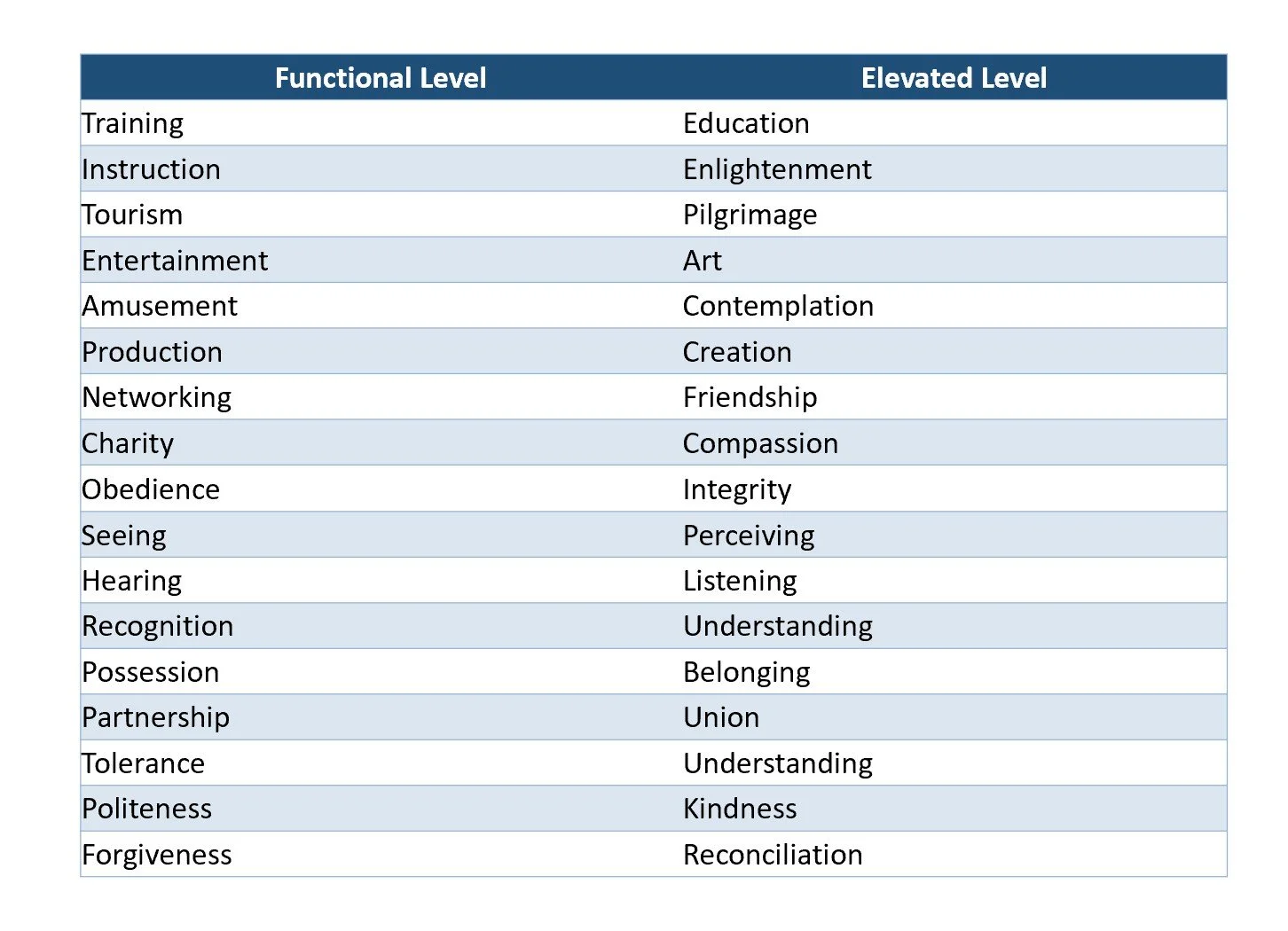

The Maltese Silkroad: Triq iċ-Ċawsli (Mulberry Road)
When I look at the geography of traditional industries, which are based on agricultural commodities, I always remember the model of Johann Heinrich von Thünen, a land owner an economist, who developed a theory in which agricultural intensity generally decreases with distance to the market. This is the Thünen Ring Modell from 1842. Another phenomena it describes, is that with increasing logistic cost, the value ad of the products produced increases …
When I look at the geography of traditional industries, which are based on agricultural commodities, I always remember the model of Johann Heinrich von Thünen, a land owner an economist, who developed a theory in which agricultural intensity generally decreases with distance to the market. This is the Thünen Ring Modell from 1842. Another phenomena it describes, is that with increasing logistic cost, the value ad of the products produced increases. This means for example, that while you produce wool in proximity to a market, you need to knit socks when you are remote. Or while you produce milk and perishable goods close to the market, you need to make cheese in remote, first for preservation, but also to make it a feasible product. Some even say this is maybe the origin of the high value industries in Switzerland. And I was reminded of it when a former student of mine, Sebastian Lindstrom, started promoting the production of camel milk cheese in Somalia. Following this logic, and given the geographic location of the Maltese Islands, it immediately made sense to me, when I heard about the historic attempt to build up silk production in Malta.
The idea was put into action by Sir Moses Montefiore. A British-Jewish banker of immense wealth and influence, Montefiore was a man of his time – a Victorian visionary who believed in progress, industry, and the power of capital to transform societies. In 1826, through his “British, Irish and Colonial Silk Company,” he set his sights on Malta. The plan was audacious: to turn the sun-baked island into a producer of silk, that most luxurious of commodities.
The logic seemed sound, at least on paper. Malta’s climate, it was believed, would be even more favorable than Italy’s for the cultivation of mulberry trees, the sole food of the silkworm. The venture was launched with characteristic Victorian confidence. An incredible 110,000 mulberry saplings were imported, and over 62,000 were planted, many of them along this very stretch of road in Żejtun. By 1830, the company employed nearly 300 local silk reelers. For a brief moment, it must have seemed like the future was shimmering, spun from delicate thread.
But the dream unravelled as quickly as it had been conceived. The project was a catastrophic failure. The reasons, in retrospect, are painfully obvious. The company’s managers, for all their financial acumen, lacked the deep, specific knowledge of sericulture. More fundamentally, they had misread the land itself. Malta’s soil is notoriously shallow, and the young mulberry trees, though they grew, could not provide the lush, abundant foliage required to sustain a viable silkworm population. The entire enterprise collapsed, leaving behind a legacy of debt and disappointment. The colonial government was left with an unpaid rent bill of over 15,000 pounds, a long line of useless trees.
And so, the road remains. Triq iċ-Ċawsli. A name that has outlived the industry it was meant to serve. Driving along it today, you can see the irony. The road was recently reconstructed, a multi-million Euro project to accommodate the relentless demands of modern traffic. In the process, some of the original, now-sickly mulberry trees were felled. They were replaced, of course, with new saplings, a gesture towards preserving the historical character of the place. But it feels like an echo of the original folly – planting trees in a place that has already proven it cannot sustain them.

With my Vespa passing through Rhine-Nahe
The year is soon coming to and end, and even it’s not quite time to wrap up yet, I am spending some times in the forests above the Upper Middle Rhine Valley. It is a UNECO World Heritage Site, with idyllic landscapes of rolling vineyards and historic castles. Very picturesque, but also here you can feel economic pressures and cultural decline, like in many other parts of Germany. The areas does not just stand for castles and old Sagas like the Nibelungs, …
The year is soon coming to and end, and even it’s not quite time to wrap up yet, I am spending some times in the forests above the Upper Middle Rhine Valley. It is a UNECO World Heritage Site, with idyllic landscapes of rolling vineyards and historic castles. Very picturesque, but also here you can feel economic pressures and cultural decline, like in many other parts of Germany. The areas does not just stand for castles and old Sagas like the Nibelungs, but also was a once celebrated viticultural land. Thomas Mann’s Felix Krull - Bekenntnisse eines Hochstaplers (Confessions of Felix Krull, Confidence Man) is set here in a time the wine industry was the backbone of the region, attracting also travel and tourism from across the globe.
In deed, the Rhine and Nahe valleys have been synonymous with world-class winemaking, also beyond renowned Rieslings. Working in the steep, sun-drenched slopes, meticulously terraced over centuries is hard work. I have done it as a teenager during harvest season myself. But it is not only the wine production itself, but this industry also sculpted a unique cultural landscape. Now when I travel through the vinyards on my Vespa, I can see more and more land unmaintained or abandonned. Since 2025, an alarming two-thirds of independent German wine producers are in financial distress, with nearly one in three facing the risk of closure. The crisis is most acute for bulk wine producers and cooperatives, which form the backbone of the industry, with many forced to sell their wines at prices below the cost of production.
This crisis is not the result of one single factor and been brewing for years. A dramatic 30-40% surge in operational costs since 2019, encompassing everything from labor and energy to packaging and machinery, has squeezed profit margins to unsustainable levels. Compounding these economic woes are significant shifts in consumer behavior. A growing health consciousness, particularly among younger generations, has led to a decline in alcohol consumption. If you wonder where the drinking of alcohol originated? Historically, when water was infested by anything from e-Coli to Cholera, ethanol was a way of purifying water. It was literally safer to drink beer or diluted wine, than water. Sure, there are better ways to keep water safe today than adding a cell and nerve poison. The career of alcohol as a recreational drug, started later. I am personally always confused by the term “recreational drug”, because I doubt the “creation” part of that story. So, in a way, when the government of Rhineland Palatine (a German province), subsidizes the wine industry, it may even prevent a necessary structural change, and putting taxpayers’ money in the wrong place. Some people told me that the provincial government would do it because they “profit” from the alcohol tax. In fact the German alcohol tax is a federal tax. So it’s not like the “Taliban supporting the opium production in Afghanistan to get a share or benefit from trade involvement and raising protection money”, like one (drunk) local tried to convince me.
Another factor, is the increasingly volatile climate, creating whiplash effects in supply: while some years have seen yields slashed by extreme weather events, others have resulted in oversupply, flooding the already saturated bulk wine market and causing prices to plummet and more producers going out of business.
The increasing abandonment of these terraces, which are difficult and costly to cultivate, has a cascading effect on the environment. Without the deep-rooted vines to hold the soil in place, the abandoned slopes are highly susceptible to erosion, leading to the loss of fertile topsoil and increased runoff. This not only degrades the land but also poses a threat to the delicate ecosystems of the Rhine and its tributaries.
Once, with my Vespa, I pass the vineyards, and entering the main towns, also the cultural effect is very prominent, even more pronounced on the left river bank, where the sun does not allow significant wine production. There are still some lovely very small towns which can maintain their character. But once you come into places like Bingen or Bad Kreuznach, they are mere shitholes. Unfortunately, for Germany, this is not the only industry in a crisis, and we look at parallel developments in many producing industries, while the former competitive advantages dwindle. There is also not just one thing you can do, to turn it around. It’s a country in a cluster-fuck!
On a positive note, there are beautiful forests and landscapes above the Rhine valley towards the West, towards Luxembourg and France. It’s the land of “Schinderhannes” (Skinner Hannes), a famous outlaw active around the turn of the 19th during French occupation. He is often remembered in folklore as a kind of “German Robin Hood,” though historically he was primarily a violent robber and extortionist. The area was very poor back then, and the Devonian base rock does not produce large stretches of fertile soil. So, there are amazing forests maintained and landscapes to hike for days. And if you have enough of the green, the area as one big plus: it’s a short drive to Paris.

The Leuty Lifeguard Station
For the majority of two years, I have been passing buy the Leuty Lifeguard Station more than once a day, strolling out with “Eddie” the Australian Shepherd. It is close to a fenced area, where dogs are amoung themselves and at the beginning of The Beach-stretch to the really amazing R.C. Harris Water Treatment Plant. During winters, dogs are allowed to run free, behind the snow fence. That’s something Eddie definitely made use of. The Leuty Lifeguard Station is one of the last remaining historic structures on Toronto's waterfront in the neighborhood known as The Beach …
For the majority of two years, I have been passing the Leuty Lifeguard Station more than once a day, strolling out with “Eddie” the Australian Shepherd. It is close to a fenced area, where dogs are amoung themselves and at the beginning of The Beach-stretch to the really amazing R.C. Harris Water Treatment Plant. During winters, dogs are allowed to run free, behind the snow fence. That’s something Eddie definitely made use of.
The Leuty Lifeguard Station is one of the last remaining historic structures on Toronto's waterfront in the neighborhood known as The Beach. Constructed in 1920, the station monitored Kew Beach for decades, with its lifeguards credited with saving over 6,000 lives. At the turn of the 20th century, the Toronto Harbor Commission developed the shoreline in what would become The Beach. The area transitioned from heavily wooded swamplands with private homes to include parks, boardwalks, and public gardens. Designed by the architecture firm Chapman, Oxley & Bishop, the station is a clapboard structure featuring a rooftop lookout tower. During its peak period, the Beach area contained boat houses, food vendors, and boats for hire. However, the erosive currents of Lake Ontario gradually affected Kew Beach and many of its historic buildings. The area's shorelines have historically experienced cycles of recession and regeneration. To address erosion, the municipality installed groynes to stabilize the shoreline.
After my return to Toronto from Hong Kong, times were very busy. One part of that was to vacate our home on Wheeler Avenue and prepare for a winter outside Canada. As Toronto is having a high rent environment, it seemed more feasible to put things into storage and return in spring time. So all, including the car, went into a 10 x 25 feet shelter in Scarborough. It’s not too far to fetch, but also far enough to get a good storage rate. It’s not climatized. So, I disconnected the car battery, and filled it up with defrosting agent which supports - 50° Celsius. I took a storage with a significant step at the entrance, so that, should there be a storm or some bizarre ways of melting snow, nothing should run in. The Subaru Forester took this step like a Gekko, of course: good clearance and a perfect 4x4.
While writing this, I am sitting in a forest in Germany, en route to Southern Europe. The fireplace is keeping things cosy and Eddie is sleeping under the table. He has a big journey in his crate to come here, in hold, with other oversized luggage, like surf boards and prams. He took it well, and enjoys running though the wet meadows, during the time the morning fog is still covering the valleys. Suddenly Canada looks very far, and definetely, I have a very sobre opinion on it. It is a great country with amazing people. But it has been completely mismanaged for about a decade. It’s dangerously complacent. There was a wake up call by the Southern neighbor, but somehow, somebody hit the snooze butten. Don’t snooze too long, Canada! I really feel the itch of doing my part, to get it back on it’s feet.
The photos below, are from my very early farewell walk to The Beach and the Leuty Lifeguard Station, together with Eddie having a last sniff of the “dog’s social media messages” and leaving a goodbye to his friends.


World Economic Indicators in the South China Sea
After a few weeks in Ontario, I flew from Toronto via San Francisco to Hong Kong, where I am currently waiting for the landfall of Typhoon TAPAH. I abandoned my plan for a hike in the New Territories, as heavy rain bands are already touching the city on the periphery of the cyclone. Last week, I had the chance to go for a hike on Lamma Island and revisit my previous home turf. I also took the opportunity to climb Mount Stenhouse on the island's southern part and enjoyed the view over the South China Sea …
After a few weeks in Ontario, I flew from Toronto via San Francisco to Hong Kong, where I am currently waiting for the landfall of Typhoon TAPAH. I abandoned my plan for a hike in the New Territories, as heavy rain bands are already touching the city on the periphery of the cyclone. Last week, I had the chance to go for a hike on Lamma Island and revisit my previous home turf. I also took the opportunity to climb Mount Stenhouse on the island's southern part and enjoyed the view over the South China Sea. Back at the height of the financial crisis in 2008, I discovered that the number of container ships anchoring and undergoing maintenance behind the cover of the outer islands is a good indicator of the global economy's condition. The more ships you see, the worse it is. And now, there are many ships.
What surprised me recently, while strolling through a Walmart in the US, was that the shelves were well-stocked. I would have expected this, particularly in the non-food section, which sources many SKUs from China. But it was okay. The prices also appeared acceptable, though I honestly don't follow Walmart prices regularly, so it's just a layman's impression. The moderate inflation in the US, following the president's tariff frenzy, has led people to debate whether Trump might even be right with his economic worldview. I think, he is just lucky and the US economy is more resilient than many expected. I am really surprised, you can run a country like this. I guess, that’s why I am not the President of the United States.

Grumpy Old Men
For some time now, I've observed a troubling trend among people I know - even close friends - where many are becoming increasingly grumpy and irritable. This phenomenon has led me to wonder: what's driving this shift in temperament, particularly among older men? While discussing this observation with younger people, a friend mentioned Pick's Disease, a form of frontotemporal dementia that affects the brain and typically strikes people under 65 …
For some time now, I've observed a troubling trend among people I know even close friends - where many are becoming increasingly grumpy and irritable. This phenomenon has led me to wonder: what's driving this shift in temperament, particularly among older men? While discussing this observation with younger people, a friend mentioned Pick's Disease, a form of frontotemporal dementia that affects the brain and typically strikes people under 65. However, expert estimates suggest only 15-22 cases per 100,000 people are affected by this condition. Even if the actual numbers are higher - since the disease can only be definitively diagnosed after death - it cannot account for the large number of grumpy older men I encounter. There had to be another explanation.
The thought that all these individuals might have manifest brain damage was difficult to accept, so I turned to Hannah Arendt's seminal work, "The Banality of Evil," her account of observing the Eichmann trials in Jerusalem in 1963. I delved deeper into her writings on totalitarianism and violence - works that, incidentally, should be required reading in every American high school today (if they have required reading).
At first glance, these grumpy older men appear irritable, cranky, cynical, and sarcastic - simply unpleasant to be around. They often begin supporting radical political views or embracing conspiracy theories. Their worldviews become highly contradictory; for instance, they might support autocratic measures while claiming to defend "freedom of speech." Many drift towards pseudo-theories, attempting to construct a consistent worldview within some parallel reality. Disturbingly, they often advocate for violent solutions to restore "law and order," to "teach them a lesson," or to "take back our country." These individuals are frequently intelligent, as they need considerable brainpower and creativity to construct these alternative realities. Some are among the smartest people I've ever encountered, and some possess dangerous charisma. The photo I have chosen to illustrate this blog post, is my grandfather. He was the prototype of a grumpy old man, but he had his own history which may not explain much of the contemporary causes of the phenomena.
Many of the men I've observed have defined themselves primarily through their careers. Now, in the process of retiring or having been forced into retirement, they've lost their sense of identity. However, an identity crisis alone probably isn't the sole trigger for becoming a "grumpy old man."
Arendt writes about how isolation and subsequent loneliness lay the foundation for dissatisfied and potentially violent societies. Even before retirement, many people face professional isolation—they're no longer considered for new positions, excluded from development workshops, or marginalized in other ways. Beyond isolation comes loneliness, where people lose their sense of belonging to the world entirely. At this point, the hunger for meaning drives people toward ideologies. The line between fact and fiction becomes blurred, and these older men become vocal advocates for nonsense because they feel they have nothing left to lose.
Normally, my first instinct when someone becomes a "grumpy old man" would be to delete them from my contacts and move on. I don't have the time or energy to deal this. However, if my analysis holds any truth, further isolation only exacerbates the problem on a societal level. Therefore, I've made a decision: once a month, I will reach out to a grumpy old man in my circle. I'll take him for a drink, a walk with the dog, or engage in whatever activity he enjoys—as long as it's not attending a Trump rally or its equivalent.

Harvest time
Somehow the time of wheat harvest has been always a melancholic moment for me. It always strikes me, how fast the first half of the year has passed. Even many crops and fruits are not in their harvesting season yet in Central Northern Europe, the grains start this season of closing down the year early. Of course, this is disproportionate, because there are still 5 months to go for the new year …
Somehow the time of wheat harvest has been always a melancholic moment for me. It always strikes me, how fast the first half of the year has passed. Even many crops and fruits are not in their harvesting season yet in Central Northern Europe, the grains start this season of closing down the year early. Of course, this is disproportionate, because there are still 5 months to go for the new year. Perhaps it’s also, because I just arrived in this season into my home landscape. So, it had a bit of touch of Heinrich Heine’s “Heimkehr” in “Neue Gedichte”. Until there is the German Thanksgiving on October 5th, there are still two months to go. In North America it falls this year on October 15th. The character between European and American Thanksgiving is very different. Modern America has been built on a few religious utopias and the results are obviously more pronounced, while in Europe things go along quietly in religious communities. Even the Munich “Oktoberfest”, which actually happens in September, has a connection to Thanksgiving.
I had the chance though to go down South for some business meetings in Munich, which I enjoyed. The city is still very detached from the world’s worries. More than the other nice large German city: Hamburg. Hamburg is traditionally a port city, so naturally more connected, for the better and the worse. In Munich, I had the chance to visit the first time since ages, the new office of my former employer, The Boston Consulting Group (BCG). My time was still in Sendlingerstraße, but they moved soon after to Ludwigstraße 21, into a former building of the insurer Allianz. And it’s really amazing.
While staying some weeks at the upper Middle Rhine Valley, I noticed the “hunger stones”, appearing in the river bed. These stones were in the past pointing at a bad harvest. When the water level of the Rhine river is low, you can even see it in the German GDP nowadays. The river has a major logistic role and when ships can’t move freely, for example BASF (a big German chemical company located in Ludwigshafen) gets limited supplies. BASF is anyways under pressure for many reasons, one of them that it is highly dependent on the natural gas and other energy prices. It’s not the river these days, but politics, which defines the odds of the company. It’s the same with the harvest. Today it’s not the “hunger stones”, but politics defining the output. That’s why I was very worried that under the previous German government, the “Green Party” has in charge. Imagine a bunch of Yoga-teachers and vegetarians playing with the food system! Nothing wrong with Yoga-teachers and mindful vegetarians. But if things go wrong, a country like Germany will buy up supplies from the world market and let others starve on their behalf. “Mindfulness” seems very much a concept of actually being out of their minds, and with food production this tricky and can easily turn evil.
Last but not least, I was in Malta. I bought a summer hat (it was hot!), had lunch and dinners with friends and swam in the turquoise sea, overlooking Valletta. There was the Malta Jazz Festival, and I am always surprised what niche performances draw a large enthusiastic crowd in Malta. With all the challenges it has, Malta is a great little country. It’s always somehow at the edge of ruing it, but then succeeds.
Now I am back in Toronto. People complain about a heat wave. I don’t quite know what they mean, but okay. I would say, it’s just summer. Lake Ontario is a bit eutrophic on our side. I stopped my dog drinking from it, to avoid trouble. The only thing bad about summer in Toronto, is that you see a lot of fat people with tattoos. The rest is just how it is.

Water level at the Rhine river North of Bingen

Birgu street and transport (Malta)

Malta Jazz Festival

Land of a Thousand Fires - Why I love the "Ruhrgebiet", against all the odds
In the mid 90s, I did my PhD in Essen, a city in the Rhine-Ruhr-Area (Germany). Back then, I was working on man made precipitation modifications in urban areas. Honestly, back then I did not know really what an “urban area” looks like, and I thought this conglomerate of smaller towns, growing together to one urban cluster could have impacts on the atmospheric boundary layer that modify rainfall patterns. Actually, it does. But that’s a different topic. Earlier this week, …
In the mid 90s, I did my PhD in Essen, a city in the Rhine-Ruhr-Area (Germany). Back then, I was working on man made precipitation modifications in urban areas. Honestly, back then I did not know really what an “urban area” looks like, and I thought this conglomerate of smaller towns, growing together to one urban cluster could have impacts on the atmospheric boundary layer that modify rainfall patterns. Actually, it does. But that’s a different topic. Earlier this week, meetings and catching up with old friends brought me back to this place after many years. The Rhine-Ruhr-Area is often stigmatized in Germany, as of its industrial history. What’s true is, that it has a heart of steel, but some of the most friendly people. What is also true, is that it was the military industrial power house for two catastrophic world wars. But again, people are amazing. Once you were down in a coal mine, all that counts, is cooperation and team work. You had to take care of your colleagues and in the many tragic cases, also of their widows and their children as a community. Anybody who worked in mining, knows what I talk about. I am really not a trade union supporter, just the opposite these days, but I completely understand why the roots of the German workers’ movement are here. After discontinuing coal mining and large parts of the steel production capacity, the region went through amazing structural reforms. This has not ended. The previous federal industrial ministry pushed for green steel production using “green hydrogen”. That’s a difficult process, very expensive and the market for it is very small, given high prices and fierce competition and trade barriers. Last but not least, the green hydrogen is not available in the necessary amounts. So, the heart of steel is having a serious cardiovascular problems, while other opportunities are coming up, specifically with the new NATO target of spending 5% GDP on defense. History does not repeat itself, but it rhymes.
For two hours I dropped by “Zeche Zollverein”, a museum on the premises of the old coal mine. I had the privilege of chatting with one of the last technical mining apprentices from the 1980s, telling me his life story having seen work down in the mines and how is is now serving as a security staff in a museum of his former workplace. I also learned from one of my PhD colleagues, that my former office mate Ewald Zmarsly passed away already in 2018. I remember Ewald as such a great fellow. He wasn’t social. But he was the only Chemist in the department and he had infinite patience to explain anything chemistry to the rest of us when we needed it. Even he was not communicating much, I remember, he had an amazing talent and patience to explain complicated things to beginners in any science field - always helpful, always friendly, but never smiling. He also co-authored multiple textbooks with Wilhelm Kuttler and others, which are all brilliant books. I don’t know much of Ewald’s history and when his family came to the “Pott”. But for me Ewald was prototype of the people here: knowing what he talks about, without talking much. The world needs more Ewalds. Rest in peace.


The grandkids of "Radio Veronica"
In April 1960 a group independent Dutch electronics retailers brought a 1 kW AM offshore pirate radio station on air, broadcasting from the a former lightship Borkum Riff. They intended to boost sales of radio appliances by offering an alternative programme to the official Dutch radio and selling airtime to advertisers. VRON, Vrije Radio Omroep Nederland (Free Radio Station Netherlands) was born, which later became “Radio Veronica” named after the poem "Het Zwarte Schaap Veronica" (The Black Sheep Veronica) …
In April 1960 a group independent Dutch electronics retailers brought a 1 kW AM offshore pirate radio station on air, broadcasting from the the former lightship Borkum Riff. They intended to boost sales of radio appliances by offering an alternative programme to the official Dutch radio and selling airtime to advertisers. VRON, Vrije Radio Omroep Nederland (Free Radio Station Netherlands) was born, which later became “Radio Veronica” named after the poem "Het Zwarte Schaap Veronica" (The Black Sheep Veronica). After its closure in 1974 some staff members obtained a license and continued operation in the increasingly competitive liberalized market.
The story continued as usual: after the pioneers come the settlers, then the bankers, then the liars, then the lawyers, then the churches, schools and finally at some time the shopping malls - or even worse. For pioneering pirate radio station this journey ended somewhere with TikTok. I imagine, that’s the end of the life cycle. But I have no real insight into TikTok. However, yesterday I looked at YouTube. It must be something like the “Instagram for video content”. Well, on the one hand, I like amateurism. It has a great spirit. But on YouTube you see housewives explaining the universe, fired journalists running “alternative channels”, ex-hedge fund managers explaining geopolitics and its impact on the markets, tattooed ex-bodybuilders being podcast hosts, … you name it. I guess, low technical entry barriers do more harm than good. At least back in the time of Radio Veronica, you needed a ship and a captain’s licence. You needed to build a radio station out of components and modules available. You needed to calibrate the antennas hanging on masts. And last, but not least you needed to power the thing and eat canned food for weeks in a go, together with sea sickness pills in bad weather. Now you just need a smart phone and a ring lamp and can disseminate all garbage globally.

Ottawa
Some time ago, I went to Ottawa by train. But now, I decided to go by car again and visit friends on the weekend. We were actually neighbors back in Beijing in 北京東湖別墅 and have not seen each other for more than a decade. It’s always great, when you can catch up after more than 10 years and it feels like, “just yesterday”. This time in Ottawa, I was for there for leisure and I really enjoyed the historical views (given the short modern history), and just to see how life is in town. It’s a very pleasant city and easy to get around. It’s now summer of course, when living is easy …
Some time ago, I went to Ottawa by train. But now, I decided to go by car again and visit friends on the weekend. We were actually neighbors back in Beijing in 北京東湖別墅 and have not seen each other for more than a decade. It’s always great, when you can catch up after more than 10 years and it feels like, “just yesterday”. This time in Ottawa, I was for there for leisure and I really enjoyed the historical views (given the short modern history), and just to see how life is in town. It’s a very pleasant city and easy to get around. It’s now summer of course, when living is easy.
Another experience was the drive, with a new car. It’s a Subaru Forester 2025. I tried it’s offroad capabilities before which are really superb. The 2.5 litre boxer engine is not the most modern design. But it still is one of the best ways to get a low center of gravity in such a car. Also, it can handle dogy fuel, if necessary. And what did surprise me on this 5 hour drive from Toronto to Ottawa, is the comfortable long haul capability. Given a boxer engine, also the fuel economy was fine, with 8.1 liters (regular) / 100 km. It comes with all the driving assistance systems of a modern car. So, the drive was really a breeze. I just hocked myself behind another car, put cruise control to max 110 km/h and listened to French satellite radio. Canadian Subarus com with a Starlink connection.
On the way, I took two breaks: the 1000 Islands Boat Museum at Gananoque and the Pickering Nuclear Power Plant. I am a big fan of old boats and nuclear power. So, for me, both worth visiting.

Good night and good luck
I just returned from a study trip to the United States, which I helped organizing for the MBA Programme of the Hong Kong University Business School. We studied the success factors of tech clusters in and around the Boston/Cambridge area, explored the startup environment in New England, debated the current US-China trade relations at the Fletcher School of Law and Diplomacy and also got quite some insight into the current struggles between the US federal government and Harvard University …
I just returned from a study trip to the United States, which I helped organizing for the MBA Programme of the Hong Kong University Business School. We studied the success factors of tech clusters in and around the Boston/Cambridge area, explored the startup environment in New England, debated the current US-China trade relations at the Fletcher School of Law and Diplomacy and also got quite some insight into the current struggles between the US federal government and Harvard University. Also the tone at the Massachusetts Institute of Technology (MIT) was quite subtle, watching what is happening to their neighbor down the road. We also took the chance to explore arts and culture, made a day trip to Nantucket and made a dive into American history. It is not a long, but an intense one. Perhaps this is what explains the intensity of today’s debates on some levels. What surprised me, personally, was the caution with which friends and colleagues were expressing their opinions. I guess, this is a time, where you can get easily labeled. And while new labels are made up every day, the old ones undergo an inflation. It’s a time in history where the Overtone window is pulled wide open. And that in itself has quite some danger.
There have been times similar in the United States. Even if these comparisons always fail to be exact, still history rhymes. Obviously, I am thinking of the anti-communist crusade of the US Senator Joseph McCarthy. And I borrowed as a title for this post, the signature sign-off used by the CBS-Journalist Edward Murrow, ending his broadcasts with “Good Night and Good Luck”, and it became a powerful reminder to keep up journalistic standards in these turbulent times, and holding public figures accountable.
When you watch the news on the US now, it appears to be quite a circus. And I guess, that’s the intention. Just look at the cast and their costumes. With Harvard being in the crosshairs now, what could happen though, is that the intellectual elite will come under scrutiny. I also have my criticism on how academia works. But it is easy to to throw out the baby with the bathwater here, especially in this irrational and heated debate, which is meant to fire up people and achieve submission. During my time in China, I heard countless accounts of professors being humiliated, injured or even killed by the mob during the Cultural Revolution. We also had the chance to speak to Jewish students at Harvard, and yes, they confirmed experiencing frightening antisemitic aggression on their campus. But they also do not want to be the pawn for a potentially much bigger power struggle in the US. There is no easy solution to any of this. America, good night and good luck!