
Amalienhöhe - the mine that swallowed its own village
The Grube Dr. Geier above Waldalgesheim is not a ruin in the picturesque sense. It is an abandoned baroque palace that happened to be a manganese mine, and I spent this afternoon walking around it. Two symmetrical wings, a gate house, a court of honour, an octagonal basin in front of the machine hall that was really a cooling pond. Weeds in the joints, a burnt-out section from a fire in 2003, corrugated iron over windows. What is most conspicuous is what is missing: the 50-metre steel headframe that stood at the centre of every photograph of this place until January 2014 …
The Grube Dr. Geier above Waldalgesheim is not a ruin in the picturesque sense. It is an abandoned baroque palace that happened to be a manganese mine, and I spent this afternoon walking around it. Two symmetrical wings, a gate house, a court of honour, an octagonal basin in front of the machine hall that was really a cooling pond. Weeds in the joints, a burnt-out section from a fire in 2003, corrugated iron over windows. What is most conspicuous is what is missing: the 50-metre steel headframe that stood at the centre of every photograph of this place until January 2014.
The Darmstadt firm Markwort & Seibert laid the complex out from 1916 onwards - in the middle of the First World War, while bread was rationed - with the buildings arranged almost axially around the courtyard, the director's house and the hostel flanking the entrance. The most elaborate building held a dining hall with a stage. Miners here ate above ground, in a room with a theatre in it. I know of no other German ore mine that decided that was a priority.
Much of what I know about what this place did to the village did not come out of an archive. Outside Waldalgesheim there are small lakes where people fish, and on the bench there you can find ladies from the care home "Carpe Diem", which opened on Neustraße a few years ago. They are in their eighties and nineties. Their fathers and grandfathers worked this hill. Where something in what follows has no document behind it, it usually has one of them.
The man on the gate is harder to see clearly than the buildings. Heinrich Claudius Geier, born in Mainz in 1834, son of a builder, Corps student in Darmstadt, Catholic, married, architect and entrepreneur by trade. Between 1881 and 1887 he sat in the Second Chamber of the Grand Duchy of Hesse for the National Liberals - the party of industry, railways and tariffs. On 15 March 1883, while still a sitting deputy, he received the mining concession. Two years later he was drilling on the Amalienhöhe, and at about eighteen metres he hit ore. Where the "Dr." in front of his name came from I could not establish; the biographical record calls him an architect. Nor could I find out who Amalie was, or Elise, whose name is on the neighbouring field the company later bought. He died in 1896 (or 1898), and his heirs turned the family firm into a "Gewerkschaft Braunsteinbergwerke Doktor Geier", divided into a thousand shares. That is roughly the whole man as the archives have kept him: a well-connected liberal with an eye for a seam and, on the evidence of the courtyard, a taste for architecture that outlived him by a century.
What made the hill valuable was steel. Manganese binds sulphur and oxygen; without it the Thomas process does not give you good steel, and without good steel you do not get rails, ships or guns. In August 1914 Germany was cut off from foreign ore in a single stroke, and a modest Hunsrück mine became a strategic asset. Work stopped briefly and resumed by October. Russian prisoners of war were put to work here. The Reich paid half the cost of sinking the new shaft on the Stöckert from 1916. In 1917 the mine produced around 240,000 tons — its record, never matched again.
The logistics are the part I find most beautiful, in the engineer's sense of the word. Waldalgesheim sits some six kilometres from the Rhine with a forested ridge in between, which is a nuisance if you are moving heavy rock. So in 1912 they strung a 7.6-kilometre aerial ropeway through the Binger Wald down to a loading point at the river near Trechtingshausen, good for sixty tons an hour. Buckets of ore floating over the treetops, all day, until 1967. From 1914 they also drove a tunnel - the Rheinstollen, 3,300 metres, finished only in 1924 because of the war - which drained the workings and carried ore out towards Bingerbrück. That puts the mouth of the works almost exactly at the stretch of river I wrote about earlier this summer, the choke point below the Binger Loch. The same few hundred metres of water that decide today whether a chemical plant gets its feedstock decided a century ago whether a blast furnace got its manganese. The Rhine does not change its role. Only the cargo does.
The price was paid by the village. From 1908 the damage was unmistakable: cracks, sinking streets, hollows filling with rainwater. Nobody here talks about earthquakes in the geological sense, and I found no seismic record - but people talk about the ground moving. A settlement of a few centimetres does not announce itself politely; when a roof falls in a chamber two hundred metres down, the house above it feels a jolt, plaster lets go, a door stops closing. One of the ladies described a house that was sound on the Tuesday and condemned by the Friday. Another said her grandfather had a field where one of the fishing lakes is now, and said it without drama, the way you would mention a road that got widened. From around 1910 the company built 124 replacement houses south of the old core, and roughly sixty more between 1916 and 1920, by the same architects who were building the palace on the hill. Whole streets were given up. Both churches had to go. The Protestant congregation closed its old church in June 1937 and consecrated a new one on 27 March 1938, carrying the organ and the spire across to the new site like relatives moving a grave.
And here the two halves of the story meet. In April 1938 - within weeks of that consecration - the Oberbergamt moved the "Sicherheitspfeiler" further south. The safety pillar is the block of rock a mine is forbidden to touch because a village stands on it. It was moved because Hermann Göring's Four-Year Plan wanted the ore, and it was moved again in 1941. Landowners who refused to sign were brought round by pressure from the state and the church, and by the threat of expropriation. That is what rearmament looked like at parish scale: not a rally, but a line on a mine surveyor's map shifted a few hundred metres, and a community agreeing, under duress and with compensation, to let the ground beneath its new houses be taken as well. Output reached about 160,000 tons in 1944, the highest since the first war. Work stopped in March 1945.
It stopped because the Americans arrived. The Hunsrück was not defended in any meaningful sense. Through mid-March, exhausted German columns of fifteen or twenty men trudged east through Bingen towards a Rhine whose bridges their own engineers were blowing up behind them — the Hindenburg bridge on 15/16 March, others in the days after, one detonation strong enough to take out windows across the town. American infantry was in Bingerbrück on the afternoon of 18 March. Once the party officials had gone, white sheets went out of the windows. There is an account from a village up on the plateau of teenagers finding a store of Panzerfäuste and tipping the ammunition into a water hole in the meadows before the soldiers came, with their parents running down into the valley to fetch them home. That is the Hunsrück's version of the end of the war: not resistance, not liberation in any triumphal sense, but enormous relief at not being fought over, mixed with how quickly the flags changed colour. On the night of 22 March, thirty kilometres upstream at Nierstein, Patton put a few hundred men across the Rhine in rubber boats without a preliminary bombardment, a day before Montgomery's set-piece crossing at Wesel, and the river stopped being a front. Of the three ladies, one did not talk about the war at all, which is also a way of talking about it.
The mine outlived the regime by twenty-six years and was killed by metallurgy. When no significant manganese reserves could be opened up after about 1952, the company switched to dolomite, first delivered in 1959, peaking at some 350,000 tons in 1969. Then the steelworks moved from the Siemens-Martin furnace to the LD converter, which did not need it. Demand collapsed. On 31 December 1971 the last shift came up - sixty-three men underground, seventy-seven above, thirty-two in the offices. The deepest shaft had reached 267 metres. One of the ladies remembered her father coming up filthy and singing, which is the only detail anyone offered me that sounded like nostalgia.
After that, the long undignified afterlife: a visitor mine for three years, then tenants, then the 2003 fire, then owners with plans and no money. The headframe rusted until it was condemned. In December 2013 the water tank and roof came off and the frame began to lean towards the houses. In January 2014 they put a steel cable on it and pulled it down deliberately; it fell into the ore bunker and the machine hall and hurt nobody. Since 2002 the whole ensemble has been a protected monument inside the UNESCO Upper Middle Rhine Valley - a World Heritage site with its landmark lying on the ground.
Mining places are always three things at once. Hope: a man drills a hole in a hill in 1885 and a village gets wages, a theatre and 184 new houses. Despair: the same village watches its church crack and signs away the rock under its feet because a Reichsmarschall wants more steel. Tragedy: the tonnages that mattered most were dug in 1917 and 1944, and everyone knew what they were for.
Standing in the courtyard, what strikes you is how little of this the buildings admit to. They were designed to look like a residence, and they still do. The most durable thing the mine produced is not in the courtyard at all. It is the shape of the ground: eight million tons taken out, the surface let down onto the void, and a set of lakes that nobody planned and that now hold protected wetland and a fishing club. The hill also gave up a Celtic princess in gold, dug out of the same ground by a farmer in 1869 and important enough that a whole style of European art is named after this village. Two extractions, two thousand years apart, and only one of them left a hole.

Toronto - a farewell visit. For now!
The flight out of Germany started in Frankfurt. This is a major airport, and like many of this category it is not designed for travel, but for transport. Everything is cargo here, including the people. There is no romance left in this operation, no sense that you are embarking on anything. You are being processed. And yet, against all statistical probability, I made it onto the plane out of Germany on time. This, I assure you, is an exception of historic proportions for German transport. Just a few days prior, …
The flight out of Germany started in Frankfurt. This is a major airport, and like many of this category it is not designed for travel, but for transport. Everything is cargo here, including the people. There is no romance left in this operation, no sense that you are embarking on anything. You are being processed. And yet, against all statistical probability, I made it onto the plane out of Germany on time. This, I assure you, is an exception of historic proportions for German transport. Just a few days prior, I took a train in this country that accumulated six hours of delay as if time itself had given up on the Deutsche Bahn and wandered off to find a more punctual civilization. So when the wheels lifted off the runway at Frankfurt, I felt something relieved to have left it behind. Looking down at the grey patchwork below, I couldn't help but think: the Marshall Plan was such a spectacular waste of money. You could have rebuilt a few decent countries for that amount.
I landed at Toronto Pearson, and the contrast was immediate. The immigration process was efficient and genuinely friendly, even though I had to answer a few questions. I don't always get stopped at immigration, but when I do, the officers seem to enjoy the conversation. Perhaps it is the passport stamps, perhaps it is the stories behind them. Perhaps they are even a little jealous. Either way, we parted on good terms, as we always do. I spent a few days in Etobicoke, taking bus trips downtown into the beating heart of Toronto. It felt unreal to be back, like walking through a dream you once had but never quite finished. The city was familiar and foreign at the same time. Seeing the CN Tower piercing the skyline, I always have to think of the 11th birthday of Lars up in the 360 revolving restaurant, the whole city rotating slowly beneath us like a giant clockwork model, looking down on the tiny propeller planes taxiing around Billy Bishop airport on the islands below.
One morning, I took the tram east to The Beaches, our old neighborhoods . One of the most beautiful places to live in Toronto, stretched along the shores of Lake Ontario like a postcard someone forgot to send. I had breakfast at the Beacher's Cafe, sitting where we had many Sunday family breakfasts and even more often Elena and Lars went to have pancakes and play chess. Afterwards, I walked down to the Leuty Lifeguard Station, and then through Kew Gardens, where the trees have grown taller and the benches have been repainted but the light still falls the same way it always did. I stopped by the dog park, and for a moment where Eddie back then made friends among local huskies.
From Etobicoke, I moved to Scarborough, on the other side of the Toronto suburban outskirts. Bonjour Tristesse. There is a particular melancholy to the sprawling concrete of the eastern suburbs, a kind of architectural resignation. But I was not there for the aesthetics. I had a mission: get a car to the shipping forwarder close to Pinkerton, move my personal items from storage on the way to Malta. The car - hail to Subaru - actually started after a long and brutal Canadian winter, once I reconnected the battery. It just woke up like a bear from winter hybernation. Then the storage unit. Everything packed, processed, sent. All of it now on its way to Malta by sea. I would love to return to Canada one day, but this specific chapter had to be closed. Canada is nice, and the people are genuinely friendly, but they can be a bit of snowflakes, easy to offend if you don't tread lightly around their ever-expanding catalogue of sensibilities. Still, I have a soft spot for this country.
For my final days in Toronto, I moved into Knox Residence on the University of Toronto's St. George campus. A nice place with a great location, right in the intellectual heart of the city. The Knox College building, erected in 1915 in Gothic Revival splendor, sits on King's College Circle like a stone sentinel guarding nearly two centuries of academic tradition. During the summer, the campus is mostly populated by East-Asian and Indian students, heads down, working, researching, studying with an intensity and discipline that commands respect. The Western cultures, it seems, are more characters suited for holiday parks these days, off somewhere "finding themselves" while others are busy building futures. I enjoyed being on campus and explored it in meticulous detail by foot. The University of Toronto, founded in 1827 by royal charter of King George IV as King's College, is a sprawling 138-acre tapestry of Romanesque stone, Victorian brick, and modern glass. University College, completed in 1859, still stands as a national historic site with its medieval turrets and carved gargoyles. Hart House, the great Gothic Revival student center, presides over its circle like a secular cathedral. This is where insulin was discovered, where the first cardiac pacemaker was built, where deep learning was developed—a campus that has produced five Canadian prime ministers and thirteen Nobel laureates, and still somehow manages to feel like a quiet park on a Sunday afternoon.
Today is Victoria Day, in honor of Queen Victoria's birthday, and the official start of the Canadian summer. The holiday mood is everywhere. But for me, it is time to get ready to return to Malta. There is a melancholy in leaving. I hope to return soon. But for now, Malta is calling. Toronto, especially the Beaches, are a bit like Lamma Island in the South China Sea for me. Sometimes, you have to leave these places. But they remember you.

The Maltese Silkroad: Triq iċ-Ċawsli (Mulberry Road)
When I look at the geography of traditional industries, which are based on agricultural commodities, I always remember the model of Johann Heinrich von Thünen, a land owner an economist, who developed a theory in which agricultural intensity generally decreases with distance to the market. This is the Thünen Ring Modell from 1842. Another phenomena it describes, is that with increasing logistic cost, the value ad of the products produced increases …
When I look at the geography of traditional industries, which are based on agricultural commodities, I always remember the model of Johann Heinrich von Thünen, a land owner an economist, who developed a theory in which agricultural intensity generally decreases with distance to the market. This is the Thünen Ring Modell from 1842. Another phenomena it describes, is that with increasing logistic cost, the value ad of the products produced increases. This means for example, that while you produce wool in proximity to a market, you need to knit socks when you are remote. Or while you produce milk and perishable goods close to the market, you need to make cheese in remote, first for preservation, but also to make it a feasible product. Some even say this is maybe the origin of the high value industries in Switzerland. And I was reminded of it when a former student of mine, Sebastian Lindstrom, started promoting the production of camel milk cheese in Somalia. Following this logic, and given the geographic location of the Maltese Islands, it immediately made sense to me, when I heard about the historic attempt to build up silk production in Malta.
The idea was put into action by Sir Moses Montefiore. A British-Jewish banker of immense wealth and influence, Montefiore was a man of his time – a Victorian visionary who believed in progress, industry, and the power of capital to transform societies. In 1826, through his “British, Irish and Colonial Silk Company,” he set his sights on Malta. The plan was audacious: to turn the sun-baked island into a producer of silk, that most luxurious of commodities.
The logic seemed sound, at least on paper. Malta’s climate, it was believed, would be even more favorable than Italy’s for the cultivation of mulberry trees, the sole food of the silkworm. The venture was launched with characteristic Victorian confidence. An incredible 110,000 mulberry saplings were imported, and over 62,000 were planted, many of them along this very stretch of road in Żejtun. By 1830, the company employed nearly 300 local silk reelers. For a brief moment, it must have seemed like the future was shimmering, spun from delicate thread.
But the dream unravelled as quickly as it had been conceived. The project was a catastrophic failure. The reasons, in retrospect, are painfully obvious. The company’s managers, for all their financial acumen, lacked the deep, specific knowledge of sericulture. More fundamentally, they had misread the land itself. Malta’s soil is notoriously shallow, and the young mulberry trees, though they grew, could not provide the lush, abundant foliage required to sustain a viable silkworm population. The entire enterprise collapsed, leaving behind a legacy of debt and disappointment. The colonial government was left with an unpaid rent bill of over 15,000 pounds, a long line of useless trees.
And so, the road remains. Triq iċ-Ċawsli. A name that has outlived the industry it was meant to serve. Driving along it today, you can see the irony. The road was recently reconstructed, a multi-million Euro project to accommodate the relentless demands of modern traffic. In the process, some of the original, now-sickly mulberry trees were felled. They were replaced, of course, with new saplings, a gesture towards preserving the historical character of the place. But it feels like an echo of the original folly – planting trees in a place that has already proven it cannot sustain them.

With my Vespa passing through Rhine-Nahe
The year is soon coming to and end, and even it’s not quite time to wrap up yet, I am spending some times in the forests above the Upper Middle Rhine Valley. It is a UNECO World Heritage Site, with idyllic landscapes of rolling vineyards and historic castles. Very picturesque, but also here you can feel economic pressures and cultural decline, like in many other parts of Germany. The areas does not just stand for castles and old Sagas like the Nibelungs, …
The year is soon coming to and end, and even it’s not quite time to wrap up yet, I am spending some times in the forests above the Upper Middle Rhine Valley. It is a UNECO World Heritage Site, with idyllic landscapes of rolling vineyards and historic castles. Very picturesque, but also here you can feel economic pressures and cultural decline, like in many other parts of Germany. The areas does not just stand for castles and old Sagas like the Nibelungs, but also was a once celebrated viticultural land. Thomas Mann’s Felix Krull - Bekenntnisse eines Hochstaplers (Confessions of Felix Krull, Confidence Man) is set here in a time the wine industry was the backbone of the region, attracting also travel and tourism from across the globe.
In deed, the Rhine and Nahe valleys have been synonymous with world-class winemaking, also beyond renowned Rieslings. Working in the steep, sun-drenched slopes, meticulously terraced over centuries is hard work. I have done it as a teenager during harvest season myself. But it is not only the wine production itself, but this industry also sculpted a unique cultural landscape. Now when I travel through the vinyards on my Vespa, I can see more and more land unmaintained or abandonned. Since 2025, an alarming two-thirds of independent German wine producers are in financial distress, with nearly one in three facing the risk of closure. The crisis is most acute for bulk wine producers and cooperatives, which form the backbone of the industry, with many forced to sell their wines at prices below the cost of production.
This crisis is not the result of one single factor and been brewing for years. A dramatic 30-40% surge in operational costs since 2019, encompassing everything from labor and energy to packaging and machinery, has squeezed profit margins to unsustainable levels. Compounding these economic woes are significant shifts in consumer behavior. A growing health consciousness, particularly among younger generations, has led to a decline in alcohol consumption. If you wonder where the drinking of alcohol originated? Historically, when water was infested by anything from e-Coli to Cholera, ethanol was a way of purifying water. It was literally safer to drink beer or diluted wine, than water. Sure, there are better ways to keep water safe today than adding a cell and nerve poison. The career of alcohol as a recreational drug, started later. I am personally always confused by the term “recreational drug”, because I doubt the “creation” part of that story. So, in a way, when the government of Rhineland Palatine (a German province), subsidizes the wine industry, it may even prevent a necessary structural change, and putting taxpayers’ money in the wrong place. Some people told me that the provincial government would do it because they “profit” from the alcohol tax. In fact the German alcohol tax is a federal tax. So it’s not like the “Taliban supporting the opium production in Afghanistan to get a share or benefit from trade involvement and raising protection money”, like one (drunk) local tried to convince me.
Another factor, is the increasingly volatile climate, creating whiplash effects in supply: while some years have seen yields slashed by extreme weather events, others have resulted in oversupply, flooding the already saturated bulk wine market and causing prices to plummet and more producers going out of business.
The increasing abandonment of these terraces, which are difficult and costly to cultivate, has a cascading effect on the environment. Without the deep-rooted vines to hold the soil in place, the abandoned slopes are highly susceptible to erosion, leading to the loss of fertile topsoil and increased runoff. This not only degrades the land but also poses a threat to the delicate ecosystems of the Rhine and its tributaries.
Once, with my Vespa, I pass the vineyards, and entering the main towns, also the cultural effect is very prominent, even more pronounced on the left river bank, where the sun does not allow significant wine production. There are still some lovely very small towns which can maintain their character. But once you come into places like Bingen or Bad Kreuznach, they are mere shitholes. Unfortunately, for Germany, this is not the only industry in a crisis, and we look at parallel developments in many producing industries, while the former competitive advantages dwindle. There is also not just one thing you can do, to turn it around. It’s a country in a cluster-fuck!
On a positive note, there are beautiful forests and landscapes above the Rhine valley towards the West, towards Luxembourg and France. It’s the land of “Schinderhannes” (Skinner Hannes), a famous outlaw active around the turn of the 19th during French occupation. He is often remembered in folklore as a kind of “German Robin Hood,” though historically he was primarily a violent robber and extortionist. The area was very poor back then, and the Devonian base rock does not produce large stretches of fertile soil. So, there are amazing forests maintained and landscapes to hike for days. And if you have enough of the green, the area as one big plus: it’s a short drive to Paris.

World Economic Indicators in the South China Sea
After a few weeks in Ontario, I flew from Toronto via San Francisco to Hong Kong, where I am currently waiting for the landfall of Typhoon TAPAH. I abandoned my plan for a hike in the New Territories, as heavy rain bands are already touching the city on the periphery of the cyclone. Last week, I had the chance to go for a hike on Lamma Island and revisit my previous home turf. I also took the opportunity to climb Mount Stenhouse on the island's southern part and enjoyed the view over the South China Sea …
After a few weeks in Ontario, I flew from Toronto via San Francisco to Hong Kong, where I am currently waiting for the landfall of Typhoon TAPAH. I abandoned my plan for a hike in the New Territories, as heavy rain bands are already touching the city on the periphery of the cyclone. Last week, I had the chance to go for a hike on Lamma Island and revisit my previous home turf. I also took the opportunity to climb Mount Stenhouse on the island's southern part and enjoyed the view over the South China Sea. Back at the height of the financial crisis in 2008, I discovered that the number of container ships anchoring and undergoing maintenance behind the cover of the outer islands is a good indicator of the global economy's condition. The more ships you see, the worse it is. And now, there are many ships.
What surprised me recently, while strolling through a Walmart in the US, was that the shelves were well-stocked. I would have expected this, particularly in the non-food section, which sources many SKUs from China. But it was okay. The prices also appeared acceptable, though I honestly don't follow Walmart prices regularly, so it's just a layman's impression. The moderate inflation in the US, following the president's tariff frenzy, has led people to debate whether Trump might even be right with his economic worldview. I think, he is just lucky and the US economy is more resilient than many expected. I am really surprised, you can run a country like this. I guess, that’s why I am not the President of the United States.

Land of a Thousand Fires - Why I love the "Ruhrgebiet", against all the odds
In the mid 90s, I did my PhD in Essen, a city in the Rhine-Ruhr-Area (Germany). Back then, I was working on man made precipitation modifications in urban areas. Honestly, back then I did not know really what an “urban area” looks like, and I thought this conglomerate of smaller towns, growing together to one urban cluster could have impacts on the atmospheric boundary layer that modify rainfall patterns. Actually, it does. But that’s a different topic. Earlier this week, …
In the mid 90s, I did my PhD in Essen, a city in the Rhine-Ruhr-Area (Germany). Back then, I was working on man made precipitation modifications in urban areas. Honestly, back then I did not know really what an “urban area” looks like, and I thought this conglomerate of smaller towns, growing together to one urban cluster could have impacts on the atmospheric boundary layer that modify rainfall patterns. Actually, it does. But that’s a different topic. Earlier this week, meetings and catching up with old friends brought me back to this place after many years. The Rhine-Ruhr-Area is often stigmatized in Germany, as of its industrial history. What’s true is, that it has a heart of steel, but some of the most friendly people. What is also true, is that it was the military industrial power house for two catastrophic world wars. But again, people are amazing. Once you were down in a coal mine, all that counts, is cooperation and team work. You had to take care of your colleagues and in the many tragic cases, also of their widows and their children as a community. Anybody who worked in mining, knows what I talk about. I am really not a trade union supporter, just the opposite these days, but I completely understand why the roots of the German workers’ movement are here. After discontinuing coal mining and large parts of the steel production capacity, the region went through amazing structural reforms. This has not ended. The previous federal industrial ministry pushed for green steel production using “green hydrogen”. That’s a difficult process, very expensive and the market for it is very small, given high prices and fierce competition and trade barriers. Last but not least, the green hydrogen is not available in the necessary amounts. So, the heart of steel is having a serious cardiovascular problems, while other opportunities are coming up, specifically with the new NATO target of spending 5% GDP on defense. History does not repeat itself, but it rhymes.
For two hours I dropped by “Zeche Zollverein”, a museum on the premises of the old coal mine. I had the privilege of chatting with one of the last technical mining apprentices from the 1980s, telling me his life story having seen work down in the mines and how is is now serving as a security staff in a museum of his former workplace. I also learned from one of my PhD colleagues, that my former office mate Ewald Zmarsly passed away already in 2018. I remember Ewald as such a great fellow. He wasn’t social. But he was the only Chemist in the department and he had infinite patience to explain anything chemistry to the rest of us when we needed it. Even he was not communicating much, I remember, he had an amazing talent and patience to explain complicated things to beginners in any science field - always helpful, always friendly, but never smiling. He also co-authored multiple textbooks with Wilhelm Kuttler and others, which are all brilliant books. I don’t know much of Ewald’s history and when his family came to the “Pott”. But for me Ewald was prototype of the people here: knowing what he talks about, without talking much. The world needs more Ewalds. Rest in peace.


Ottawa
Some time ago, I went to Ottawa by train. But now, I decided to go by car again and visit friends on the weekend. We were actually neighbors back in Beijing in 北京東湖別墅 and have not seen each other for more than a decade. It’s always great, when you can catch up after more than 10 years and it feels like, “just yesterday”. This time in Ottawa, I was for there for leisure and I really enjoyed the historical views (given the short modern history), and just to see how life is in town. It’s a very pleasant city and easy to get around. It’s now summer of course, when living is easy …
Some time ago, I went to Ottawa by train. But now, I decided to go by car again and visit friends on the weekend. We were actually neighbors back in Beijing in 北京東湖別墅 and have not seen each other for more than a decade. It’s always great, when you can catch up after more than 10 years and it feels like, “just yesterday”. This time in Ottawa, I was for there for leisure and I really enjoyed the historical views (given the short modern history), and just to see how life is in town. It’s a very pleasant city and easy to get around. It’s now summer of course, when living is easy.
Another experience was the drive, with a new car. It’s a Subaru Forester 2025. I tried it’s offroad capabilities before which are really superb. The 2.5 litre boxer engine is not the most modern design. But it still is one of the best ways to get a low center of gravity in such a car. Also, it can handle dogy fuel, if necessary. And what did surprise me on this 5 hour drive from Toronto to Ottawa, is the comfortable long haul capability. Given a boxer engine, also the fuel economy was fine, with 8.1 liters (regular) / 100 km. It comes with all the driving assistance systems of a modern car. So, the drive was really a breeze. I just hocked myself behind another car, put cruise control to max 110 km/h and listened to French satellite radio. Canadian Subarus com with a Starlink connection.
On the way, I took two breaks: the 1000 Islands Boat Museum at Gananoque and the Pickering Nuclear Power Plant. I am a big fan of old boats and nuclear power. So, for me, both worth visiting.

Good night and good luck
I just returned from a study trip to the United States, which I helped organizing for the MBA Programme of the Hong Kong University Business School. We studied the success factors of tech clusters in and around the Boston/Cambridge area, explored the startup environment in New England, debated the current US-China trade relations at the Fletcher School of Law and Diplomacy and also got quite some insight into the current struggles between the US federal government and Harvard University …
I just returned from a study trip to the United States, which I helped organizing for the MBA Programme of the Hong Kong University Business School. We studied the success factors of tech clusters in and around the Boston/Cambridge area, explored the startup environment in New England, debated the current US-China trade relations at the Fletcher School of Law and Diplomacy and also got quite some insight into the current struggles between the US federal government and Harvard University. Also the tone at the Massachusetts Institute of Technology (MIT) was quite subtle, watching what is happening to their neighbor down the road. We also took the chance to explore arts and culture, made a day trip to Nantucket and made a dive into American history. It is not a long, but an intense one. Perhaps this is what explains the intensity of today’s debates on some levels. What surprised me, personally, was the caution with which friends and colleagues were expressing their opinions. I guess, this is a time, where you can get easily labeled. And while new labels are made up every day, the old ones undergo an inflation. It’s a time in history where the Overtone window is pulled wide open. And that in itself has quite some danger.
There have been times similar in the United States. Even if these comparisons always fail to be exact, still history rhymes. Obviously, I am thinking of the anti-communist crusade of the US Senator Joseph McCarthy. And I borrowed as a title for this post, the signature sign-off used by the CBS-Journalist Edward Murrow, ending his broadcasts with “Good Night and Good Luck”, and it became a powerful reminder to keep up journalistic standards in these turbulent times, and holding public figures accountable.
When you watch the news on the US now, it appears to be quite a circus. And I guess, that’s the intention. Just look at the cast and their costumes. With Harvard being in the crosshairs now, what could happen though, is that the intellectual elite will come under scrutiny. I also have my criticism on how academia works. But it is easy to to throw out the baby with the bathwater here, especially in this irrational and heated debate, which is meant to fire up people and achieve submission. During my time in China, I heard countless accounts of professors being humiliated, injured or even killed by the mob during the Cultural Revolution. We also had the chance to speak to Jewish students at Harvard, and yes, they confirmed experiencing frightening antisemitic aggression on their campus. But they also do not want to be the pawn for a potentially much bigger power struggle in the US. There is no easy solution to any of this. America, good night and good luck!

Hockey, doughnuts and death
Tim Hortens is more than just a doughnut place for every Canadian. It is a community center and has a place in Canadian identity. The first “restaurant” being started in May 1964 Hamilton (Ontario) at the crossing Ottawa Street North and Dunsmure Road by the the ice hockey player Miles Gilbert “Tim” Hortens, playing for the Toronto Maple Leaves, and his partner Jim Charade to provide an income in off season. Hortens later played for the Pittsburgh Penguins, …
Tim Hortens is more than just a doughnut place for every Canadian. It is a community center and has a place in Canadian identity. The first “restaurant” being started in May 1964 Hamilton (Ontario) at the crossing Ottawa Street North and Dunsmure Road by the the ice hockey player Miles Gilbert “Tim” Hortens, playing for the Toronto Maple Leaves, and his partner Jim Charade to provide an income in off season. Hortens later played for the Pittsburgh Penguins, the New York Rangers, and finally the Buffalo Sabres. The restaurant chain was expanded with the investor Ron Joyce and grew into a multinational business with nearly 6000 restaurants in 13 countries. In 2014 Burger King and Tim Hortens merges in an US$ 11.4 billion deal.
For the 1973/74 hockey season Hortens played for the Buffalo Sabres and received a De Tomaso Pantera as a sign up bonus. Driving back from Buffalo on February 21st, 1977, he lost control of the sports car at high speed and fatally crashed. Tim Hortens became 44 years old.
The restaurant chain, unlike Starbucks, became never quite so successful in the USA. It does not have the “Starbucks chique”, if there is something like that. But in Canada, nearly no settlement is without one. And in the cities, definitely in Toronto, if you want a doughnut, coffee or sandwich, the next one is definely just a few steps away.
The original location on Ottawa Street North in Hamilton, seems to be just starting again some gentrification. There are some design stores and even an art gallery. But nothing really special yet. Of course, I am wondering how it looked like back in 1964.

The first Tim Hortens Franchise in 1964 (photo Creative Commons)

Tim Hortens at the same location in Hamilton in 2025


Toronto Spring 2025
Arriving in Toronto at the beginning of the week, spring wasn’t that advanced. But also here the snow melted away within a week and I took the chance catching up with my favorite hangouts: the Norma Ridley Lounge at the Art Gallery of Ontario and the Toronto Reference Library. The Lounge is in The Grange, which was the first home of the gallery, in a Georgian manor. It also has also a small and cosy library. The reference library of Toronto though, …
Arriving in Toronto at the beginning of the week, spring wasn’t that advanced. But also here the snow melted away within a week and I took the chance catching up with my favorite hangouts: the Norma Ridley Lounge at the Art Gallery of Ontario and the Toronto Reference Library. The Lounge is in The Grange, which was the first home of the gallery, in a Georgian manor. It also has also a small and cosy library. The reference library of Toronto though, is modern by contrast, and has all a modern library needs. The whole network of public libraries in Toronto is quite outstanding. The collections, but also the buildings they are in.
By contrast to the previous winter, this one brought some snow. Quite enjoyable, but also time for spring now. In another 2 weeks time, I will be heading over the Atlantic again, stopping over in Reykjavik briefly and then continuing to Helsinki. When I am back to Toronto, spring will have caught up. There is still a lot of logistics ahead, with having sea shipments on the way from Germany to Malta. That’s also something coming next. If I continue like this, I don’t need even a wardrobe, because I can just leave things in the dry clean until I arrive back to the place. Managing this sounds like an idea for another useless App.

Our neighborhood this winter.

Digging out the driveway in our street at The Beaches.

A Streetcar named 501 QUEEN
Toronto’s Streetcar 501 QUEEN is the world’s longest streetcar line. It spans Toronto’s East and West by reaching from Neville Park Loop to Humber Loop, and taking the 24.8 km (15.4 miles) ride along Queen Street is a good way to get an impression of the city along this profile. Today I did it, starting from the East, passing through The Beaches first, which is the nice and lively residential area we live. From Leslieville …
Toronto’s Streetcar 501 QUEEN is the world’s longest streetcar line. It spans Toronto’s East and West by reaching from Neville Park Loop to Humber Loop, and taking the 24.8 km (15.4 miles) ride along Queen Street is a good way to get an impression of the city along this profile. Today I did it, starting from the East, passing through The Beaches first, which is the nice and lively residential area we live. From Leslieville to crossing the Don River (not the Russian) looking out of the window on a rainy day, always reminds me of the opening scene of the Jim Jarmusch Movie “Down by Law”, just in a Nordic Climate. Then approaching Church there is unfortunately a lot of drug abuse on display, and the travel companions change until the stop close to the Salvation Army. Further, there is a little detour due to construction, passing through the CBD and then some nice and busy shopping parts with an impact of Chinatown up to Spadina. The following Western lag, starts with a lot of broken windows and run down shops. About a month ago, there was a large fire fight between gangs here in a recording studio. Over 100 shots were fired, an unmarked police vehicle was hit, but nobody was hurt. I frequently mentioned that I perceive Canadians as very friendly. And I even extend this compliment now to the mafia, for the unexpected act of kindness having a major gun battle and hurting nobody. After leaving the area still attached and shaped by the city, comes a residential area again, High Park and then the final stretch to Humber Loop. Just before that the streetcar gets an extra track, separated from the car traffic and moves a little faster. The average speed of the ride was 10.1 km/h. That’s half the speed of a bicycle, but double the experience.
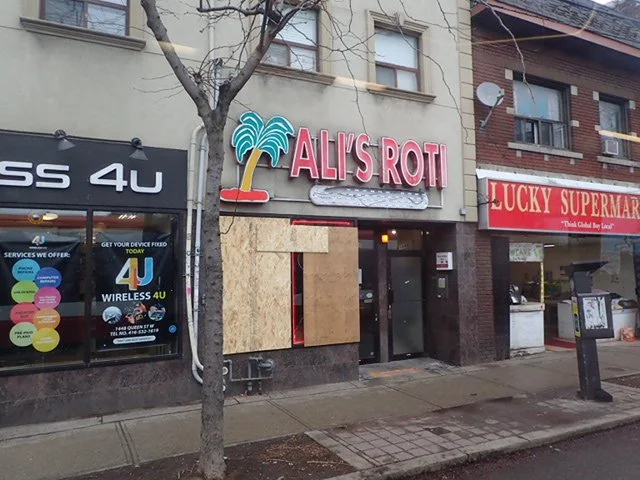
Queens Road West. A lot of broken windows.
In summer of 1875 the Kensington Road Tramway service was opened to carry gravel and building materials on horse drawn carriages by the TRC (Toronto Railway company). The extension went stepwise and was first containing two stretches: one from downtown to Woodbine and another connection along Queens Street to Muro Park. There were various phases marked by conflict between different stakeholders and in 1921 the Toronto Transport Commission (TTC) took over the responsibilities of TRC and operated a line similar to today’s 501 QUEEN. The line has a long history of unreliable service. Of course the longer a streetcar line gets, and with all uncertainties of an urban environment (e.g. parking on the tracks or any kind of technical failure), these problems get amplified to the ends of the line. So, there were attempts to split the line into smaller, overlapping units, and experimentation until 2019. In any case, if you ever get nostalgic about the 1970s, come to Toronto. And that’s not just the streetcars. I personally like it. It’s style. You can’t afford being in a hurry. Because it won’t work. So, where ever you get stranded: just go to the next Tim Hortens, get your Double Double and see what happens.

GPS Plot of 501 Queen. Pretty much a straight line.

Speed plot of 501 Queen, averaging 10.1 km/h.
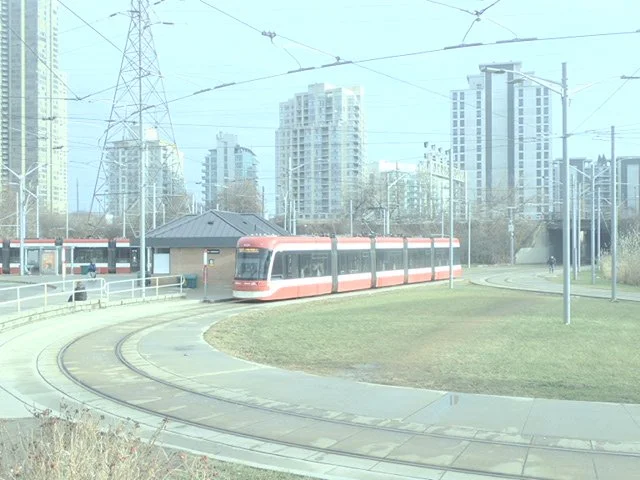
Humber Loop Terminal of 501 QUEEN. My Olympus Though camera had a problem with the lighting. I think it needs a software update. But like this, it looks vintage and is a good bridge to older photos below.


Toronto and Ottawa
Since returning to Toronto, I have experienced some highlights. For instance, we celebrated a birthday dinner at the 360 Degree Restaurant in the CN Tower. We were advised to go early to enjoy the view starting in daylight, and it was a fantastic recommendation. The most impressive sight was the view of Billy Bishop Airport from the top. This regional airport serves routes to Canadian destinations as well as cities like Boston and New York …
Since returning to Toronto, I have experienced some highlights. For instance, we celebrated a birthday dinner at the 360 Degree Restaurant in the CN Tower. We were advised to go early to enjoy the view starting in daylight, and it was a fantastic recommendation. The most impressive sight was the view of Billy Bishop Airport from the top. This regional airport serves routes to Canadian destinations as well as cities like Boston and New York. The main airline is Porter, and due to the relatively short runway, it primarily accommodates turboprop planes. From above, the airport looks like a toy, and watching the runway operations feels like observing an animation.
Another highlight was attending the “Art and Architecture” event at the Toronto Parliament Building. The building houses a sizeable collection, and it was fascinating to learn about how Ontario governs itself. While I didn't know many of the political figures, some were quite some characters. This impression was sustained during a trip to Ottawa, where, among other meetings, I attended the Thomas d’Aquino 2024 Lecture on Leadership presented by Ivey, and delivered by Steve Paikin. Thomas Paul d’Aquino -an entrepreneur, policy innovator, author, educator, philanthropist, art patron, and lover of early music, medieval and modern architecture, great gardens, fly fishing, and world history - provided an the context to the challenges Canada faces today. Steve Paikin, known as an anchor at TV Ontario, drew on his extensive knowledge from interviewing world leaders as a journalist and author. It was a truly interesting event at the Canadian National Gallery.
I traveled to Ottawa by VIA Rail. Train travel in Canada feels like the 1980s in Germany, though the trains are higher and have more clearance - I guess to have the ability to plough through high snow. You nedd to reserve a seat and check in 15 minutes before departure, with stewards assisting at every door. Large luggage needs to be booked and checked in separately. Train travel in Canada is slow and a little backward. But for a train enthusiast like me, it's cool. In many ways, "cool and backward" describes various aspects of Canada. I recall Mr. d’Aquino's quote, “Canada is not broken, but dangerously complacent,” which I wholeheartedly agree with.

Via the North Pole to Hong Kong
Luckily Chinese Airlines continue flying over Russia, and so I was able to take the short cut from Toronto over the North Pole to Hong Kong. It is interesting watching the flight map, diving into Asia from that perspective. Still the 12 hour time difference, made me a little trouble this time. Then I also caught a fever and still had to flag pole over Macao due to a delayed visa process ...
Luckily Chinese Airlines continue flying over Russia, and so I was able to take the short cut from Toronto over the North Pole to Hong Kong. It is interesting watching the flight map, diving into Asia from that perspective. Still the 12 hour time difference, made me a little trouble this time. Then I also caught a fever and still had to flag pole over Macao due to a delayed visa process. So, everything became very tightly scheduled and there was only very little time for anything extra. I did not even go over to Lamma Island: no hike, no seafood, no nothing really. I apologize to all the friends I did not see this time.
Hong Kong is slowly digging itself out of the Covid-recession. It’s not easy. It helps to be closer connected to Shenzhen and the Pearl River Delta. But you can feel, the city is in a bit of an identity crisis. But at least it’s peaceful, unlike it was in 2029. That’s partly a result of the National Security Law implemented, and also because economic pressures start biting. There were celebrations for the 75th anniversary of the foundation of the People’s Republic of China. And as usual, an amazing fireworks lit up the skyline. 75 years. That’s a lifetime, and a period of tremendous development in China - including ups and downs.
Just after finishing my course at Hong Kong University, I drove to the airport and travelled to Turkey. This time over India with a little detour. I like Turkey a lot, and I can only imagine that it must have a great economic future. There is no real reason why for example many German companies should not move production capacities into Turkey. The country has a young, well trained and motivated workforce. There are some unwise economic policies, I think. But that should not be hard to fix.
Finally, my trip also brought me to Germany, in a plane from Antalya full with German tourists. Luckily it was just a 3 hour flight, and manageable. But when landing in Germany, still with this preparation, it came to me like a shock how agressive the environment has become. Germans lives in the frustration of the second year of self inflicted recession, and meaningless government slogans like “Doppelwums”, “Wachstumsturbo”, “Bauturbo”, “Zeitenwende” … The socialist past socialist GDR-Slogans at least were not baby speak, and you could understand the words, if not the intended meaning. The effect though is the same: nobody listens anymore. Instead they start blaming random groups for their misery. Sometimes they even blame me. Today I parked my Vespa motorcycle (orderly) in front of a shop to get some food and somebody just kicked it over to the ground, while yelling something about immigrants. Luckily, actually an immigrant, helped me to put it back on its wheels, so I could continue my ride. Let’s see how this stopover in Germany is going to continue.

Re-surfacing on the other side of the Atlantic
After some time packed with logistics in Europe, I am resurfacing in Toronto. Nothing against Europe. I really cherish the cultural richness and complexity, from the Mediterranean to Scandinavia and Eastern Europe. But no place there is as relaxed and friendly as Canada. It appears to be hard wired, somehow. Recently, I was downtown Toronto, waiting for the streetcar (tramway) at Church station …
After some time packed with logistics in Europe, I am resurfacing in Toronto. Nothing against Europe. I really cherish the cultural richness and complexity, from the Mediterranean to Scandinavia and Eastern Europe. But no place there is as relaxed and friendly as Canada. It appears to be hard wired, somehow. Recently, I was downtown Toronto, waiting for the streetcar (tramway) at Church station. It is a bit of a problem area with drug addicts loitering in the streets and a Salvation Army post near by. So, after some time of waiting, a man, clearly under the heavy influence of narcotics approached me. I was bracing for trouble. But this fellow, who could barely walk and was literally falling to pieces, made it over the street just to tell me: “Excuse me sir, you are at the wrong stop. There is a construction site over there and you need to wait over there”. Then he turned around, tumbled a few times on the way back over until he sat down on a bench and fell into “coma”. This incident reminded me of early research of brain structure where subjects with certain brain injuries were examined and then seen what capabilities remained. This poor fellow, was completely smashed, but he remained super friendly and polite. My conclusion is, that Canadians are friendly down to the reptile parts of the brain, and they remain friendly no matter what. It’s like the opposite of a German.
After technically settling in Canada, now the time has come to explore it more. Toronto has a few good museums, an opera house and a number of small theatres. I am of course very interested in finding out more about the indigenous people of Canada. Access to that is not that easy, especially because the discourse appears to be sensitive. Two things are always important for me, when I come to a new place: the public library and the post office. Toronto has an amazing public library. Not just the physical collection, but also the digital resources and the events and courses they offer. The central post office, I still need to see. But the postal service appears reliable, and supports my habit of sending postcards.
It’s also time to get some intellectual stimulus besides work. So, I am very happy to start teaching in the evenings at the Toronto Metropolitan University. I will expand on this also in other Universities in Canada, but also in the US.
The days already turn chilly now and I can’t believe, I have not explored the Canadian forests yet. I do hang out with my dog at the Northern shore of Lake Ontario, which is beautiful. By the way, even the dogs are more friendly here. One or two small incidents, but for having a male dog, who is “in tact” as they call it here, I was expecting more tension among piers. But no. All good.

Boston revisited
The Charles River (Quinobequin) separates Boston from Cambridge Massachusetts and, given the number and quality of Universities on its banks, is dubbed “the most educated river”. There are Harvard, MIT, Boston University and many more. I have been to Boston before to visit the office of my former employer, The Boston Consulting Group (BCG) …
The Charles River (Quinobequin) separates Boston from Cambridge Massachusetts and, given the number and quality of Universities on its banks, is dubbed “the most educated river”. There are Harvard, MIT, Boston University and many more. I have been to Boston before to visit the office of my former employer, The Boston Consulting Group (BCG). But they have now moved to a very modern and spacious location at the southern bank of the redeveloped harbor, just across Logan International Airport. Boston as a major trading port, became the center of the American Revolution, and subsequently the independence war. This was triggered by the English heavily taxing many goods imported to their colonies without offering political representation. The “Tea Party” were not just crazy people throwing tea into the port.
Today Boston is a very friendly, walkable and clean city. Unlike in other US and Canadian cities you rarely see drug addicts in the streets. The Boston mayor, Michelle Wu (吳弭), recently added policies to make it easier for law enforcement to remove tents and at the same time expanded the number of shelters in critical areas. She also pushed the Boston Green New Deal, proposed free public transport (there is not much public transport though) and other progressive policies. There seem to be no big public budget worries, or perhaps since the “great dig”, a major move to put infrastructure under ground from 1991 to 2007 (!), which overshot the budget by factor 10, the Bostonians maybe used to it. In any case, Boston is a very livable city today and among other initiatives this is also a result of the “great dig”.
There are great museums, libraries and galleries, which in itself justify to return to Boston soon. What I really enjoyed was a musical performance in the Boston Citizen Opera. An amazing building, which was originally a movie theatre and converted under Sarah Caldwell to an opera house and acquired by the Opera Company of Boston. However, it did not achieve financial viability. It was renovated and reopened in 2004 under new leadership with the Broadway production of The Lion King, and it is kept busy with concerts and pop concerts. We saw the musical “Come from Away”, which was great. It is based on the story of Gander, a small city in Newfoundland, which gave shelter to 7000 stranded passengers in the days after September 11 in 2001 when US airspace was closed in response to the terrorist attacks. It is a very American story, and nobody can help remembering these terrible days. But the musical does not leave its audience dwell on that for too long and quickly switches to individual stories and of course to the great people of Gander coming together to help. The theatre was cracking full, standing ovations, and people had a great evening. I can well imagine though, what the German purists would say to musical in an opera house. But Germany is a social angina pectoris anyways. And it’s why German theatres are more of a highly subsidized mortuary, instead of reaching all generations.
We had the very kind opportunity to stay as a guest in the The Country Club in Brookline, Massachusetts. It was founded as the Philadelphia Cricket Club in 1854 as the first country club for any sports. Today it is mostly about golf, and even I don’t play that, it is a marvelous place. Honestly, in a world where it becomes more and more acceptable to have loose manners, such a club feels like a beacon of civilisation. But I can actually expand this to the whole of the Boston area. Sure, some say, this is a bubble with Harvard, MIT and all the rest of it. It does not represent the USA. That’s right. But people are luckily free these days to choose the environment they want to live in, and contribute to improve it. And Boston I find a great place to exactly do that.

Toronto’s Palace of Purification
Toronto offers once a year the opportunity to enter a large number of sites and buildings in Doors Open Toronto. This time it was the weekend of May 25th-26th. The sheer number of buildings listed is overwhelming. But there was one I had in focus, because I caught myself already a few times pressing my nose to the windows …
Toronto offers once a year the opportunity to enter a large number of sites and buildings in Doors Open Toronto. This time it was the weekend of May 25th-26th. The sheer number of buildings listed is overwhelming. But there was one I had in focus, because I caught myself already a few times pressing my nose to the windows of the R.C. Harris Water Treatment Plant at the end of our beach at Lake Ontario. It is a wonderful complex consisting mainly of two buildings: the pumping station and the filter building. Its grand 1930s architecture and Art Deco elements, made people dub it “The Palace of Purification”. There are three recommended readings which are John Bentley Mays (1992): A Masterwork of Art Deco and in the Market gallery of the City of Toronto Archives (1982), The Architecture of Public Works: R.C. Harris, Comissioner, 1912-1945. I could not find them online. But that’s just one more reason to also explore the Central Library of Toronto soon. Toronto’s 3 million people have an annual drinking water demand of 400 billion liters, and the R.C. Harris plant provides about 1/3 of it. Tap water is actually chlorinated in Toronto, which made me buy a domestic water filter to run it through first. But I can imagine, that given the over 6000 km of piping in town, chlorination is necessary to keep it safe until reaching the last corner.

The Bay of Broken Promises
On December 2nd and 3rd 1989 Michael Gorbatchev and George H.W. Bush met on the Soviet ship TS Maksim Gorkiy south of Malta, mooring in the Bay of Marsaxlokk. The sea was choppy, which brought the meeting the name “Seasickness Summit”. It is often described as one of the most important summits since the Yalta Conference in 1945, …
On December 2nd and 3rd 1989 Michael Gorbatchev and George H.W. Bush met on the Soviet ship TS Maksim Gorkiy South of Malta, mooring in the Bay of Marsaxlokk. The sea was choppy, which brought the meeting the name “Seasickness Summit”. It is often described as one of the most important summits since the Yalta Conference in 1945, as it marked the end of the Cold War, just about a month after the fall of the Berlin Wall. There was no treaty signed, but a core message by Gorbatchev was: “[…] The world is leaving one epoch and entering another. We are at the beginning of a long road to a lasting, peaceful era. The threat of force, mistrust, psychological and ideological struggle should all be things of the past […]”. Bush’s response was: “[…] We can realize a lasting peace and transform the East-West relationship to one of enduring co-operation. That is the future that Chairman Gorbachev and I began right here in Malta.”
The rest of the story we all know, with different interpretations. The TS Maksim Gorkiy had a dramatic story in the same year, when it hit ice near Norway and began sinking quickly. The Norwegian ship Senja took on 700 people from the ship and managed to stop it from further sinking. More were rescued by helicopter from life boats and ice. Perhaps that was a bad omen for the Malta Summit. Or a good one, given that the ship was rescued, repaired and put back to service. History will tell.
Marsaxlokk Bay, or also Kalafrana Bay in Birżebbuġa, is framed by the power plant with its LPG tanker to the East and the Freeport to the West. But it is still a very pretty area with its turquoise waters and the traditional fishing boats. It was also a set for the award winning Maltese movie Simshar (trailer also below). There is a fish market on Sundays which became a tourist attraction. What I enjoy is a hike along the Maltese West coast, along the cliffs and then going to the place where you get the world’s best Octopus in Garlic. It’s a family business. I am not an “Influenza” and don’t make promotions of my favorite places. But if you write to me in the contact section, and describe why you think you qualify to go there, I may tell you.
I have walked to this bay many times, and always like it as a day’s outing. This time I saw it though a little different, perhaps being overwhelmed by recent events which’s historical trail also crossed this little bay, back in 1989.


"Feldpost" from de-industrializing Germany
Last week, I had the chance to present the industrial and economic facets of Germany to MBA students from The University of Hong Kong. Our journey began in Berlin, then proceeded to Wolfsburg, Dortmund, Duisburg, Hannover, and concluded back in Berlin. I extend my heartfelt gratitude to our hosts …
Last week, I had the chance to present the industrial and economic facets of Germany to MBA students from The University of Hong Kong. Our journey began in Berlin, then proceeded to Wolfsburg, Dortmund, Duisburg, Hannover, and concluded back in Berlin. I extend my heartfelt gratitude to our hosts for their generous insights: Volkswagen AG, TU Dortmund, the City of Duisburg, Future Car Lab, Neoxphere Technology, and Bundesverband Musikindustrie (Federal Association of the Music Industry). This broad array of industries and subjects was enhanced by cultural excursions to Potsdam's Sanssouci, the former Sachsenhausen Concentration Camp in Oranienburg, and several sites that depict the process and impact of Germany's reunification.
This trip occurred against the backdrop of Germany's struggling economy. Since the Greens and Socialists were ushered into power with the support of a small liberal party in December 2021, the nation has grappled with erratic and ideological policies. These are often portrayed to the populace as investments in future competitiveness or as efforts to catch up with the previous government's developmental shortcomings. From being Europe's economic powerhouse, Germany has become the OECD's underperformer in just a few years. To counter the demographic trend of an aging population and a shortage of skilled labor, Germany has opened its doors to immigration. Yet, skilled individuals often opt for regions with lower taxes and simpler bureaucracy, finding better opportunities elsewhere. Nevertheless, immigration remains high, consisting of refugees and migrants, many of whom face challenges integrating into the labor market.
Still there are many things to learn in Germany. Many capabilities have not vanished immediately, but are just getting unfeasible in the country. Also, assets of privately owned SMEs are getting cheap to acquire. And of course, Germany is a lesson on a new kind of political risk, where technocratic political leadership is succeeded by a new class of politicians which are genuinely ideologic, but does not even have the skills, education and character to follow through their own agenda.

Settling down in my New World
Life is easy in Canada. Sure, moving to a new place across an ocean has it’s challenges. But Toronto is a good place to settle. It’s a vast land, and there is not much infrastructure. So one of the next tasks will be to find a good 4x4. But the main challenge lies not in Canada, but still back in Europe. There is a boat to store and potentially transport over to the new world …
Life is easy in Canada. Sure, moving to a new place across an ocean has challenges. But Toronto is a good place to settle in. It’s a vast land, and there is not much infrastructure. So, one of the next tasks will be to find a good 4x4. But the main challenge lies not in Canada but still back in Europe. There is a boat to store and potentially transport over to the new world. There is a “Dacha” to finish and a home to dissolve. It is funny that the main administrative challenges are not to settle in Canada, but to leave Germany.
Where I live, East of Toronto (pronounce “Tronno”) people are very friendly. That’s the reputation of Canadians and it really is true. But who is Canadian, really? It’s such a mélange, and it feels just natural to be an immigrant and much as it is to be born in Canada or being the descendant of those living here for many centuries. I consider it a great privilege to have the opportunity to spend a part of my life in this country - a little unprepared, but this is how it always was.
I always say, that if you want to know how friendly people really are, then look at their dogs. They are such a good mirror of society. Dogs here are a playful, peaceful, but of the tough type. When I watch my 28 kg Australian Shepherd, playing in the morning on the beach of Lake Ontario with a 90 kg sled dog that looks like just coming from Iditarod, I sometimes hold my breath. But, except a few scratches, it always goes well.
I listen to the French Radio on 90.30 MHz (FM) and I love it. It is a different kind of French. It’s not what you would call sophisticated, but it’s super cool. But who am I to judge French accents? I also will brush up my Chinese. Like in many former British Colonies, it’s not easy to get quality food supplies. So, I stroll to Chinatown for shopping, and it’s wonderful.
But I am not in Canada, to dwell in a city. It’s a frontier country. It is a country rich of beauty, minerals, natural gas, coal, even gold. It’s time to make plans how to explore all this.

Index of Economic Freedom
It’s finally getting chilly in Toronto, and I decided to get shoes for my dog. Not so much because of the cold but more because of the defrosting agents on the paths. This morning, while walking along the Northern side of Lake Ontario, I heard some comments on the Index of Economic Freedom provided annually by the Heritage Foundation (click here) …
It’s finally getting chilly in Toronto, and I decided to get shoes for my dog. Not so much because of the cold but more because of the defrosting agents on the paths. This morning, while walking along the Northern side of Lake Ontario, I heard some comments on the Index of Economic Freedom provided annually by the Heritage Foundation (click here). Like all rankings, you may be critical about the factors and methodology used. Also, of course, economic freedom in itself is not personal freedom. But it “kinda rhymes”. And then there are a lot of details to account for, like which part of the economy and what businesses are affected. You may be very free because your competitors are regulated, for example. Still, the trend shows that the world is getting less free. The top three countries are now Singapore (1), Switzerland (2), Ireland (3) and the region Taiwan (4). I can support this from my own experience in Singapore and Switzerland. It was one of the reasons why Swissforecast has been set up in Switzerland. Then follows New Zealand (5), Estonia (6), Luxembourg (7), and the Netherlands (8), all of which I conducted business myself in the latter three and found the environment and business culture very pleasant. Some people say EU countries tend to be dragged down by Bruxelles’ bureaucracy. It is a pity that the European Union, which started as such a great vision, is now merely perceived as a bureaucratic and undemocratic moloch. But it also has, of course, substantial cross-border advantages inside the union. That’s, I guess, what my British friends are feeling now.
In any case, if you can operate well in a less free environment, then you may turn this into a competitive advantage. For example, that’s what I think about doing business in China (154). I have seen so many successful entrepreneurs and companies in China that the complaints may come predominantly from the game’s losers.
On the other hand, Germany (14) is ranked predominantly free but has been turned latest since 2021 economically and socially into a nightmare. I regard countries. with a personal income tax above 15 % as communism. And then life depends on how much a government can deliver services and infrastructure. In the case of Germany, tax money is not employed so much to serve its citizens but to make them troubled by overburdened bureaucracy. The most significant budget is a redistribution into a social system, which gives opportunity for misuse. The opposition leader was once scolded for using the term “social tourism”, but it is obvious that there is a lot of abuse really happening. Germany is a fallen superstar like the whole country would be Franz Beckenbauer.
Now, I am in Canada (16) and looking over Lake Ontario to the USA (25). I was surprised to see Canada ranking higher than the US. For example, I thought the relatively high prices of mobile phone services may result from entry barriers into Canada. But I am just starting my North American journey, and up to now, I would not say I am really knowledgeable.