"Feldpost" from de-industrializing Germany
Last week, I had the chance to present the industrial and economic facets of Germany to MBA students from The University of Hong Kong. Our journey began in Berlin, then proceeded to Wolfsburg, Dortmund, Duisburg, Hannover, and concluded back in Berlin. I extend my heartfelt gratitude to our hosts …
Last week, I had the chance to present the industrial and economic facets of Germany to MBA students from The University of Hong Kong. Our journey began in Berlin, then proceeded to Wolfsburg, Dortmund, Duisburg, Hannover, and concluded back in Berlin. I extend my heartfelt gratitude to our hosts for their generous insights: Volkswagen AG, TU Dortmund, the City of Duisburg, Future Car Lab, Neoxphere Technology, and Bundesverband Musikindustrie (Federal Association of the Music Industry). This broad array of industries and subjects was enhanced by cultural excursions to Potsdam's Sanssouci, the former Sachsenhausen Concentration Camp in Oranienburg, and several sites that depict the process and impact of Germany's reunification.
This trip occurred against the backdrop of Germany's struggling economy. Since the Greens and Socialists were ushered into power with the support of a small liberal party in December 2021, the nation has grappled with erratic and ideological policies. These are often portrayed to the populace as investments in future competitiveness or as efforts to catch up with the previous government's developmental shortcomings. From being Europe's economic powerhouse, Germany has become the OECD's underperformer in just a few years. To counter the demographic trend of an aging population and a shortage of skilled labor, Germany has opened its doors to immigration. Yet, skilled individuals often opt for regions with lower taxes and simpler bureaucracy, finding better opportunities elsewhere. Nevertheless, immigration remains high, consisting of refugees and migrants, many of whom face challenges integrating into the labor market.
Still there are many things to learn in Germany. Many capabilities have not vanished immediately, but are just getting unfeasible in the country. Also, assets of privately owned SMEs are getting cheap to acquire. And of course, Germany is a lesson on a new kind of political risk, where technocratic political leadership is succeeded by a new class of politicians which are genuinely ideologic, but does not even have the skills, education and character to follow through their own agenda.

Birthday South of Greenland
I started my birthday on an Air Canada flight, up in the air over the Atlantic, South of Greenland. In the afternoon, I drove to visit my parents in Westerwald and crossed farmers’ protests on the way. This was one of the most friendly and well-organized protests I have ever seen, …
I started my birthday on an Air Canada flight, up in the air over the Atlantic, South of Greenland. In the afternoon, I drove to visit my parents in Westerwald and crossed farmers’ protests on the way. This was one of the most friendly and well-organized protests I have ever seen, with strong support from the public. For the police, this was a pure traffic management job. No riot gear, no water canons, no teargas. Instead, the protesting farmers arranged, together with the police, emergency lanes in case something would be needed for rescue services. People still have in their minds the recent protest in Berlin, where an ambulance was blocked by climate activists glueing themselves on the roads, where rescue services could not reach an unrelated accident site, and subsequently, a woman died. Members of the current German government have preemptively discredited the farmer’s protests unfairly. Discontent with this government is extreme, and all hope is the call for a vote of no confidence and opening up the path for new elections. The question just is how the political landscape changed and what reasonable and competent coalitions could emerge. At the moment, it feels like it can’t get worse. But who knows?
This morning I had an early start driving to Tilburg. Train staff started striking today, so I was taking the car and passed through commuting hotspots before the rush hour. Still, the drive was slow because of the many construction sites until I reached the Dutch border. Infrastructure in Germany is a complete mess. I had lunch on the University campus and will start teaching a strategy course at TIAS tomorrow. This is a very nice business school co-owned by Tilburg and Eindhoven Universities. It will be long days with 12 hours of “stage time” per day. But I am looking forward to it. It’s an MBA programme, but unlike some other programmes, these students are special as they are already very experienced. So, it’s more like Executive Education, which is what I like doing.

Luxury revisited
I have been recently volunteering at the Academy of Fashion and Design (AMD). Neither fashion nor design is my field, but I filled some gaps in necessary management disciplines. To my surprise, a student of fashion management, Ms Mia Just, chose me as a second reader for her thesis on the ambiguity between creativity and commerce in fashion …
I have been recently volunteering at the Academy of Fashion and Design (AMD). Neither fashion nor design is my field, but I filled some gaps in necessary management disciplines. To my surprise, a student of fashion management, Ms Mia Just, chose me as a second reader for her thesis on the ambiguity between creativity and commerce in fashion. It led me back to many of the thoughts I had when looking closer at the contemporary art space, but it also brought me back to the time the Volkswagen Group bought Rolls-Royce - Bentley. We were the “Beetle-people” now owning the holy grail of luxury cars and thinking of what to do with them. To prepare myself for reading the thesis, I also revisited my notes on the exhibition “What is Luxury?” at the Victoria and Albert Museum in 2015. And I took two books out from the shelf again: Soetsu Yanagi’s The Beauty of Everyday Things and Junichiro Tanizaki’s In Praise of Shadows.
With all the definitions of Luxury given, I found that I have my own one, which is about the people’s view on the object. I don’t mean that luxury is in the eyes of the beholder and that everything can be luxury—quite the opposite. Luxury products are defined for me by the “connaisseur”, meaning the one who knows what he looks at and recognises its qualities in material, design, craftsmanship or symbolic value. This is why, for example, Porsche is not a luxury car anymore, because it’s a Volkswagen. This is why many luxury fashion brands are not luxury, as most buyers have no clue what they look at and only see the logo. Recently, a colleague of mine told me that she lost a diamond bracelet in a Sauna in the Netherlands, but that “these people”, for sure, can not distinguish diamonds from glass.
Contemporary luxury branding, I find, often has more of the task of explaining to ignorant people that the thing they look at may be something special. In the better cases, it really is. In many, it isn’t. I was recently looking at “luxury apartments” in Toronto. What’s “luxury” about a concrete frame building with triple glazing and an expensive toilet?
That also changes what a status symbol is. Many years ago, as a young manager at Volkswagen in the German headquarters, I had a new boss for a short period of time. He was a European Business School (EPS) graduate who gained significant corporate experience in the US before returning to Germany to run the group’s strategic marketing unit. Joining a meeting once, he educated me that the first thing he looks at in a person is the watch, then the shoes, then the suit (it wasn’t the same sequence for women, by the way). Then he knows what person he has in front of him! I looked at his pocket calculator on the meeting table, which did not even have trigonometric functions. So, I knew what kind of person I had in front of me! I picked up the calculator and looked at it, then at him, then at the calculator, put it in front of him and asked: “Yours?” This meeting did not end up being very productive.
Fortunately, we live in a world where money is only one of a number of factors defining status. So, also, the symbols change.
If luxury products and the connoisseur come together, then my understanding of luxury has a strategic disadvantage. With education levels plummeting in the Western world and people interacting less and less intensely with things, the degree of understanding and appreciation also will disappear. Who can pull an old Ferrari into a barn and restore it step by step with a glass of wine and classical music as evening entertainment? Who can even repair his home appliances without “service”? So, if nobody is willing to interact with things, then also nobody will know the quirks, and nobody will appreciate their qualities and beauty. And it maybe even the same dealing not with things, but with people.

TIAS and on to Zürich
Last week was the first time I taught my Strategy Course at TIAS (Tilburg Institute of Advanced Studies) in the EMBA Programme. And I really enjoyed it. Great participants from all kinds of industries and walks of life, which reflect the structure of the Dutch industry landscape …
Last week was the first time I taught my Strategy Course at TIAS (Tilburg Institute of Advanced Studies) in the EMBA Programme. And I really enjoyed it. Great participants from all kinds of industries and walks of life, which reflect the structure of the Dutch industry landscape. TIAS developed into a highly regarded business school, which Tilburg University and Eindhoven University own. Teaching this course gave me a really good insight into the current challenges of Dutch companies, which are different from what we experience in Germany. For the future, I will also restructure my course a bit to reflect these differences.
After driving back from Tilburg, with a quick stopover in Germany, I flew from Frankfurt to Zürich to work the next week. Normally, I would have taken the train for such a small distance. But the German railway is currently in such a desolate condition that I took the plane. The flight time was just 35 minutes. With the German Railway, such a trip is completely unpredictable and can take you a whole day, if you arrive at all.
Arriving in Zürich is nice: friendly, quiet, efficient, clean and safe. Switzerland appears to be everything Germany is not anymore. So, I am looking forward to start my week here.
Impressed by EMBA Global Asia

Yesterday night I was invited to to the Hong Kong Four Seasons Hotel, and talk on the future of the Chinese Auto Industry. This was for the information session of EMBA Global Asia. It is a joined Executive MBA Programme of London Business School, Columbia Business School, and The University of Hong Kong School of Business. Back in 2008, when I was the Programme's Dean in Hong Kong, I already believed that we are creating something exceptional in Business Education: truly global, academically rigorous and a life changing experience far beyond the classroom. And when I met yesterday some of the alumni and prospect students, I was literally blown away. Under the restless effort of many people after my time involved, this has developed into one of the world's strongest Executive MBA-Progammes. It will be interesting where it will be in the rankings, once the time has come. The mother programme, EMBA Global, which is run unitedly by London Business School and Columbia University Business School, has been ranking world's number one in the Financial Times, just when EMBA Global Asia was launched. At that time, we always comforted ourselves that the ranking of the Asia stream will be still years ahead. But soon this time has come. And I am very confident, that the quality will be recognized also in the rankings.
Back to the classroom
Teaching my MBA Elective at HKU is great fun. It is a very nice class of smart and engaged students. Even the course covers the whole Saturday and is quite intense, a critical mass stays switched on all day. Given that some of them have a full time job aside, I really respect this level of energy. The Friday before, we had an excellent dinner with Maurice Tse, Sachin Tipnis and Josephine Chan. Under the leadership Dean Eric Chan, their team has built up the MBA Programme of the University of Hong Kong to the level that it was recently ranked Best Programme in Asia by The Economist. Given the intense competition in the region, this is really an outstanding achievement. I know this from my own previous experience with launching the EMBA Global Asia here in Hong Kong University. It is tough. So congratulations. Even rankings are not the only thing to look at, they do reflect the quality of delivery and design of educational programs, and last but not least the standard of students. And this time they are really good. Nice to be back to the classroom.

Getting ready for the next lecture on Sunday
Commencement
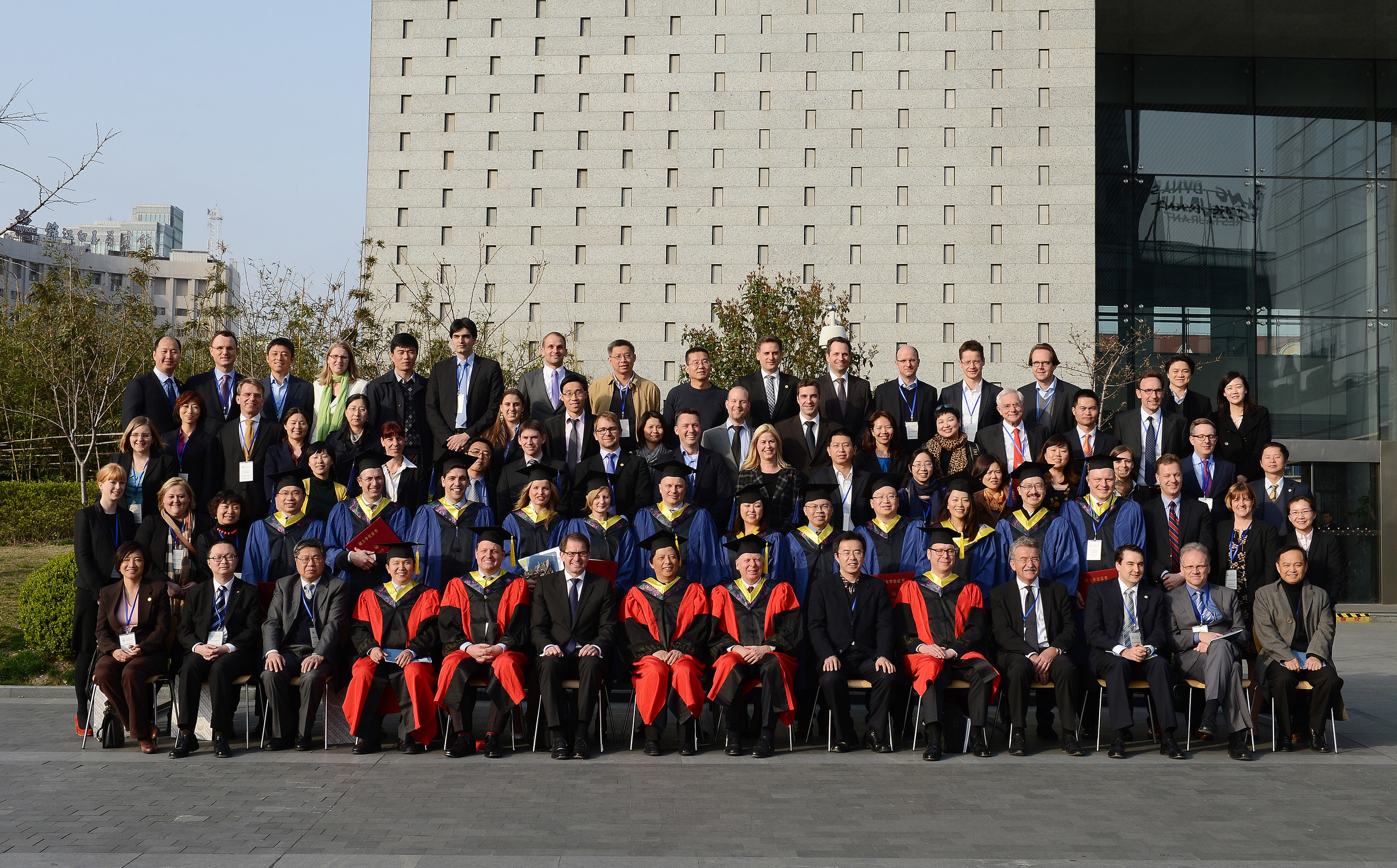
Yesterday was their day. The first 14 students of the Tongji-Mannheim EMBA graduated, and proudly received their degrees handed over by the Ambassador of the Federal Republic of Germany and high ranking faculty of Tongi and Mannheim University. Now our young programme has the first alumni. And this core is going to grow quickly. I have been with this programme from its moment of birth until the first Commencement now and it became an initiative close to my heart, but empowered by the brain. We are getting quite some recognition now, not just on a University level, but also by major corporations. As a very unique alternative to "American Style" EMBAs we have even been covered on a channel of the Chinese Central Television yesterday. It is a diverse and academically rigorous English taught programme made and delivered in Germany and China. It was often described yesterday as a bridge connecting the two economic epicenters in Asia and Europe. But it is of course not about Nations, but about minds and people coming together. My congratulations to the graduates, all the best to the current students, welcome to the newly enrolled participants and thanks to all those who made this happen and support it. I am personally looking forward to contribute on the academic and management side, as much as my schedule allows it. Our "alumni management system", might be simple so far, but it is effective: for example you can just give me a call.