When I look at the geography of traditional industries, which are based on agricultural commodities, I always remember the model of Johann Heinrich von Thünen, a land owner an economist, who developed a theory in which agricultural intensity generally decreases with distance to the market. This is the Thünen Ring Modell from 1842. Another phenomena it describes, is that with increasing logistic cost, the value ad of the products produced increases. This means for example, that while you produce wool in proximity to a market, you need to knit socks when you are remote. Or while you produce milk and perishable goods close to the market, you need to make cheese in remote, first for preservation, but also to make it a feasible product. Some even say this is maybe the origin of the high value industries in Switzerland. And I was reminded of it when a former student of mine, Sebastian Lindstrom, started promoting the production of camel milk cheese in Somalia. Following this logic, and given the geographic location of the Maltese Islands, it immediately made sense to me, when I heard about the historic attempt to build up silk production in Malta.
The idea was put into action by Sir Moses Montefiore. A British-Jewish banker of immense wealth and influence, Montefiore was a man of his time – a Victorian visionary who believed in progress, industry, and the power of capital to transform societies. In 1826, through his “British, Irish and Colonial Silk Company,” he set his sights on Malta. The plan was audacious: to turn the sun-baked island into a producer of silk, that most luxurious of commodities.
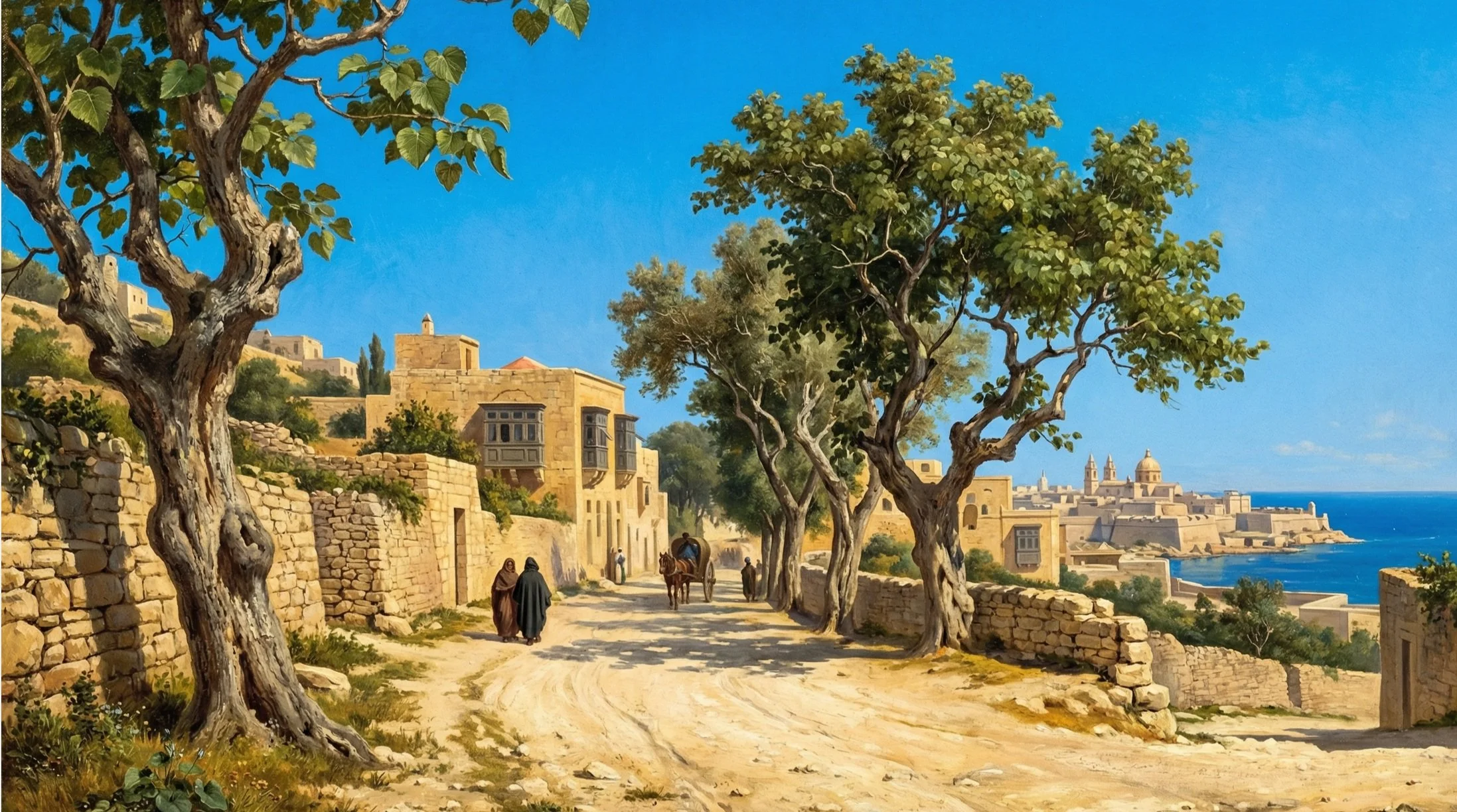
The logic seemed sound, at least on paper. Malta’s climate, it was believed, would be even more favorable than Italy’s for the cultivation of mulberry trees, the sole food of the silkworm. The venture was launched with characteristic Victorian confidence. An incredible 110,000 mulberry saplings were imported, and over 62,000 were planted, many of them along this very stretch of road in Żejtun. By 1830, the company employed nearly 300 local silk reelers. For a brief moment, it must have seemed like the future was shimmering, spun from delicate thread.
But the dream unravelled as quickly as it had been conceived. The project was a catastrophic failure. The reasons, in retrospect, are painfully obvious. The company’s managers, for all their financial acumen, lacked the deep, specific knowledge of sericulture. More fundamentally, they had misread the land itself. Malta’s soil is notoriously shallow, and the young mulberry trees, though they grew, could not provide the lush, abundant foliage required to sustain a viable silkworm population. The entire enterprise collapsed, leaving behind a legacy of debt and disappointment. The colonial government was left with an unpaid rent bill of over 15,000 pounds, a long line of useless trees.
And so, the road remains. Triq iċ-Ċawsli. A name that has outlived the industry it was meant to serve. Driving along it today, you can see the irony. The road was recently reconstructed, a multi-million Euro project to accommodate the relentless demands of modern traffic. In the process, some of the original, now-sickly mulberry trees were felled. They were replaced, of course, with new saplings, a gesture towards preserving the historical character of the place. But it feels like an echo of the original folly – planting trees in a place that has already proven it cannot sustain them.