
Toronto - a farewell visit. For now!
The flight out of Germany started in Frankfurt. This is a major airport, and like many of this category it is not designed for travel, but for transport. Everything is cargo here, including the people. There is no romance left in this operation, no sense that you are embarking on anything. You are being processed. And yet, against all statistical probability, I made it onto the plane out of Germany on time. This, I assure you, is an exception of historic proportions for German transport. Just a few days prior, …
The flight out of Germany started in Frankfurt. This is a major airport, and like many of this category it is not designed for travel, but for transport. Everything is cargo here, including the people. There is no romance left in this operation, no sense that you are embarking on anything. You are being processed. And yet, against all statistical probability, I made it onto the plane out of Germany on time. This, I assure you, is an exception of historic proportions for German transport. Just a few days prior, I took a train in this country that accumulated six hours of delay as if time itself had given up on the Deutsche Bahn and wandered off to find a more punctual civilization. So when the wheels lifted off the runway at Frankfurt, I felt something relieved to have left it behind. Looking down at the grey patchwork below, I couldn't help but think: the Marshall Plan was such a spectacular waste of money. You could have rebuilt a few decent countries for that amount.
I landed at Toronto Pearson, and the contrast was immediate. The immigration process was efficient and genuinely friendly, even though I had to answer a few questions. I don't always get stopped at immigration, but when I do, the officers seem to enjoy the conversation. Perhaps it is the passport stamps, perhaps it is the stories behind them. Perhaps they are even a little jealous. Either way, we parted on good terms, as we always do. I spent a few days in Etobicoke, taking bus trips downtown into the beating heart of Toronto. It felt unreal to be back, like walking through a dream you once had but never quite finished. The city was familiar and foreign at the same time. Seeing the CN Tower piercing the skyline, I always have to think of the 11th birthday of Lars up in the 360 revolving restaurant, the whole city rotating slowly beneath us like a giant clockwork model, looking down on the tiny propeller planes taxiing around Billy Bishop airport on the islands below.
One morning, I took the tram east to The Beaches, our old neighborhoods . One of the most beautiful places to live in Toronto, stretched along the shores of Lake Ontario like a postcard someone forgot to send. I had breakfast at the Beacher's Cafe, sitting where we had many Sunday family breakfasts and even more often Elena and Lars went to have pancakes and play chess. Afterwards, I walked down to the Leuty Lifeguard Station, and then through Kew Gardens, where the trees have grown taller and the benches have been repainted but the light still falls the same way it always did. I stopped by the dog park, and for a moment where Eddie back then made friends among local huskies.
From Etobicoke, I moved to Scarborough, on the other side of the Toronto suburban outskirts. Bonjour Tristesse. There is a particular melancholy to the sprawling concrete of the eastern suburbs, a kind of architectural resignation. But I was not there for the aesthetics. I had a mission: get a car to the shipping forwarder close to Pinkerton, move my personal items from storage on the way to Malta. The car - hail to Subaru - actually started after a long and brutal Canadian winter, once I reconnected the battery. It just woke up like a bear from winter hybernation. Then the storage unit. Everything packed, processed, sent. All of it now on its way to Malta by sea. I would love to return to Canada one day, but this specific chapter had to be closed. Canada is nice, and the people are genuinely friendly, but they can be a bit of snowflakes, easy to offend if you don't tread lightly around their ever-expanding catalogue of sensibilities. Still, I have a soft spot for this country.
For my final days in Toronto, I moved into Knox Residence on the University of Toronto's St. George campus. A nice place with a great location, right in the intellectual heart of the city. The Knox College building, erected in 1915 in Gothic Revival splendor, sits on King's College Circle like a stone sentinel guarding nearly two centuries of academic tradition. During the summer, the campus is mostly populated by East-Asian and Indian students, heads down, working, researching, studying with an intensity and discipline that commands respect. The Western cultures, it seems, are more characters suited for holiday parks these days, off somewhere "finding themselves" while others are busy building futures. I enjoyed being on campus and explored it in meticulous detail by foot. The University of Toronto, founded in 1827 by royal charter of King George IV as King's College, is a sprawling 138-acre tapestry of Romanesque stone, Victorian brick, and modern glass. University College, completed in 1859, still stands as a national historic site with its medieval turrets and carved gargoyles. Hart House, the great Gothic Revival student center, presides over its circle like a secular cathedral. This is where insulin was discovered, where the first cardiac pacemaker was built, where deep learning was developed—a campus that has produced five Canadian prime ministers and thirteen Nobel laureates, and still somehow manages to feel like a quiet park on a Sunday afternoon.
Today is Victoria Day, in honor of Queen Victoria's birthday, and the official start of the Canadian summer. The holiday mood is everywhere. But for me, it is time to get ready to return to Malta. There is a melancholy in leaving. I hope to return soon. But for now, Malta is calling. Toronto, especially the Beaches, are a bit like Lamma Island in the South China Sea for me. Sometimes, you have to leave these places. But they remember you.

Toronto Spring 2025
Arriving in Toronto at the beginning of the week, spring wasn’t that advanced. But also here the snow melted away within a week and I took the chance catching up with my favorite hangouts: the Norma Ridley Lounge at the Art Gallery of Ontario and the Toronto Reference Library. The Lounge is in The Grange, which was the first home of the gallery, in a Georgian manor. It also has also a small and cosy library. The reference library of Toronto though, …
Arriving in Toronto at the beginning of the week, spring wasn’t that advanced. But also here the snow melted away within a week and I took the chance catching up with my favorite hangouts: the Norma Ridley Lounge at the Art Gallery of Ontario and the Toronto Reference Library. The Lounge is in The Grange, which was the first home of the gallery, in a Georgian manor. It also has also a small and cosy library. The reference library of Toronto though, is modern by contrast, and has all a modern library needs. The whole network of public libraries in Toronto is quite outstanding. The collections, but also the buildings they are in.
By contrast to the previous winter, this one brought some snow. Quite enjoyable, but also time for spring now. In another 2 weeks time, I will be heading over the Atlantic again, stopping over in Reykjavik briefly and then continuing to Helsinki. When I am back to Toronto, spring will have caught up. There is still a lot of logistics ahead, with having sea shipments on the way from Germany to Malta. That’s also something coming next. If I continue like this, I don’t need even a wardrobe, because I can just leave things in the dry clean until I arrive back to the place. Managing this sounds like an idea for another useless App.

Our neighborhood this winter.

Digging out the driveway in our street at The Beaches.

A Streetcar named 501 QUEEN
Toronto’s Streetcar 501 QUEEN is the world’s longest streetcar line. It spans Toronto’s East and West by reaching from Neville Park Loop to Humber Loop, and taking the 24.8 km (15.4 miles) ride along Queen Street is a good way to get an impression of the city along this profile. Today I did it, starting from the East, passing through The Beaches first, which is the nice and lively residential area we live. From Leslieville …
Toronto’s Streetcar 501 QUEEN is the world’s longest streetcar line. It spans Toronto’s East and West by reaching from Neville Park Loop to Humber Loop, and taking the 24.8 km (15.4 miles) ride along Queen Street is a good way to get an impression of the city along this profile. Today I did it, starting from the East, passing through The Beaches first, which is the nice and lively residential area we live. From Leslieville to crossing the Don River (not the Russian) looking out of the window on a rainy day, always reminds me of the opening scene of the Jim Jarmusch Movie “Down by Law”, just in a Nordic Climate. Then approaching Church there is unfortunately a lot of drug abuse on display, and the travel companions change until the stop close to the Salvation Army. Further, there is a little detour due to construction, passing through the CBD and then some nice and busy shopping parts with an impact of Chinatown up to Spadina. The following Western lag, starts with a lot of broken windows and run down shops. About a month ago, there was a large fire fight between gangs here in a recording studio. Over 100 shots were fired, an unmarked police vehicle was hit, but nobody was hurt. I frequently mentioned that I perceive Canadians as very friendly. And I even extend this compliment now to the mafia, for the unexpected act of kindness having a major gun battle and hurting nobody. After leaving the area still attached and shaped by the city, comes a residential area again, High Park and then the final stretch to Humber Loop. Just before that the streetcar gets an extra track, separated from the car traffic and moves a little faster. The average speed of the ride was 10.1 km/h. That’s half the speed of a bicycle, but double the experience.

Queens Road West. A lot of broken windows.
In summer of 1875 the Kensington Road Tramway service was opened to carry gravel and building materials on horse drawn carriages by the TRC (Toronto Railway company). The extension went stepwise and was first containing two stretches: one from downtown to Woodbine and another connection along Queens Street to Muro Park. There were various phases marked by conflict between different stakeholders and in 1921 the Toronto Transport Commission (TTC) took over the responsibilities of TRC and operated a line similar to today’s 501 QUEEN. The line has a long history of unreliable service. Of course the longer a streetcar line gets, and with all uncertainties of an urban environment (e.g. parking on the tracks or any kind of technical failure), these problems get amplified to the ends of the line. So, there were attempts to split the line into smaller, overlapping units, and experimentation until 2019. In any case, if you ever get nostalgic about the 1970s, come to Toronto. And that’s not just the streetcars. I personally like it. It’s style. You can’t afford being in a hurry. Because it won’t work. So, where ever you get stranded: just go to the next Tim Hortens, get your Double Double and see what happens.

GPS Plot of 501 Queen. Pretty much a straight line.

Speed plot of 501 Queen, averaging 10.1 km/h.
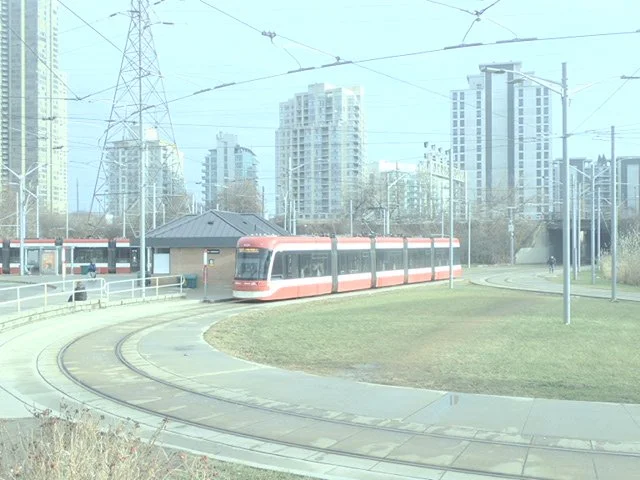
Humber Loop Terminal of 501 QUEEN. My Olympus Though camera had a problem with the lighting. I think it needs a software update. But like this, it looks vintage and is a good bridge to older photos below.


Toronto and Ottawa
Since returning to Toronto, I have experienced some highlights. For instance, we celebrated a birthday dinner at the 360 Degree Restaurant in the CN Tower. We were advised to go early to enjoy the view starting in daylight, and it was a fantastic recommendation. The most impressive sight was the view of Billy Bishop Airport from the top. This regional airport serves routes to Canadian destinations as well as cities like Boston and New York …
Since returning to Toronto, I have experienced some highlights. For instance, we celebrated a birthday dinner at the 360 Degree Restaurant in the CN Tower. We were advised to go early to enjoy the view starting in daylight, and it was a fantastic recommendation. The most impressive sight was the view of Billy Bishop Airport from the top. This regional airport serves routes to Canadian destinations as well as cities like Boston and New York. The main airline is Porter, and due to the relatively short runway, it primarily accommodates turboprop planes. From above, the airport looks like a toy, and watching the runway operations feels like observing an animation.
Another highlight was attending the “Art and Architecture” event at the Toronto Parliament Building. The building houses a sizeable collection, and it was fascinating to learn about how Ontario governs itself. While I didn't know many of the political figures, some were quite some characters. This impression was sustained during a trip to Ottawa, where, among other meetings, I attended the Thomas d’Aquino 2024 Lecture on Leadership presented by Ivey, and delivered by Steve Paikin. Thomas Paul d’Aquino -an entrepreneur, policy innovator, author, educator, philanthropist, art patron, and lover of early music, medieval and modern architecture, great gardens, fly fishing, and world history - provided an the context to the challenges Canada faces today. Steve Paikin, known as an anchor at TV Ontario, drew on his extensive knowledge from interviewing world leaders as a journalist and author. It was a truly interesting event at the Canadian National Gallery.
I traveled to Ottawa by VIA Rail. Train travel in Canada feels like the 1980s in Germany, though the trains are higher and have more clearance - I guess to have the ability to plough through high snow. You nedd to reserve a seat and check in 15 minutes before departure, with stewards assisting at every door. Large luggage needs to be booked and checked in separately. Train travel in Canada is slow and a little backward. But for a train enthusiast like me, it's cool. In many ways, "cool and backward" describes various aspects of Canada. I recall Mr. d’Aquino's quote, “Canada is not broken, but dangerously complacent,” which I wholeheartedly agree with.

Re-surfacing on the other side of the Atlantic
After some time packed with logistics in Europe, I am resurfacing in Toronto. Nothing against Europe. I really cherish the cultural richness and complexity, from the Mediterranean to Scandinavia and Eastern Europe. But no place there is as relaxed and friendly as Canada. It appears to be hard wired, somehow. Recently, I was downtown Toronto, waiting for the streetcar (tramway) at Church station …
After some time packed with logistics in Europe, I am resurfacing in Toronto. Nothing against Europe. I really cherish the cultural richness and complexity, from the Mediterranean to Scandinavia and Eastern Europe. But no place there is as relaxed and friendly as Canada. It appears to be hard wired, somehow. Recently, I was downtown Toronto, waiting for the streetcar (tramway) at Church station. It is a bit of a problem area with drug addicts loitering in the streets and a Salvation Army post near by. So, after some time of waiting, a man, clearly under the heavy influence of narcotics approached me. I was bracing for trouble. But this fellow, who could barely walk and was literally falling to pieces, made it over the street just to tell me: “Excuse me sir, you are at the wrong stop. There is a construction site over there and you need to wait over there”. Then he turned around, tumbled a few times on the way back over until he sat down on a bench and fell into “coma”. This incident reminded me of early research of brain structure where subjects with certain brain injuries were examined and then seen what capabilities remained. This poor fellow, was completely smashed, but he remained super friendly and polite. My conclusion is, that Canadians are friendly down to the reptile parts of the brain, and they remain friendly no matter what. It’s like the opposite of a German.
After technically settling in Canada, now the time has come to explore it more. Toronto has a few good museums, an opera house and a number of small theatres. I am of course very interested in finding out more about the indigenous people of Canada. Access to that is not that easy, especially because the discourse appears to be sensitive. Two things are always important for me, when I come to a new place: the public library and the post office. Toronto has an amazing public library. Not just the physical collection, but also the digital resources and the events and courses they offer. The central post office, I still need to see. But the postal service appears reliable, and supports my habit of sending postcards.
It’s also time to get some intellectual stimulus besides work. So, I am very happy to start teaching in the evenings at the Toronto Metropolitan University. I will expand on this also in other Universities in Canada, but also in the US.
The days already turn chilly now and I can’t believe, I have not explored the Canadian forests yet. I do hang out with my dog at the Northern shore of Lake Ontario, which is beautiful. By the way, even the dogs are more friendly here. One or two small incidents, but for having a male dog, who is “in tact” as they call it here, I was expecting more tension among piers. But no. All good.

Toronto’s Palace of Purification
Toronto offers once a year the opportunity to enter a large number of sites and buildings in Doors Open Toronto. This time it was the weekend of May 25th-26th. The sheer number of buildings listed is overwhelming. But there was one I had in focus, because I caught myself already a few times pressing my nose to the windows …
Toronto offers once a year the opportunity to enter a large number of sites and buildings in Doors Open Toronto. This time it was the weekend of May 25th-26th. The sheer number of buildings listed is overwhelming. But there was one I had in focus, because I caught myself already a few times pressing my nose to the windows of the R.C. Harris Water Treatment Plant at the end of our beach at Lake Ontario. It is a wonderful complex consisting mainly of two buildings: the pumping station and the filter building. Its grand 1930s architecture and Art Deco elements, made people dub it “The Palace of Purification”. There are three recommended readings which are John Bentley Mays (1992): A Masterwork of Art Deco and in the Market gallery of the City of Toronto Archives (1982), The Architecture of Public Works: R.C. Harris, Comissioner, 1912-1945. I could not find them online. But that’s just one more reason to also explore the Central Library of Toronto soon. Toronto’s 3 million people have an annual drinking water demand of 400 billion liters, and the R.C. Harris plant provides about 1/3 of it. Tap water is actually chlorinated in Toronto, which made me buy a domestic water filter to run it through first. But I can imagine, that given the over 6000 km of piping in town, chlorination is necessary to keep it safe until reaching the last corner.

Settling down in my New World
Life is easy in Canada. Sure, moving to a new place across an ocean has it’s challenges. But Toronto is a good place to settle. It’s a vast land, and there is not much infrastructure. So one of the next tasks will be to find a good 4x4. But the main challenge lies not in Canada, but still back in Europe. There is a boat to store and potentially transport over to the new world …
Life is easy in Canada. Sure, moving to a new place across an ocean has challenges. But Toronto is a good place to settle in. It’s a vast land, and there is not much infrastructure. So, one of the next tasks will be to find a good 4x4. But the main challenge lies not in Canada but still back in Europe. There is a boat to store and potentially transport over to the new world. There is a “Dacha” to finish and a home to dissolve. It is funny that the main administrative challenges are not to settle in Canada, but to leave Germany.
Where I live, East of Toronto (pronounce “Tronno”) people are very friendly. That’s the reputation of Canadians and it really is true. But who is Canadian, really? It’s such a mélange, and it feels just natural to be an immigrant and much as it is to be born in Canada or being the descendant of those living here for many centuries. I consider it a great privilege to have the opportunity to spend a part of my life in this country - a little unprepared, but this is how it always was.
I always say, that if you want to know how friendly people really are, then look at their dogs. They are such a good mirror of society. Dogs here are a playful, peaceful, but of the tough type. When I watch my 28 kg Australian Shepherd, playing in the morning on the beach of Lake Ontario with a 90 kg sled dog that looks like just coming from Iditarod, I sometimes hold my breath. But, except a few scratches, it always goes well.
I listen to the French Radio on 90.30 MHz (FM) and I love it. It is a different kind of French. It’s not what you would call sophisticated, but it’s super cool. But who am I to judge French accents? I also will brush up my Chinese. Like in many former British Colonies, it’s not easy to get quality food supplies. So, I stroll to Chinatown for shopping, and it’s wonderful.
But I am not in Canada, to dwell in a city. It’s a frontier country. It is a country rich of beauty, minerals, natural gas, coal, even gold. It’s time to make plans how to explore all this.

Welcome to Canada
It has been a few days now, since I arrived in Canada. Eddie had to stay in his transport box for 14 hours but took it with ease, in both airports and then in the pressurized luggage space. On advice of my vet, I did not sedate him. She told me, that it may happen that dogs even panic more when they feel the non-familiar impact of medications …
It has been a few days now, since I arrived in Canada. Eddie had to stay in his transport box for 14 hours but took it with ease, in both airports and then in the pressurized luggage space. On the advice of my vet, I did not sedate him. She told me, that it may happen that dogs even panic more when they feel the non-familiar impact of medications. To enter Canada from Europe, dogs need proof of rabies vaccination and a health certificate in English or French. There is no quarantine required. All is pretty straightforward in Canada. Not so at Frankfurt airport. The Air Canada ground staff was still very helpful. Also the security check. But then you get with your dog into the rude and incompetent hands of the Frankfurt airport staff.
Coming from this place, it felt wonderful to arrive at YYZ - Toronto Pearson Airport. People are friendly, welcoming and helpful. I had a call with a friend, and we formed the hypothesis that cultures in former “frontier countries” tend to develop a practical and friendly culture. That may be true, and at least it is supported by my observations in Australia, New Zealand and the USA. Funny, everyday things also happened. For example, I took a stroll with my dog to Lake Ontario. Suddenly, another dog shot at us and barked. The owner apologised friendly, and I said: “No worries, my dog is a stoic”. “Really?” he responded, “I thought it was an Australian Shepherd”. Another man stood with a Voigtländer at the beach of Lake Ontario. So, we really had something to talk about. A Voigtländer in Ontario. That’s not what you would expect.