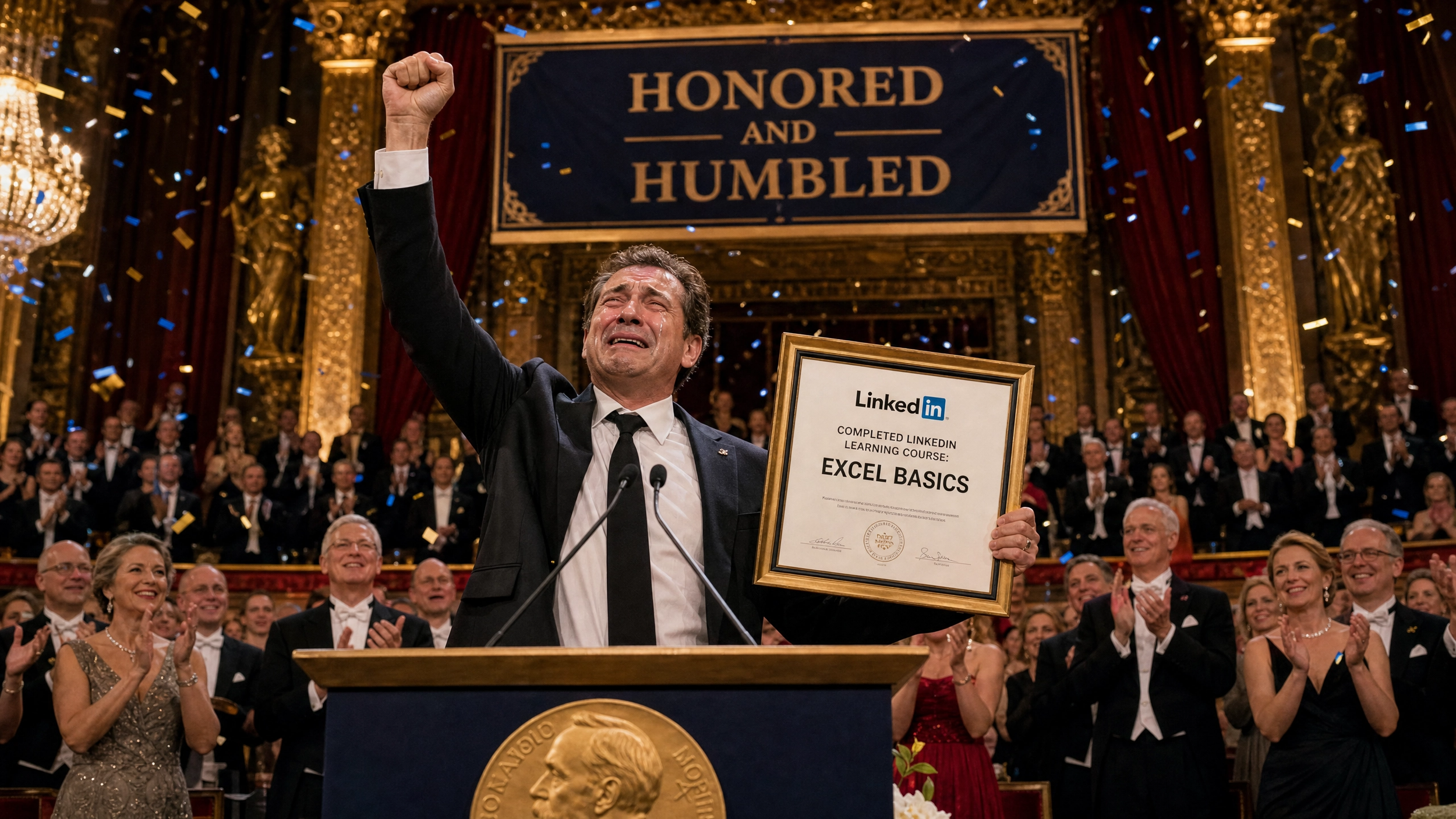
I do not have the privileges of memberships with Facebook, Instagram, Tiktok, you name them. LinkedIn is my last and only social media resort, because for some time it had something professional. But now and again I am very ambiguous about its usefulness. For some time now, I've observed a troubling trend among people I know - even close friends - where many are becoming increasingly insufferable online. This phenomenon has led me to wonder: what's driving this shift in temperament, particularly among otherwise rational professionals?
The answer, it seems, lies in the relentless, soul-crushing machinery of LinkedIn itself, which has morphed into a bizarre parallel universe where every minor career update is treated like the receipt of a Nobel Prize.
The flight out of reality started quietly enough. At first, people merely updated their job titles. But soon, a strange new dialect emerged. A dialect built entirely on the foundations of manufactured authenticity and profound self-importance.
At the core of this linguistic dystopia is the "Thrilled, Honored and Humbled" post opening. If you spend any time on the platform, you've seen this blight on the ecosystem. "Humbled" gets trotted out whenever someone wants to brag about themselves but doesn't want to get caught bragging. As if the very purpose of LinkedIn isn't giving people a platform for self-promotion.
Just last week, I saw someone post that they were "honored and humbled" to speak to the German Chamber of Commerce and Industry. Honored? Maybe. But humbled? How low does one's self-esteem have to be that addressing a room full of mid-level managers discussing supply chain logistics is considered a humbling experience? If anything, dealing with the bureaucratic realities of Germany should leave one exhausted, not humbled. By definition, "humbled" and "proud" are opposites. You simply cannot be both at the same time. Choose one, please!
Then there is the "Open to Work" badge. The green ring of desperation. It is the corporate equivalent of standing on a street corner with a cardboard sign, only that you are tagging fifty recruiters who will never reply.
For those who wish to participate in this charade, I have compiled a step-by-step guide to the LinkedIn Bullshit Bingo. If you must post nonsense, you might as well do it with the required structural integrity.
Step 1) The Hook of False Modesty: Always begin with the H-words. "I am absolutely thrilled, honored, and deeply humbled to announce..." This immediately signals to the reader that what follows will be a profound exaggeration of a mundane event. Remember, you are not just taking a new job; you are embarking on a transformative journey of synergistic synergy.
Step 2) The Manufactured Epiphany: Your post cannot simply state facts. It must include a story of personal growth. Did you miss your train? Turn it into a lesson on "agile pivoting in the face of logistical adversity." Did you buy a coffee? Write three paragraphs on how the barista taught you about "B2C customer-centric touchpoints."
Step 3) The Jargon Salad: To sound professional, you must abandon all recognizable human speech. Sprinkle liberally with terms like thought leadership, disruptive innovation, paradigm shift, and leveraging synergies. Remember: you aren't "doing things differently"; you are "disrupting the legacy ecosystem."
Step 4) The Gratitude Dump: Tag no fewer than fifteen people. Thank your new boss, your old boss, the recruiter, your mentor, your supportive family, the janitor, and the concept of the universe itself. This ensures the algorithm will force your post onto the feeds of thousands of innocent bystanders.
Step 5) The Call to Engagement: End with a vacuous question designed solely to generate comments for better reach. "What are your thoughts on leveraging AI to optimize the Cappuccino-drinking experience with oat milk? Let me know in the comments below! 👇"