Wet markets - where the food chain crosses the social fabric
I don’t know what’s super in a Supermarket or what is convenient in a Convenience Store. If you fancy convenience then you have the Tabaccino for a bottle of Cynar and a pack of Gauloises Caporal late at night - for breakfast! I personally don’t smoke, but had intimate insight into the breakfast triology: café, cigarette, caca. That’s convenience! The whole thing about the retail of necessities, is that a supply meets a demand in style. And that’s about the opposite of any modern retail format …
I don’t know what’s super in a Supermarket or what is convenient in a Convenience Store. If you fancy convenience then you have the Tabaccino for a bottle of Cynar and a pack of Gauloises Caporal late at night - for breakfast! I personally don’t smoke, but had intimate insight into the breakfast triology: café, cigarette, caca. That’s convenience! The whole thing about the retail of necessities, is that a supply meets a demand in style. And that’s about the opposite of any modern retail format. So, wherever new place I go, I first locate the police station, then the post office, the fuel station and then: the wet market, the Wochenmarkt, the pazar, the souk, the mercado, the 街市. Not the boutique farmers' market where some hippie sells you a US$ 15 jar of artisanal hope, but the place where a woman cooking for a family buys five kilos of onions and argues about the price. These markets are not folklore. They are engineering. Their architecture is a thermodynamic answer to a local question, and once you see the question, the buildings, the cuisine and the social rules all fall into place.
Start with the word, because it is more revealing than people think. "Wet market" is not an ancient term at all. It came into common use in Singapore in the early 1970s, when the government needed a word for what a supermarket was not. The "wet" is not moral, it is literal: melting ice, hosed floors, produce sprayed to stop it wilting. And the distinction from the "dry market" is a formal administrative category, not a metaphor. In Oaxaca, the Mercado Margarita Maza de Juárez is split by the municipality into a zona húmeda and a zona seca. Wet is where things rot; dry is where they do not. The whole typology of these places begins from that one variable, and my working test for whether a market is real is equally simple: look for offal, feet, heads and bones. A market where nobody buys a pig's trotter is not a market, it is a hobby.
The intellectual frame I keep returning to is one I have written about before in a different context: Johann Heinrich von Thünen's ring model of 1842. Agricultural intensity declines with distance from the market, and the degree of processing rises with the cost of getting there. You keep the milk close and you make the cheese far away. What von Thünen did not spell out, because he did not need to, is that the market itself is the piece of infrastructure where this becomes visible, and that its physical form is set by the perishability of what arrives. If the ambient air does the refrigeration for you, you need no building at all. If the ambient air is your enemy, you need a roof with a chimney effect, or a great deal of ice, or a compressor. Everything else - the governance, the haggling, the cuisine - is downstream of that. Having been a consultant some time in my life, on this basis I would propose six types.
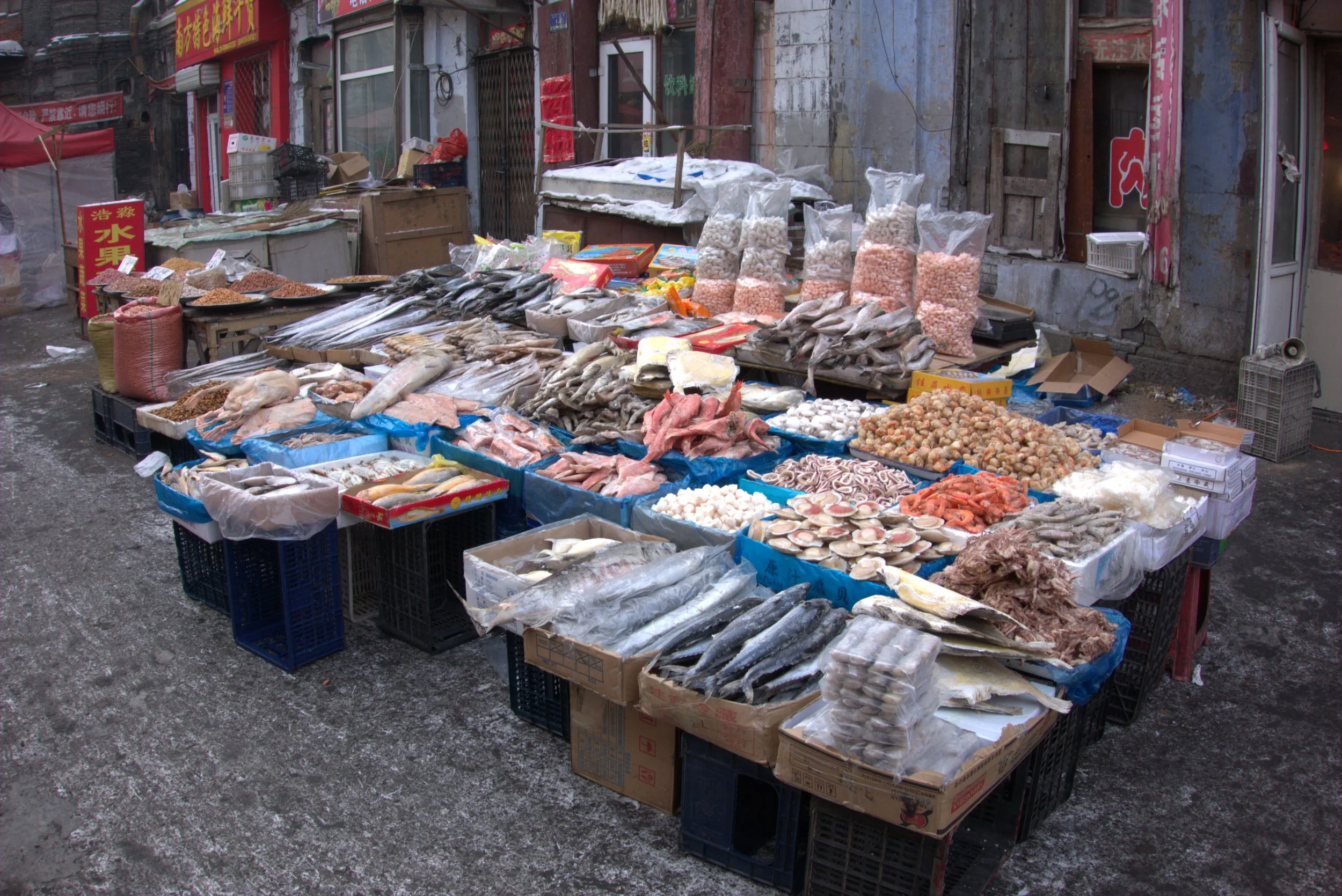
The first is the ambient freezer, and it is the one that converted me to the idea that climate writes the architecture. In Harbin, the Hongzhuan Street morning market (红专街早市) runs for 487 metres with roughly 300 stalls, on a site it has occupied since 2003, and in January it operates at around −25 °C with the goods laid out on open trestle tables. Nothing is refrigerated because everything already is. You buy 冻梨, the frozen pear that has gone black and glassy, and frozen persimmons, and fish stacked like cordwood. The municipal authority's contribution to market integrity was to distribute 70 tamper-proof electronic scales to the traders, which tells you something charming about where the actual risk lies. Push further north and the logic intensifies. At the Krestyansky market in Yakutsk, established in 1995 on about two hectares, the winter trading floor works at −40 to −50 °C; frozen fish stand vertically in their crates; buyers inspect the gills for blood as proof the fish was frozen alive on the ice; the nelma for stroganina goes for over 2,000 roubles a kilo; and the vendors keep their card terminals in polystyrene boxes with heating pads, because the electronics freeze before the fish does. This is my favourite detail in the entire subject. The payment system is the perishable good.
And then Greenland, which pushes the type to its logical end. The brætter — the "boards" — are open-air fresh markets where hunters sell directly, and the largest, Kalaaliaraq in Nuuk, was founded in 1958 on the model of a Danish market square, demolished in 2018 and rebuilt with 271 m² indoors and 46 m² of covered outdoor space. What is sold is seal, whale, reindeer, muskox, halibut, wolffish. The regulatory history is the interesting part: until a dispensation in September 2018, only fresh meat could legally be sold there, and the change permitting dried, salted, smoked and frozen product was explicitly argued as a step towards Greenlandic self-sufficiency. Meanwhile trichinella inspection for seal and polar bear was still not mandatory as of 2017, after an infection cluster in 2016 from polar bear meat bought at a brætter. The Arctic gives you a free cold chain and charges you in parasites.
The exact mirror image is the tropical ice economy, where the market is a continuous battle against its own climate and the infrastructure is water and ice. Khlong Toei in Bangkok covers roughly 100,000 m² with about 1,500 stalls and never closes: 24 hours, 365 days. The fundamental technology on display is a man with a hose keeping fish alive on a bench. Hong Kong industrialised the same problem. The Food and Environmental Hygiene Department operates 74 markets with some 13,000 stalls, and the characteristic built form is the multi-storey municipal services building, which stacks the wet market on top of a cooked-food centre on top of a sports hall, as at Java Road since 1992. The old Wan Chai market of 1937 is a Grade III listed Streamline Moderne block, and its successor from 2008 is air-conditioned, with 50 stalls. The red lampshades hanging over the pork are a small, honest fraud that every Cantonese shopper understands. And since 2008, every live bird in Hong Kong must be slaughtered before 20:00, so that no live poultry remains overnight. This is an avian-influenza measure that quietly abolished a centuries-old trading rhythm. Singapore, having invented the vocabulary, also formalised the institution: the National Environment Agency runs 123 markets and hawker centres, allocates stalls by monthly open tender, and carries subsidised rents from S$160 to S$320 a month against open bids above S$1,200. My favourite piece of institutional memory from there: the reason officials hesitated to introduce frozen fish to these markets in the late 1970s was the fear that hawkers would thaw it and sell it as fresh. The category "wet" was born as an act of consumer protection.
The third type is the one Europeans think of as the market, and it is really a 19th-century public health project: the ventilated hall. Iron, glass, a high roof to let the heat rise, and above all an inspection regime. Berlin's Markthalle Neun opened on 1 October 1891 to a design by the city building officer Hermann Blankenstein with August Lindemann, about 3,500 m² with 300 stalls of four square metres each, a dedicated meat inspection centre, cooling in the cellar and gateways sized for horse-drawn delivery carts. That is not a nostalgic building, that is a food-safety machine. Barcelona took the idea furthest, because Ildefons Cerdà treated markets as municipal utilities to be distributed like schools and drains: today the Institut Municipal de Mercats runs 43 markets across 73 neighbourhoods with 8,000 traders, 65 million visits a year and about €1 billion of turnover, and the city put €133 million into modernising 25 of them between 2011 and 2015. The Mercat de la Concepció of 1888 by Antoni Rovira i Trias, iron and glass fabricated by La Maquinista Terrestre y Marítima, is 2,910 m² of exactly this logic. Porto's Bolhão of 1914 was reopened in 2022 after a €28 million rebuild in which the clever move was invisible: deliveries and cold rooms went into a new underground level so the historic hall could go back to breathing. At Matosinhos, the 1952 market by Fortunato Cabral and Cunha Leão deliberately put the fishmongers on the lower level for airflow and natural cooling. Turin's Porta Palazzo, at 51,000 m² the largest open-air market in Europe, with about a thousand traders and 100,000 visitors a week, sits above four subterranean levels of ghiacciaie — ice houses from 1922. Even the Soviet Union built to the same specification with different politics: Moscow's Danilovsky, a kolkhoz market since 1963, got a 14-petal reinforced concrete dome with a central oculus in 1986, by Felix Novikov and Gavriil Akulov, borrowing from the Druzhba arena of the 1980 Olympics. Nixon walked through the earlier version in 1959 and was handed fruit and pickles. In 2015 the Ginza Project bought it for 425 million roubles and promised 800 million for the reconstruction, which is how a collective-farm market becomes a food court.
The fourth type is the one my German readers will recognise in their bones: the periodic market, where the market is not a place but a time. German law is magnificently precise about this. § 67 of the Gewerbeordnung defines a Wochenmarkt as a regularly recurring, time-limited event at which a plurality of vendors offers foodstuffs, agricultural products and raw natural produce — and, in a clause of pure Teutonic exactitude, generally excludes alcoholic drinks unless the farmer produced them himself. There are more than 3,000 such markets in the country. The version I actually use is the Turkish markets which are artefacts of the Gastarbeiter economy and one of the few genuinely unpretentious things left in Germany. Istanbul runs the same principle at industrial scale: the Fatih Çarşamba Pazarı, over three hundred years old, fills seven main streets and seventeen side streets around the mosque with 4,811 stalls, tarpaulins strung between the buildings as a temporary roof, and when it closes at 21:00 the municipality sends in sixteen refuse trucks. The Moroccan countryside operates about 800 active weekly souks, of which 161 are in Marrakech-Safi alone, and they are named after their day: souk el-had for Sunday, souk el-tnine for Monday. Oaxaca's Central Valleys have run a rotation since long before Cortés: Etla on Wednesday, Zaachila on Thursday, Ocotlán on Friday, Tlacolula on Sunday, and in Tlacolula trueque, straight barter without currency, is still practised. This is a form of architecture that consists entirely of a calendar.
Behind all of these sits the fifth type, which the shopper never sees but which sets every price they pay: the wholesale leviathan. Mexico City's Central de Abasto, inaugurated in November 1982 to a design by Abraham Zabludovsky on 328 hectares of former chinampa land, moves around 30,000 tonnes a day and supplies roughly 80 per cent of the food consumed in the metropolitan area, with 70,000 people working inside a deformed hexagon 2,250 metres across. Seoul's Garak market, opened in June 1985 as Korea's first public wholesale market with auction-based trading, covers 542,920 m², handles about 7,300 tonnes a day and is now in the middle of a one-trillion-won modernisation aimed largely at tripling cold storage. Noryangjin auctions its fish between 01:00 and 03:00. Tokyo's Tsukiji opened in 1935 and closed in October 2018 in favour of the fully enclosed, temperature-controlled Toyosu; and in June 2020 Japan substantially deregulated the Wholesale Market Law of 1971, abandoning the 商物一致 principle that physical goods had to pass across the market floor. Casablanca's marché de gros, 24 hectares handling roughly half the country's wholesale produce, logged a record 1.7 million tonnes and 244,706 incoming trucks in 2025. Delhi's Azadpur Mandi, founded in 1977 on some eighty acres, turns over 12,000 to 15,000 tonnes daily and employs forty to fifty thousand people, including the palledars who carry hundred-kilo sacks through 40-degree heat wearing a pitthoo, a pad stitched from old gunny sacks. When India's farm laws of 2020 threatened to let buyers bypass the APMC mandi system, this was the machine people were fighting over. The haggle is retail; upstream it is a gavel, and the gavel is politics.
The sixth type is not defined by climate at all but by migration: the market as arrival infrastructure. Marseille's Noailles, the Marché des Capucins, formally founded as a food market in 1956 on the site of a Capuchin convent seized as national property in 1791, is where you buy preserved lemons at three to five euros a jar and fresh harissa graded by heat, and where the etiquette is absolute — you say bonjour, and you do not touch the produce, you point. Toronto's Kensington Market, 27 hectares and some 240 businesses, was the "Jewish Market" of the early twentieth century and had live chickens in sidewalk cages, slaughtered on demand, well into the post-war decades; today the traditional grocers are thinning while cannabis dispensaries multiply, and a community land trust is buying buildings to slow it down. Porta Palazzo, once the market of southern Italian migrants to Turin, is now largely run by traders from outside the EU and carries a sign reading Amare le differenze in several languages. The pattern is consistent enough to be a law: a stall is the cheapest available unit of self-employment, and a cuisine reaches a city through a market long before it reaches a restaurant.
What ties the six types together is that the kitchen writes the specification and the market is built to it, not the other way round. Cantonese steamed fish requires a fish that was alive twenty minutes earlier, which is why Hong Kong fought so hard over the live poultry rules and why the tanks are at the front of the stall. Oaxacan mole requires a wall of thirty kinds of dried chile, which no supermarket will ever carry. Kimjang, the Korean autumn kimchi-making that UNESCO lists as heritage, produces a November tonnage spike in napa cabbage, radish, coarse salt, chile and fermented seafood that the wholesale markets have to plan around. Stroganina requires −40 °C, full stop. Grüne Soße requires seven specific herbs in one bunch, which is precisely what the Frankfurt Kleinmarkthalle. There is a good academic argument here too. Chinese researchers have shown that "freshness" in these markets is not a property discovered in the goods but something actively constructed through sensory display, atmosphere and long-term trust between vendor and customer, and that the vendor's real competitive advantage is the ability to work several wholesalers at once and thereby shorten the chain. That is the honest answer to why the market survives against a supermarket that has better logistics, better lighting and better parking.
I do not want to write a sentimental piece, so let me be blunt about the two forces actually killing these places, neither of which is the supermarket alone. The first is gentrification, and it works by substitution rather than closure. La Boqueria in Barcelona now takes about 40,000 visitors a day and its fishmongers are being crowded out by chocolate-covered strawberries and paper cones of fried fish. Lisbon's Mercado da Ribeira, rebuilt in 1930 with a domed skylight the locals nicknamed the Mesquita do Nabo, gave half its floor in 2014 to the Time Out Market, which drew close to four million visitors in 2018 and is now the global template for turning a market into a curated food court. Markthalle Neun is the same story with better bread. Danilovsky is the same story with a Soviet dome. The tell is always the ratio of things you can cook to things you can only eat standing up. The second force is the state's hygiene regime, and here I refuse to be cynical, because the epidemiological case is real: the Lancet Planetary Health typology of wet markets identifies live animals, interspecies mixing, market size, hygiene and supply-chain length as the actual risk variables, and correctly separates the ordinary produce-and-butcher market from the wildlife market that the Western press spent 2020 conflating it with. Hong Kong's 20:00 slaughter rule is not bureaucratic vandalism. It is why the 1997 H5N1 event did not repeat.
The loss, when it comes, is not a loss of charm. It is a loss of price discovery, of redundancy in the food system and of the small producer's access to a customer. Thirty-nine per cent of Singaporeans surveyed had not set foot in a wet market in the previous year. The council of the 12th arrondissement of Paris spent early 2025 debating whether to let the open-air Marché d'Aligre sell meat and fish, in a market authorised by Louis XVI in 1777 and rebuilt in 1843, because turnover was falling. Japan's neighbourhood shotengai have produced enough closures to earn the name "shutter streets". And Vietnam ran the whole experiment to its conclusion: Hanoi announced in 2011 that it would replace nearly 350 wet markets with modern trade centres, the conversions failed because traders were pushed into inaccessible basements and simply went back to the pavement, and in August 2024 Decree 60/2024/NĐ-CP reversed the policy — public money now funds renovation rather than replacement, and even "naturally occurring" street markets are formally recognised. Of the eight and a half thousand markets in the country, over seven thousand are Class 3, under two hundred stalls, serving a single ward. It took the state thirteen years to work out that these were not a transitional stage on the way to somewhere better.
Which brings me back to why I bother, cheerfully carrying a bag through a puddle of fishwater on a Tuesday morning. In a supermarket I am a throughput problem. In a market I am asked what I intend to cook and then told that I have chosen wrong, which is a different and much better relationship. The vendor at Noailles selects the aubergines because he, not I, knows which crate came in this morning. The woman in Harbin hands me a frozen pear as if handing over a small dark planet. This is the last piece of retail infrastructure in the world where the transaction still contains an argument, and the argument is the point. I am now in Malta, which runs its own quietly elegant version of all six types at island scale. The wholesale Pitkalija at Ta' Qali is closed to the public and opens twice a week, where hundreds of farmers drop off thousands of kilos to be auctioned to supermarkets, grocers and hawkers through licensed pitkala middlemen; since the 2021 reform every green crate carries a barcode tying the produce to a price and a named farmer, and the Malta Food Agency now administers the Pitkalija, the Pixkerija fish market and the abattoir together. Alongside it the farmers' market at Ta' Qali opens on Tuesdays and Saturdays, and on Sundays the fish comes ashore at Marsaxlokk and is essentially gone by ten. Barcode traceability upstream, a periodic market downstream, and the sea setting the timetable.
Thrilled, Humbled, Honored, and Open to Work: A Guide to the LinkedIn Absurdity
I do not have the privileges of memberships with Facebook, Instagram, Tiktok, you name them. LinkedIn is my last and only social media resort, because for some time it had something professional. But now and again I am very ambiguous about it’s usefulness. For some time now, I've observed a troubling trend among people I know - even close friends - where many are becoming increasingly insufferable online. This phenomenon has led me to wonder: what's driving this shift in temperament, particularly among otherwise rational professionals? …
I do not have the privileges of memberships with Facebook, Instagram, Tiktok, you name them. LinkedIn is my last and only social media resort, because for some time it had something professional. But now and again I am very ambiguous about its usefulness. For some time now, I've observed a troubling trend among people I know - even close friends - where many are becoming increasingly insufferable online. This phenomenon has led me to wonder: what's driving this shift in temperament, particularly among otherwise rational professionals?
The answer, it seems, lies in the relentless, soul-crushing machinery of LinkedIn itself, which has morphed into a bizarre parallel universe where every minor career update is treated like the receipt of a Nobel Prize.
The flight out of reality started quietly enough. At first, people merely updated their job titles. But soon, a strange new dialect emerged. A dialect built entirely on the foundations of manufactured authenticity and profound self-importance.
At the core of this linguistic dystopia is the "Thrilled, Honored and Humbled" post opening. If you spend any time on the platform, you've seen this blight on the ecosystem. "Humbled" gets trotted out whenever someone wants to brag about themselves but doesn't want to get caught bragging. As if the very purpose of LinkedIn isn't giving people a platform for self-promotion.
Just last week, I saw someone post that they were "honored and humbled" to speak to the German Chamber of Commerce and Industry. Honored? Maybe. But humbled? How low does one's self-esteem have to be that addressing a room full of mid-level managers discussing supply chain logistics is considered a humbling experience? If anything, dealing with the bureaucratic realities of Germany should leave one exhausted, not humbled. By definition, "humbled" and "proud" are opposites. You simply cannot be both at the same time. Choose one, please!
Then there is the "Open to Work" badge. The green ring of desperation. It is the corporate equivalent of standing on a street corner with a cardboard sign, only that you are tagging fifty recruiters who will never reply.
For those who wish to participate in this charade, I have compiled a step-by-step guide to the LinkedIn Bullshit Bingo. If you must post nonsense, you might as well do it with the required structural integrity.
Step 1) The Hook of False Modesty: Always begin with the H-words. "I am absolutely thrilled, honored, and deeply humbled to announce..." This immediately signals to the reader that what follows will be a profound exaggeration of a mundane event. Remember, you are not just taking a new job; you are embarking on a transformative journey of synergistic synergy.
Step 2) The Manufactured Epiphany: Your post cannot simply state facts. It must include a story of personal growth. Did you miss your train? Turn it into a lesson on "agile pivoting in the face of logistical adversity." Did you buy a coffee? Write three paragraphs on how the barista taught you about "B2C customer-centric touchpoints."
Step 3) The Jargon Salad: To sound professional, you must abandon all recognizable human speech. Sprinkle liberally with terms like thought leadership, disruptive innovation, paradigm shift, and leveraging synergies. Remember: you aren't "doing things differently"; you are "disrupting the legacy ecosystem."
Step 4) The Gratitude Dump: Tag no fewer than fifteen people. Thank your new boss, your old boss, the recruiter, your mentor, your supportive family, the janitor, and the concept of the universe itself. This ensures the algorithm will force your post onto the feeds of thousands of innocent bystanders.
Step 5) The Call to Engagement: End with a vacuous question designed solely to generate comments for better reach. "What are your thoughts on leveraging AI to optimize the Cappuccino-drinking experience with oat milk? Let me know in the comments below! 👇"

Land of a Thousand Fires - Why I love the "Ruhrgebiet", against all the odds
In the mid 90s, I did my PhD in Essen, a city in the Rhine-Ruhr-Area (Germany). Back then, I was working on man made precipitation modifications in urban areas. Honestly, back then I did not know really what an “urban area” looks like, and I thought this conglomerate of smaller towns, growing together to one urban cluster could have impacts on the atmospheric boundary layer that modify rainfall patterns. Actually, it does. But that’s a different topic. Earlier this week, …
In the mid 90s, I did my PhD in Essen, a city in the Rhine-Ruhr-Area (Germany). Back then, I was working on man made precipitation modifications in urban areas. Honestly, back then I did not know really what an “urban area” looks like, and I thought this conglomerate of smaller towns, growing together to one urban cluster could have impacts on the atmospheric boundary layer that modify rainfall patterns. Actually, it does. But that’s a different topic. Earlier this week, meetings and catching up with old friends brought me back to this place after many years. The Rhine-Ruhr-Area is often stigmatized in Germany, as of its industrial history. What’s true is, that it has a heart of steel, but some of the most friendly people. What is also true, is that it was the military industrial power house for two catastrophic world wars. But again, people are amazing. Once you were down in a coal mine, all that counts, is cooperation and team work. You had to take care of your colleagues and in the many tragic cases, also of their widows and their children as a community. Anybody who worked in mining, knows what I talk about. I am really not a trade union supporter, just the opposite these days, but I completely understand why the roots of the German workers’ movement are here. After discontinuing coal mining and large parts of the steel production capacity, the region went through amazing structural reforms. This has not ended. The previous federal industrial ministry pushed for green steel production using “green hydrogen”. That’s a difficult process, very expensive and the market for it is very small, given high prices and fierce competition and trade barriers. Last but not least, the green hydrogen is not available in the necessary amounts. So, the heart of steel is having a serious cardiovascular problems, while other opportunities are coming up, specifically with the new NATO target of spending 5% GDP on defense. History does not repeat itself, but it rhymes.
For two hours I dropped by “Zeche Zollverein”, a museum on the premises of the old coal mine. I had the privilege of chatting with one of the last technical mining apprentices from the 1980s, telling me his life story having seen work down in the mines and how is is now serving as a security staff in a museum of his former workplace. I also learned from one of my PhD colleagues, that my former office mate Ewald Zmarsly passed away already in 2018. I remember Ewald as such a great fellow. He wasn’t social. But he was the only Chemist in the department and he had infinite patience to explain anything chemistry to the rest of us when we needed it. Even he was not communicating much, I remember, he had an amazing talent and patience to explain complicated things to beginners in any science field - always helpful, always friendly, but never smiling. He also co-authored multiple textbooks with Wilhelm Kuttler and others, which are all brilliant books. I don’t know much of Ewald’s history and when his family came to the “Pott”. But for me Ewald was prototype of the people here: knowing what he talks about, without talking much. The world needs more Ewalds. Rest in peace.

The grandkids of "Radio Veronica"
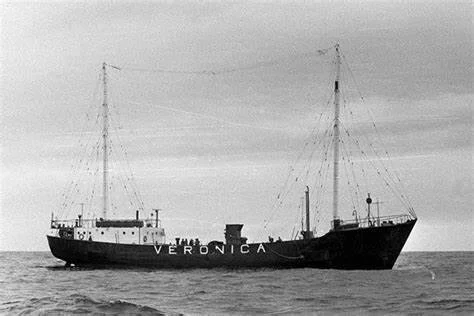
In April 1960 a group independent Dutch electronics retailers brought a 1 kW AM offshore pirate radio station on air, broadcasting from the a former lightship Borkum Riff. They intended to boost sales of radio appliances by offering an alternative programme to the official Dutch radio and selling airtime to advertisers. VRON, Vrije Radio Omroep Nederland (Free Radio Station Netherlands) was born, which later became “Radio Veronica” named after the poem "Het Zwarte Schaap Veronica" (The Black Sheep Veronica) …
In April 1960 a group independent Dutch electronics retailers brought a 1 kW AM offshore pirate radio station on air, broadcasting from the the former lightship Borkum Riff. They intended to boost sales of radio appliances by offering an alternative programme to the official Dutch radio and selling airtime to advertisers. VRON, Vrije Radio Omroep Nederland (Free Radio Station Netherlands) was born, which later became “Radio Veronica” named after the poem "Het Zwarte Schaap Veronica" (The Black Sheep Veronica). After its closure in 1974 some staff members obtained a license and continued operation in the increasingly competitive liberalized market.
The story continued as usual: after the pioneers come the settlers, then the bankers, then the liars, then the lawyers, then the churches, schools and finally at some time the shopping malls - or even worse. For pioneering pirate radio station this journey ended somewhere with TikTok. I imagine, that’s the end of the life cycle. But I have no real insight into TikTok. However, yesterday I looked at YouTube. It must be something like the “Instagram for video content”. Well, on the one hand, I like amateurism. It has a great spirit. But on YouTube you see housewives explaining the universe, fired journalists running “alternative channels”, ex-hedge fund managers explaining geopolitics and its impact on the markets, tattooed ex-bodybuilders being podcast hosts, … you name it. I guess, low technical entry barriers do more harm than good. At least back in the time of Radio Veronica, you needed a ship and a captain’s licence. You needed to build a radio station out of components and modules available. You needed to calibrate the antennas hanging on masts. And last, but not least you needed to power the thing and eat canned food for weeks in a go, together with sea sickness pills in bad weather. Now you just need a smart phone and a ring lamp and can disseminate all garbage globally.

The cradle of Teletubbies
When Wilhelm Kattwinkel visites the Olduvai Gorge in 1911 to research sleeping sickness , he observed humanoid archeological remains, in 1913 identified by the German Geologist to be probably the “cradle of mankind”. I visited Germany, also for a different purpose, but now sitting at Frankfurt Airport waiting for my flight out, I am convinced, I discovered “the cradle of Teletubbies” …
When Wilhelm Kattwinkel visited the Olduvai Gorge in 1911 to research sleeping sickness , he observed humanoid archeological remains, in 1913 identified by the German Geologist to be probably the “cradle of mankind”. I visited Germany, also for a different purpose, but now sitting at Frankfurt Airport waiting for my flight out. Now, thinking back I am convinced, I discovered “the cradle of Teletubbies” (Teletubbies - Wikipedia). It is amazing resemblance in shape, vocabulary, grammatical proficiency, everyday activities and outlook on life. Yesterday I took first a local train from Bingen to Frankfurt Main station, packed with them. My plan was to extend my expedition with a walk through Frankfurt. But the station is cordoned my a non-penetrable ring of “Zombie Proto-Teletubbies”. Before they had the chance to bite me, so I may become one of them, I jumped on an Uber and escaped to my airport hotel. There was not much around there, but I went for a little walk to discover a store selling organic produce. So, I went in to get myself some dinner ration, to discover the “Mindful Proto-Teletubbies”. It is a tribe where body and mind are one, which seems to be manifested by the IQ and the Body Mass Index (BMI) being the same number. They are so “mindful”, introverted and slow, that the main outside difference to the “Zombie Proto-Teletubbies is, that they have better teeth, and they look more peaceful, and you can communicate with them easily with the vocabulary: “Oh, oh, ey”. It’s a super efficient language, because you can express a lot of different things using these three words in a different intonation. It can be surprise, confirmation, anger, educational … anything. I guess, that’s what they call “German efficiency”. Well, I am out of here.
A Streetcar named 501 QUEEN
Toronto’s Streetcar 501 QUEEN is the world’s longest streetcar line. It spans Toronto’s East and West by reaching from Neville Park Loop to Humber Loop, and taking the 24.8 km (15.4 miles) ride along Queen Street is a good way to get an impression of the city along this profile. Today I did it, starting from the East, passing through The Beaches first, which is the nice and lively residential area we live. From Leslieville …
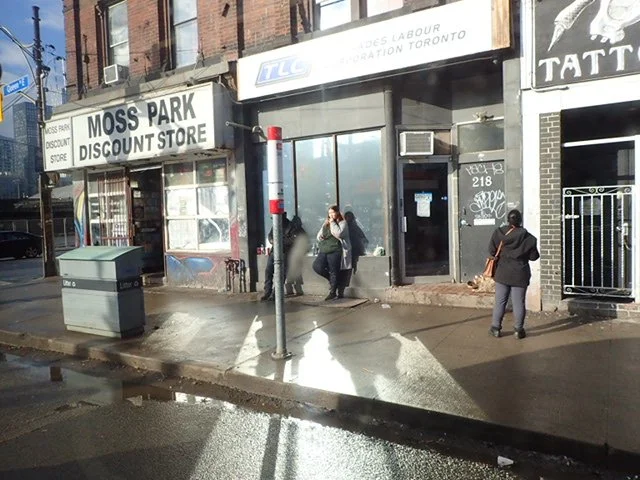
Toronto’s Streetcar 501 QUEEN is the world’s longest streetcar line. It spans Toronto’s East and West by reaching from Neville Park Loop to Humber Loop, and taking the 24.8 km (15.4 miles) ride along Queen Street is a good way to get an impression of the city along this profile. Today I did it, starting from the East, passing through The Beaches first, which is the nice and lively residential area we live. From Leslieville to crossing the Don River (not the Russian) looking out of the window on a rainy day, always reminds me of the opening scene of the Jim Jarmusch Movie “Down by Law”, just in a Nordic Climate. Then approaching Church there is unfortunately a lot of drug abuse on display, and the travel companions change until the stop close to the Salvation Army. Further, there is a little detour due to construction, passing through the CBD and then some nice and busy shopping parts with an impact of Chinatown up to Spadina. The following Western lag, starts with a lot of broken windows and run down shops. About a month ago, there was a large fire fight between gangs here in a recording studio. Over 100 shots were fired, an unmarked police vehicle was hit, but nobody was hurt. I frequently mentioned that I perceive Canadians as very friendly. And I even extend this compliment now to the mafia, for the unexpected act of kindness having a major gun battle and hurting nobody. After leaving the area still attached and shaped by the city, comes a residential area again, High Park and then the final stretch to Humber Loop. Just before that the streetcar gets an extra track, separated from the car traffic and moves a little faster. The average speed of the ride was 10.1 km/h. That’s half the speed of a bicycle, but double the experience.

Queens Road West. A lot of broken windows.
In summer of 1875 the Kensington Road Tramway service was opened to carry gravel and building materials on horse drawn carriages by the TRC (Toronto Railway company). The extension went stepwise and was first containing two stretches: one from downtown to Woodbine and another connection along Queens Street to Muro Park. There were various phases marked by conflict between different stakeholders and in 1921 the Toronto Transport Commission (TTC) took over the responsibilities of TRC and operated a line similar to today’s 501 QUEEN. The line has a long history of unreliable service. Of course the longer a streetcar line gets, and with all uncertainties of an urban environment (e.g. parking on the tracks or any kind of technical failure), these problems get amplified to the ends of the line. So, there were attempts to split the line into smaller, overlapping units, and experimentation until 2019. In any case, if you ever get nostalgic about the 1970s, come to Toronto. And that’s not just the streetcars. I personally like it. It’s style. You can’t afford being in a hurry. Because it won’t work. So, where ever you get stranded: just go to the next Tim Hortens, get your Double Double and see what happens.

GPS Plot of 501 Queen. Pretty much a straight line.

Speed plot of 501 Queen, averaging 10.1 km/h.
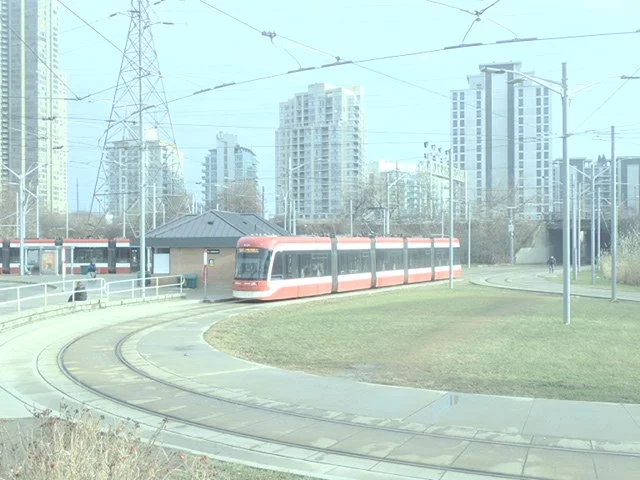
Humber Loop Terminal of 501 QUEEN. My Olympus Though camera had a problem with the lighting. I think it needs a software update. But like this, it looks vintage and is a good bridge to older photos below.


À la recherche du temps perdu
As you may have read in the news, the German automotive industry is under unprecedented pressure. It is the result of a mix of internal factors, changing geopolitics, new technologies, new competitors and last but not least a dysfunctional German government. Volkswagen Group, the company I have been associated with for decades, has been hit exceptionally hard. It is not the first crisis we see in the company, …
As you may have read in the news, the German automotive industry is under unprecedented pressure. It is the result of a mix of internal factors, changing geopolitics, new technologies, new competitors and last but not least a dysfunctional German government. Volkswagen Group, the company I have been associated with for decades, has been hit exceptionally hard. It is not the first crisis we see in the company, but this time it is different. A lot of what is happening now, and the internal shortcoming that lead to failing to confront it, have been visible for a long time. And I don’t say this in hindsight. A tragic mix of inertia, complacency, arrogance, governance issues and political interference have veiled the realities of a new world order of the auto industry. Volkswagen, especially in Germany, is in many aspects not so much managed like a company but it is more of a “brotherhood” (with only very few “sisters”).
Naturally, when I sent out my recent seasonal greetings, it reached a lot of these “brothers” and some “sisters”. I left 2015, but bonds remain strong. And there followed dozens of calls, to catch up. In the last decade, as I was the youngest back then, I have seen many retiring, and some sadly even died - sometimes just months after their corporate farewell. But this time, it is different. This time, it’s my direct former peers which quit or are pushed into early retirement. It’s those who remember their first working day in the passive Wolfsburg plant, and how they walked into the HR Department to report duty. It’s my fellows from the high potential development programs shaping the “leaders of the future”. And that future now is past. For many of them, it has been 30 years or more with the firm. And most of them think, where is the time gone, since I walked through “Tor Sandkamp” (Gate Sandkamp) for the first time. Don’t get me wrong, all of them had amazing careers and explored the world. All of them made the fortunes you can make working in the management of a true global player in that industry. But still, the time now seems lost to them. And with it some of the skills, they could now use perfectly, for example playing an instrument, the patience of reading a book, and distinguishing between friends and network.
Luckily, I never had this. I think, I was quite a free spirit during my times in any company, but very loyal to the people I work with. All I wanted, was to work on exciting topics and I never really pursued a career. Career, what ever that actually is, was just a result of the work I did. My career is the thing HR figures out, somewhere in their dusty corner. They don’t need me for that, right? I was not even aware I had a career, like I am also not really aware that I am approaching 60. Sure, sometimes you need a big title to get things done. A big name card opens bigger doors. It’s like in a computer game. There they call it tools, weapons, or assets, don’t they? It’s about the size of the toys they give you. It’s not about your size.
I have been discussing with a friend whether this attitude maybe the result of coming from a refugee family. Once you learn, that all can be taken away from you by “the system” - for sure your home, and even your life - you may stay more of a free agent. But I also know decedents of refugees, which put all into rebuilding their old life, just in a different place, where they gain trust into institutions. We had this twice: once fleeing from East Prussia and then from the Soviet occupied East Germany into the West. This part of the family never regained trust into any “system” and for sure not into any government. And then there was my father, running away from a steel worker’s apprenticeship in Differdange (Luxembourg) as a teenager looking for adventure and a better future. And then, for myself, there maybe perhaps an influence of what is called the (notorious) “Generation-X”, the latchkey kids brought up on garden hose water and neglect. Back then, we called it freedom.
In any case, I can remember anything I every did. Perhaps not the years, but the projects. There are no gaps and no time lost in my memory, even though I don’t think much about it. Thinking back to the beginning of my time in Volkswagen in the Wolfsburg headquarter, I found the picture of my view on the powerplant on an early winter morning. It was the time the factory was alive and running, workers changing shifts and many of the “office guys” did not wake up yet. That’s the golden hour in which the world is still in some kind of harmony.

"Feldpost" from de-industrializing Germany
Last week, I had the chance to present the industrial and economic facets of Germany to MBA students from The University of Hong Kong. Our journey began in Berlin, then proceeded to Wolfsburg, Dortmund, Duisburg, Hannover, and concluded back in Berlin. I extend my heartfelt gratitude to our hosts …
Last week, I had the chance to present the industrial and economic facets of Germany to MBA students from The University of Hong Kong. Our journey began in Berlin, then proceeded to Wolfsburg, Dortmund, Duisburg, Hannover, and concluded back in Berlin. I extend my heartfelt gratitude to our hosts for their generous insights: Volkswagen AG, TU Dortmund, the City of Duisburg, Future Car Lab, Neoxphere Technology, and Bundesverband Musikindustrie (Federal Association of the Music Industry). This broad array of industries and subjects was enhanced by cultural excursions to Potsdam's Sanssouci, the former Sachsenhausen Concentration Camp in Oranienburg, and several sites that depict the process and impact of Germany's reunification.
This trip occurred against the backdrop of Germany's struggling economy. Since the Greens and Socialists were ushered into power with the support of a small liberal party in December 2021, the nation has grappled with erratic and ideological policies. These are often portrayed to the populace as investments in future competitiveness or as efforts to catch up with the previous government's developmental shortcomings. From being Europe's economic powerhouse, Germany has become the OECD's underperformer in just a few years. To counter the demographic trend of an aging population and a shortage of skilled labor, Germany has opened its doors to immigration. Yet, skilled individuals often opt for regions with lower taxes and simpler bureaucracy, finding better opportunities elsewhere. Nevertheless, immigration remains high, consisting of refugees and migrants, many of whom face challenges integrating into the labor market.
Still there are many things to learn in Germany. Many capabilities have not vanished immediately, but are just getting unfeasible in the country. Also, assets of privately owned SMEs are getting cheap to acquire. And of course, Germany is a lesson on a new kind of political risk, where technocratic political leadership is succeeded by a new class of politicians which are genuinely ideologic, but does not even have the skills, education and character to follow through their own agenda.

Birthday South of Greenland
I started my birthday on an Air Canada flight, up in the air over the Atlantic, South of Greenland. In the afternoon, I drove to visit my parents in Westerwald and crossed farmers’ protests on the way. This was one of the most friendly and well-organized protests I have ever seen, …
I started my birthday on an Air Canada flight, up in the air over the Atlantic, South of Greenland. In the afternoon, I drove to visit my parents in Westerwald and crossed farmers’ protests on the way. This was one of the most friendly and well-organized protests I have ever seen, with strong support from the public. For the police, this was a pure traffic management job. No riot gear, no water canons, no teargas. Instead, the protesting farmers arranged, together with the police, emergency lanes in case something would be needed for rescue services. People still have in their minds the recent protest in Berlin, where an ambulance was blocked by climate activists glueing themselves on the roads, where rescue services could not reach an unrelated accident site, and subsequently, a woman died. Members of the current German government have preemptively discredited the farmer’s protests unfairly. Discontent with this government is extreme, and all hope is the call for a vote of no confidence and opening up the path for new elections. The question just is how the political landscape changed and what reasonable and competent coalitions could emerge. At the moment, it feels like it can’t get worse. But who knows?
This morning I had an early start driving to Tilburg. Train staff started striking today, so I was taking the car and passed through commuting hotspots before the rush hour. Still, the drive was slow because of the many construction sites until I reached the Dutch border. Infrastructure in Germany is a complete mess. I had lunch on the University campus and will start teaching a strategy course at TIAS tomorrow. This is a very nice business school co-owned by Tilburg and Eindhoven Universities. It will be long days with 12 hours of “stage time” per day. But I am looking forward to it. It’s an MBA programme, but unlike some other programmes, these students are special as they are already very experienced. So, it’s more like Executive Education, which is what I like doing.

Merry Christmas and a Wise New Year
Oh, what a year this has been! Now it’s ending, and I wish everyone a peaceful Christmas time, happy holidays, and all the best for 2024. It will be a year to make it or break it. What worries me, with my parents at very old age, is the loss of this generation of witnesses to war and famine and how fragile societies are …
Oh, what a year this has been! Now it’s ending, and I wish everyone a peaceful Christmas time, happy holidays, and all the best for 2024. It will be a year to make it or break it. What worries me, with my parents at very old age, it is the loss of this generation of witnesses to war and famine and how fragile societies are. At the same time, we experience conflicts where innocent people are slaughtered, unprecedented collateral damage among civilians is happening, and young men and women are thrown into a meat grinder by the thousands. In the streets and on University campuses, naive people cheer in support of terrorism, violence, war and a misguided and dangerous way of making necessary changes to battle environmental degradation. Then you have “military experts” in talk shows who have never spent a day in a trench, have never been under fire, nor shot a bullet, never seen a casualty or carried one to medics only to see them die. They make war entertainment. They speak for a “Think tank” but never heard the sound of a tank’s rear door opening and the infantry boots hitting the ground. And these two sounds are the scariest ones because this is the silence before the storm. I don’t think the world needs more agitation. It requires wisdom, competence and practical leadership on ethical grounds.
There will be elections in many countries in 2024, and last but not least, in the USA. For my German friends who are still in the country, I also wish you a good hand there for 2024 or a smooth way out. I know it’s not easy to leave a place you call home, but you may lose it anyway and leaving is the better option, not just regarding your perspectives but also about the impact you can have.
So, happy holidays and my greetings from The Beaches at Lake Ontario. And for 2024, stay strong and stay human. Whatever may come.

Hong Kong after Covid and the 1999 riots
My time in Hong Kong was very condensed this year. My apologies to the friends I could not meet this time. Thanks also to the great students from the MBA programme of Hong Kong University and the GBA stream coming in from Shenzhen to participate in a 5-day intensive course on Turn Around Management and Corporate Restructuring …
My time in Hong Kong was very condensed this year. My apologies to the friends I could not meet this time. Thanks also to the great students from the MBA programme of Hong Kong University and the GBA stream coming in from Shenzhen to participate in a 5-day intensive course on Turn Around Management and Corporate Restructuring. I had only one day to explore an Outer Island and chose Peng Chao to visit a long-time friend. The rest of the time I spent predominantly in Central. It was great to see fireworks again on National Day, celebrating the 74th anniversary of the foundation of the People’s Republic of China. Also, it is good to see Hong Kong’s economic situation slowly picking up. However, the city has a very narrow spectrum of industries and capabilities, which does not make it easy. Luckily, the connection to Shenzhen, the Pearl River Delta and Guangdong Province is fully open again. Furthermore, enthusiasm for the Greater Bay Area Development is picking up, and thanks to efficient management, the internal border between Hong Kong SAR and the rest of Guangdong is not so much an obstacle. Soon, taking your private car over from Hong Kong to the Mainland will also be possible. A friend told me how happy he is that he can then just drive over the bridge to his retirement apartment in Zhuhai. Less than 1 hour door to door.
The 1999 riots seem overcome. Without much drama, the local government could reinstall law and order, of course, with the support of Beijing. And I guess, Covid also played a role. Some people left on British Overseas Passports to the UK. But many tell quite miserable stories. Just imagine, instead of being in one of the centres of global innovation and growth, you decided to move to a semi-detached house in a shithole like Manchester, Birmingham, Liverpool or Glasgow. I would be miserable too. What worried me, was that many people told me that they expect a war with the US within the coming 5 years. The hope of many is that this can be contained in a naval conflict in the Pacific and outside the First Island Chain. The best option, of course, would be, not to have such a conflict at all. And I really hope at least the rhetoric could come down to make talks easier.
I ended my stay in Hong Kong, on the news of the horrendous attack of Hamas on Israel on October 7th. I was really surprised that they were able to prepare such a large-scale attack without being noticed. Also, in my mind, the cooperation between UAE, Egypt and Saudi Arabia was just going into a positive new phase. Hopefully, the safety in the invaded districts can be restored quickly. Then I assume Hamas will be ended now and forever. I just can’t imagine how terrible this will be in the densely populated Gaza Strip. And, of course, it could be possible that other players open a second front, like for example Hezbollah. Hoping for the best for my friends in Israel, Lebanon and Jordan. Especially those who just left Ukraine and Russia to make Israel their new home.
My trip ended with a Typhoon coming to Hong Kong. Signal number 8 is hoisted, potentially moveable structures are tied to the ground, windows are taped, and the city is waiting for the cyclone’s landfall nearby.

How to prepare if you have to use the German Railway
I embarked a train trip from Germany to Switzerland and unfortunately there was no Swiss train matching my schedule. So, there was no other choice than using a connection supplied and operated by the German Railway Company, called Deutsche Bahn. I really like travelling by train, and I did so in many parts of the World. But it’s always important to know what to expect …
I embarked a train trip from Germany to Switzerland and unfortunately there was no Swiss train matching my schedule. So, there was no other choice than using a connection supplied and operated by the German Railway Company, called Deutsche Bahn. I really like travelling by train, and I did so in many parts of the World. But it’s always important to know what to expect so you can best prepare for the journey. And in the case of Germany, you may go in with the misconception, that you can experience a certain standard in one of the world’s richest countries.
I better give you a few tips below.
Plan direct connections where you don’t have to change trains on the way. It is likely you will miss your connection and get stranded somewhere in a filthy train station for hours.
Have nice words ready for the train staff. They are mostly very friendly and take any situation with good humour trying to keep the spirit high. They often go more than the “extra mile” to help, whatever happens. And it’s always better, to crack a few jokes together than complain.
If you still have hand sanitiser from the Covid times, take it with you. For example, this journey started in Wiesbaden with a drug addict vomiting all over the place.
When you wash your hands in the bathroom, always check first whether the water is running before using soap. Otherwise, you may find yourself with soap in your hands and no way to wash it off. Anybody who travelled in developing countries knows the situation.
Don’t wear light colour clothes, because the trains may be really dirty. Perhaps even consider bringing something to cover the seats. People eat, drink, crumble and spill everywhere. I even developed a theory of why Germans like to travel with backpacks. Then they still have both hands to keep eating Chicken McNuggets while they walk. At the same time, they will jam their backpacks into your ribs.
In summer, the air conditioning notoriously malfunctions. So, carry a small hand fan. I got used to this when I travelled on the Columbo-Kandy train in Sri Lanka. And it comes in handy in Germany too.
There are actually quiet compartments where passengers are not supposed to use their phones. But some people don’t care and yell into their phones. Take some noise-cancellation earphones not to be forced to participate in their conversations. Here it comes in handy if you don’t understand German because at least the dull content will not bother you, and it’s just noise.
Some fellow passengers may watch movie clips or listen to music without headphones. Or, in the worst case, they blast you with a computer game. What helps here is a Wifi and GSM jammer, which interrupt the internet connection. You can buy these Shenzen. As a result, your fellow passengers will get very upset for a few minutes, because they first have to develop an alternative to what to do with their little lives in the time to come. Then they order alcohol, gaze out of the window and fall asleep. Job done.
Should you plan to work with a Laptop, synch your files and Outlook client to a local drive. There is wireless internet, in theory, but it’s patchy and slow.
Last but not least. Most of these tips refer to long haul trains which are relatively safe. But should you ever come into the situation that you have to take a local train (e.g. “S-Bahn”), you also have to consider repelling real troublemakers. Of course, de-escalation is the best first response. But even if this is successful, still consider informing the police. People who are really looking for trouble, will continue harassing others who maybe even more vulnerable. Should it come to the worst, in such confined spaces the application of teargas will cause more harm than good. Also, I learned recently that CS does not stop effectively somebody who is on drugs. So the methods of choice pacifying a Zombie are electroshock, stun grenades and cable binders for the aftermath. Besides the omnipresence of drugs, also knifes make such incidents really dangerous. On the positive side, luckily, Germany has relatively strict regulations for firearms and they are usually not involved. But better stay away from local public transport and take an Uber or rent a car.
The Deutsche Bahn has announced that they will fix all these issues by 2070. So, not in my lifetime. For me, should I have to procure the services of Deutsche Bahn again, I will take it as an adventure and with a smile, a backpack, Chicken McNuggets in one hand and a stun grenade in the other.

Luxury revisited
I have been recently volunteering at the Academy of Fashion and Design (AMD). Neither fashion nor design is my field, but I filled some gaps in necessary management disciplines. To my surprise, a student of fashion management, Ms Mia Just, chose me as a second reader for her thesis on the ambiguity between creativity and commerce in fashion …
I have been recently volunteering at the Academy of Fashion and Design (AMD). Neither fashion nor design is my field, but I filled some gaps in necessary management disciplines. To my surprise, a student of fashion management, Ms Mia Just, chose me as a second reader for her thesis on the ambiguity between creativity and commerce in fashion. It led me back to many of the thoughts I had when looking closer at the contemporary art space, but it also brought me back to the time the Volkswagen Group bought Rolls-Royce - Bentley. We were the “Beetle-people” now owning the holy grail of luxury cars and thinking of what to do with them. To prepare myself for reading the thesis, I also revisited my notes on the exhibition “What is Luxury?” at the Victoria and Albert Museum in 2015. And I took two books out from the shelf again: Soetsu Yanagi’s The Beauty of Everyday Things and Junichiro Tanizaki’s In Praise of Shadows.
With all the definitions of Luxury given, I found that I have my own one, which is about the people’s view on the object. I don’t mean that luxury is in the eyes of the beholder and that everything can be luxury—quite the opposite. Luxury products are defined for me by the “connaisseur”, meaning the one who knows what he looks at and recognises its qualities in material, design, craftsmanship or symbolic value. This is why, for example, Porsche is not a luxury car anymore, because it’s a Volkswagen. This is why many luxury fashion brands are not luxury, as most buyers have no clue what they look at and only see the logo. Recently, a colleague of mine told me that she lost a diamond bracelet in a Sauna in the Netherlands, but that “these people”, for sure, can not distinguish diamonds from glass.
Contemporary luxury branding, I find, often has more of the task of explaining to ignorant people that the thing they look at may be something special. In the better cases, it really is. In many, it isn’t. I was recently looking at “luxury apartments” in Toronto. What’s “luxury” about a concrete frame building with triple glazing and an expensive toilet?
That also changes what a status symbol is. Many years ago, as a young manager at Volkswagen in the German headquarters, I had a new boss for a short period of time. He was a European Business School (EPS) graduate who gained significant corporate experience in the US before returning to Germany to run the group’s strategic marketing unit. Joining a meeting once, he educated me that the first thing he looks at in a person is the watch, then the shoes, then the suit (it wasn’t the same sequence for women, by the way). Then he knows what person he has in front of him! I looked at his pocket calculator on the meeting table, which did not even have trigonometric functions. So, I knew what kind of person I had in front of me! I picked up the calculator and looked at it, then at him, then at the calculator, put it in front of him and asked: “Yours?” This meeting did not end up being very productive.
Fortunately, we live in a world where money is only one of a number of factors defining status. So, also, the symbols change.
If luxury products and the connoisseur come together, then my understanding of luxury has a strategic disadvantage. With education levels plummeting in the Western world and people interacting less and less intensely with things, the degree of understanding and appreciation also will disappear. Who can pull an old Ferrari into a barn and restore it step by step with a glass of wine and classical music as evening entertainment? Who can even repair his home appliances without “service”? So, if nobody is willing to interact with things, then also nobody will know the quirks, and nobody will appreciate their qualities and beauty. And it maybe even the same dealing not with things, but with people.

Where are all the Superyachts gone?
Malta’s communities have added a lot of solar panels recently. So, did my neighborhood in Kalkara. In principle that’s good of course. But with the Maltese electric grid, not being the most sophisticated, it struggles to keep the current within range …
Even my favourite ship in Cospicua Bay is gone: the U-Boat navigator of the Russian Geographic Society. So are many of the Superyachts in front of Fort Saint Angelo. This is an uncommon time to go to sea for the fun of it. Russian shareholders may want to avoid freezing or seizing their yachts and taking them into international waters. But that’s just a speculation of mine. Honestly, I don’t quite understand how it works legally to “freeze” an asset of a private person who has not even been prosecuted personally. And to seize it, as far as I understand the legal framework, there needs to be public interest and adequate compensation.
Well, please don’t think I am cynical, but with the current money flowing into a relatively corrupt Ukrainian government, we may see other Superyachts returning soon. For all those who help now, please watch your partners carefully. I send my support to the civilian victims, for example, to the Polish Red Cross, and there are also many others who are reliable and transparent. Anyway, the main corruption will just start later, when EU money flows in to rebuild Ukraine. Then is also the time when some of the weapons which are distributed now may end up on the black market and will fuel more instability and terror, perhaps in the Middle East and Central Asia. These mistakes have been made before, right? … “when will they ever learn?” to say it with Marlene Dietrich. So, I will now get milk powder and drinking water sanitiser. That can’t go wrong because any hands this will fall into are for sure innocent.

Hole in the sky
The last time I have experienced such a massive closure of airspace for civilians was in the days after September 11th 2001. Two days later, I flew to Buenos Aires and it started with an evacuation of Hannover Airport triggered by a bomb threat. Finally, we arrived well in Argentina, where the country was in a severe economic depression and surging inflation driven by the pegging of the Argentinian Peso to the USD. Later, in December that year, Argentina busted into riots, and Argentina declared state bankruptcy. In all of this, we had a car factory, with ambitious targets of the newly appointed company president for Argentina, Viktor Klima. Viktor gained experience as a politician before, being the Chancellor of Austria from 1997 to 2000. It took me a while back then, to understand that actually, a former politician can achieve more in this environment than a bunch of restructuring managers.
Back then, there were no cool internet tools to map the airspace, so I literally drew up my maps on the back of an envelope, continuing travel to Brasil, Mexico and finally the US.
Today, it’s a few clicks on the web browser to see a huge hole in the sky over Ukraine and parts of South-West Russia. Personally, I was surprised to wake up to the news, that Russia actually did launch a “special operation” last night, claiming to take out Ukrainian military infrastructure. Russian friends told me, that this clearing of the airspace and rerouting of civil flights started visibly at one in the morning and this hole took shape at around 3 a.m. This morning at shorty after 9:00 Russian media reported that the Ukrainian air defence is largely destroyed. Who knows, what’s true. But given that airspace interference started visibly to the public, just after midnight, I can’t quite understand why Western Media acted so surprised in the morning. Not paying attention? Making a drama? Well, it’s dramatic enough, if you ask me.
Source: www.planefinder.net (accessed on 24.02.2022 at 12:50 GMT+1)