Luxury revisited
I have been recently volunteering at the Academy of Fashion and Design (AMD). Neither fashion nor design is my field, but I filled some gaps in necessary management disciplines. To my surprise, a student of fashion management, Ms Mia Just, chose me as a second reader for her thesis on the ambiguity between creativity and commerce in fashion …
I have been recently volunteering at the Academy of Fashion and Design (AMD). Neither fashion nor design is my field, but I filled some gaps in necessary management disciplines. To my surprise, a student of fashion management, Ms Mia Just, chose me as a second reader for her thesis on the ambiguity between creativity and commerce in fashion. It led me back to many of the thoughts I had when looking closer at the contemporary art space, but it also brought me back to the time the Volkswagen Group bought Rolls-Royce - Bentley. We were the “Beetle-people” now owning the holy grail of luxury cars and thinking of what to do with them. To prepare myself for reading the thesis, I also revisited my notes on the exhibition “What is Luxury?” at the Victoria and Albert Museum in 2015. And I took two books out from the shelf again: Soetsu Yanagi’s The Beauty of Everyday Things and Junichiro Tanizaki’s In Praise of Shadows.
With all the definitions of Luxury given, I found that I have my own one, which is about the people’s view on the object. I don’t mean that luxury is in the eyes of the beholder and that everything can be luxury—quite the opposite. Luxury products are defined for me by the “connaisseur”, meaning the one who knows what he looks at and recognises its qualities in material, design, craftsmanship or symbolic value. This is why, for example, Porsche is not a luxury car anymore, because it’s a Volkswagen. This is why many luxury fashion brands are not luxury, as most buyers have no clue what they look at and only see the logo. Recently, a colleague of mine told me that she lost a diamond bracelet in a Sauna in the Netherlands, but that “these people”, for sure, can not distinguish diamonds from glass.
Contemporary luxury branding, I find, often has more of the task of explaining to ignorant people that the thing they look at may be something special. In the better cases, it really is. In many, it isn’t. I was recently looking at “luxury apartments” in Toronto. What’s “luxury” about a concrete frame building with triple glazing and an expensive toilet?
That also changes what a status symbol is. Many years ago, as a young manager at Volkswagen in the German headquarters, I had a new boss for a short period of time. He was a European Business School (EPS) graduate who gained significant corporate experience in the US before returning to Germany to run the group’s strategic marketing unit. Joining a meeting once, he educated me that the first thing he looks at in a person is the watch, then the shoes, then the suit (it wasn’t the same sequence for women, by the way). Then he knows what person he has in front of him! I looked at his pocket calculator on the meeting table, which did not even have trigonometric functions. So, I knew what kind of person I had in front of me! I picked up the calculator and looked at it, then at him, then at the calculator, put it in front of him and asked: “Yours?” This meeting did not end up being very productive.
Fortunately, we live in a world where money is only one of a number of factors defining status. So, also, the symbols change.
If luxury products and the connoisseur come together, then my understanding of luxury has a strategic disadvantage. With education levels plummeting in the Western world and people interacting less and less intensely with things, the degree of understanding and appreciation also will disappear. Who can pull an old Ferrari into a barn and restore it step by step with a glass of wine and classical music as evening entertainment? Who can even repair his home appliances without “service”? So, if nobody is willing to interact with things, then also nobody will know the quirks, and nobody will appreciate their qualities and beauty. And it maybe even the same dealing not with things, but with people.
Plastic Clothes
When I went to the customs in Germany to receive my stamp for tax refund before I go back to China, the officer was puzzled and asked me to open my suitcase. There was nothing wrong with the items themselves, but when he saw a collection of environmental testing chemicals and lab equipment, he felt that he wanted to confirm: "This is really for private use?"
Today was a hazy day and I spent a bit of time sorting out the equipment and played around with it: radioactive exposure is low, tab water in general parameters quite good, air quality disastrous. But then wow: formaldehyde! Where could this come from? Finally I found, that it comes from a few chemical fiber textiles I have bought in China. Formaldehyde is banned also in China, but N-methylol derivatives are used as reactant cross-linking agents to give the fabric shape stability and a "high grade finish". As catalysts for this process dialylated tin derivatives are also used. The first is known as a strong carcinogen, the second causes allergic reactions. Specially Chinese low to mid range lady fashion is entirely made of "plastic". Also many outdoor clothes, as they are supposed to be light, water resistant and fast drying and sports clothes of course too.
If a dress is supposed to set a heart on fire, then be careful, because without organophosphate substances as flame retardant this could be even dangerous. Even I have never witnesses that this kind of spark set clothes on fire, I remember three incidents in which chemical fibers caused severe injury: a cook who spilled boiling water on is legs in the army, a Nylon camping tent which caught fire and a car accident where the vehicle caught fire. In the first case I was providing first aid and wanted to cut open the trousers, but had to find that it had melted into the burned skin. In the two other cases any help came too late. Of course this was not just a result of chemical fiber clothing, but it made it worse. I also remember a comment of a Naval officer, who said that about 30 % of the men they lost in the South Atlanik War in the sinking of the Battleship Belgrano died in the flames because they Uniforms were switched to cheaper material before.
Now this sounds a bit an extreme reason why to avoid "plastic clothes". And also the health effects of many chemicals used are disputed. So, it might not be "too bad". But I just ask myself: why? Plastic clothes look cheap (even they not always are). They do not breathe well and get stingy easily. Sure, you can reduce that by adding biocides as anti-microbal agent to make them stink later. Antimicobic material for lingery, for example. How sexy can it get? How about just taking a shower from time to time and apply normal procedures of personal hygiene?
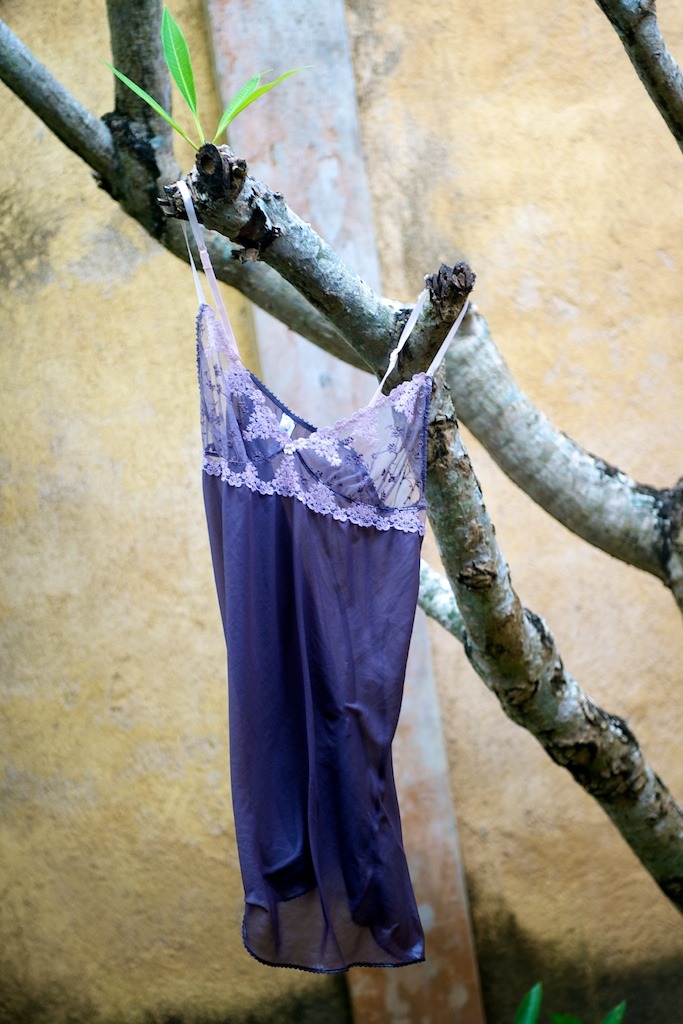
Sure, it is not easy to make something "pretty" out of chemical fibers, but often they are choosen because they are easy care. But are they really? Just a little bit too high ironing temperature and they are distroyed forever. Repairing is either not possible or not worth it. I understand the advantages of chemical fibers for outdoor clothing quite well, but even the "easy care properties" of cotton, wool, linen and silk are also very good. Just hang them on a tree and let them dry. And even they are a bit ruffled. At least they smell like fresh are and not like an oil rig.