When I first experimented with ANNs (Artificial Neuronal Networks) in the 90s, during my PhD research in the field of artificial weather modification, I did not really succeed to make them work for me. This was long before the current AI boom. The SUN UltraSparc was the best machine in town, but still computing power was very limited. Another reason, not to proceed that direction, was that these models help to predict, but not to conclude or understand. And of course, science is about understanding stuff. This was my first contact with this form of AI and I did not give it much attention for years to come. I only digged it out from time to time, teaching quant classes for MBAs for the purpose of stock price predictions, which is fun!
Much later, with two iPhones of friends, I tried to facilitate a conversation between two Apple Siris, just to check how that will go. I was teaching at a Business School by then, besides a corporate career, and my mind thought less scientific, but I was looking for useful tools. My take was, that if two smartphones can talk to each other without human intervention, then I can let them talk and do something else. They don’t need me anymore and I am definitely not interested to listen in either, as long as they get the job done. Well, it didn’t work. But soon it will. The same applies to automation of Email responses. If everybody has them, then there will be a parallel universe of mail accounts writing to each other. Sooner or later, they will find human language inefficient and develop their own, and from a certain stage it will be impossible for humans to listen in their conversation.
No doubt, AI will take over most execution, coordination and analysis tasks and provide services without human interference. And it’s clear that the moment robotics kicks in seriously, this is also the end of human production workforce in industrial settings, and maybe beyond. So, what’s left?
Yesterday, I arrived Biarritz after two days in Bilbao. The cities are very different. While Bilbao is full of arts and culture, with an amazing creative vibe in town, Biarritz is a surfer’s paradise built on the remains of wealthy beach holiday destination. What they have in common, is that they are very physical. People actually do stuff: in one it’s arts and architecture, in the other they surf. This morning, taking a walk at the Biarritz shoreline, the surfers had really fun in the waves, gliding for a stretch, then being tossed around and coming out discussing with their buddies the best tricks to stay longer afloat. They travel from all over France and beyond to come here and do this. There is no AI in the world creating this kind of enjoyment for them. And even other beaches are not that good. They call Biarritz a “Mekka” of surfers. And yes, it’s for them a “pilgrimage” and not merely “tourism”. If you catch my drift, AI can play and even compose music. But it can’t perform a concert. Technically yes. Emotionally no. It can rhyme, but it can’t write poetry. An LLM can’t express in poems, things which words can’t tell. That’s poetry. So, if you ask, what’s left for humanity? Poetry is the future! And what else?
I turned 60 this year and in my lifetime, information technology made a development which is unbelievable. Back in the mid 70s I won a science competition with a simple three wheeled vehicle, that was able to find a light source and recharge batteries. We found “cybernetics” cool and that the fridge would switch on the compressor above a preset temperature to cool down again. We thought the Turing test was amazing and unbreakable for a machine. We learned coding on Commodore and Sinclair computers. And we read Hofstaedter’s Gödel, Escher, Bach and also the Hitchiker’s Guide to the Galaxy. During this short time of my life, the world has changed completely. We are now seeing the first “intelligent” machines. And the next ones will be partially coded by their predecessors. Some people say, the AI bubble is about to burst. Well, the Dot-Com-Bubble also busted. Did that stop anything?
So, what to learn next? Where will humans still have an impact in the creation of goods and services? I think, it has to be a higher or elevated level. It’s the emotional experience. Humans are not that primitive that they want to live in a “computer game” or in TikTok or Instagram. Some are, but they won’t have money to spend anyways. At least the ones I know, are sophisticated creatures, and they move up the Maslow Pyramide or any pyramide more suitable in today’s world. Figuratively, humans have to deliver on the Michelin Star Restaurant in the future, while McDonalds will be run by machines. This is why, I was sad to see for example the “Lighthouse” Cinema in Valletta close. One of the coolest places on the island. If you have something like that, keep it open. I also bet, there will be a new luxury. Not about logos and showing off, but about connoisseurship. The pendulum will swing back towards Jun'ichirō Tanizaki’s “In Praise of Shadows”. Because people will love to hear the things words can’t tell.
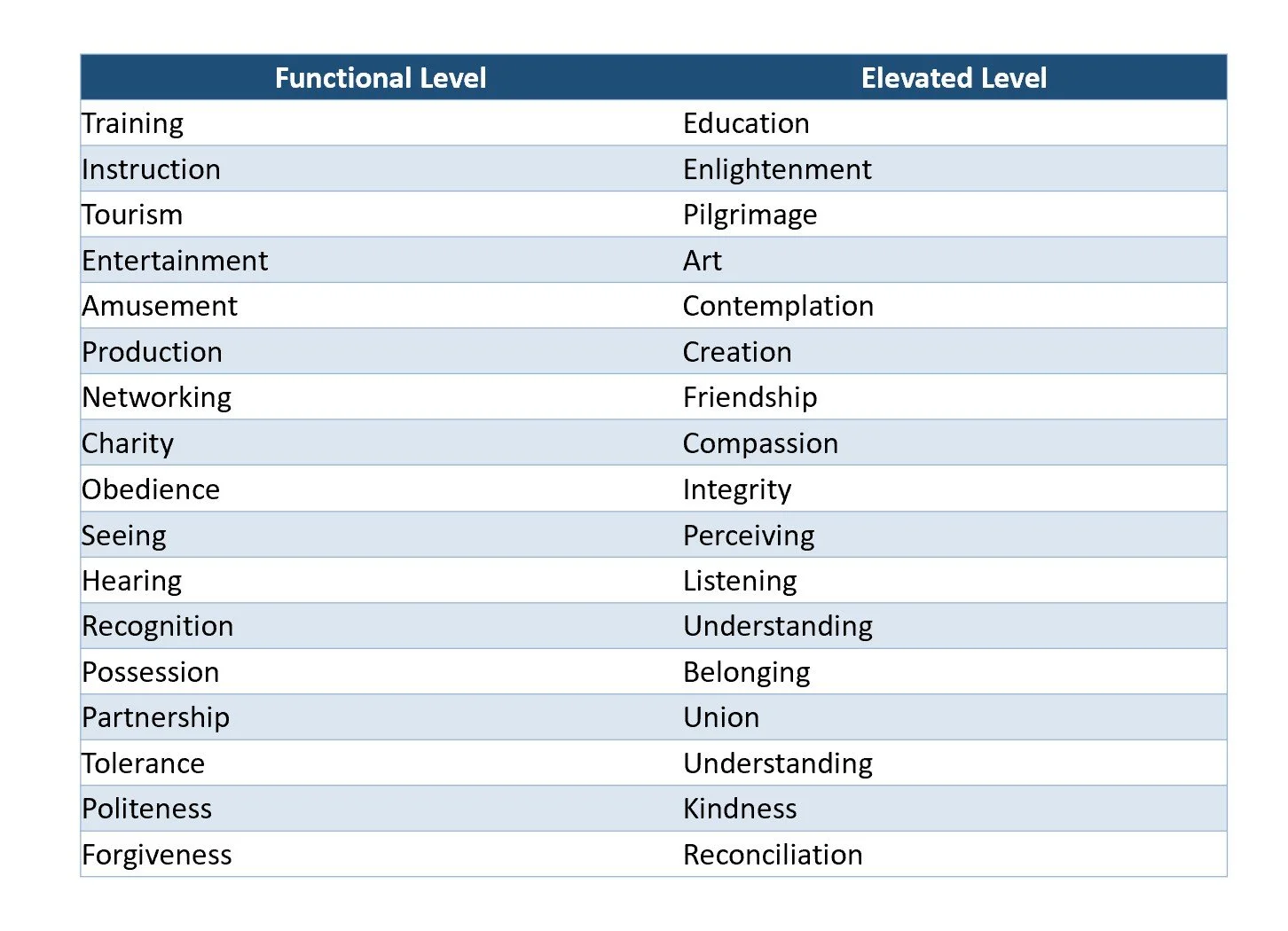
AI will for sure deliver on the functional level. Humans need to learn and some also relearn to deliver on the elevated. That maybe the key answer to the question of what to learn in the future: more creation, less production … more leadership, less coordination …And quickly we end in disciplines like literature, arts and culture.
In the end, I asked Perplexity to give me a list of word pairs which fall into functional and elevated categories. Humans have to go for the right column of the table, and use the tools provided on the left by AI.