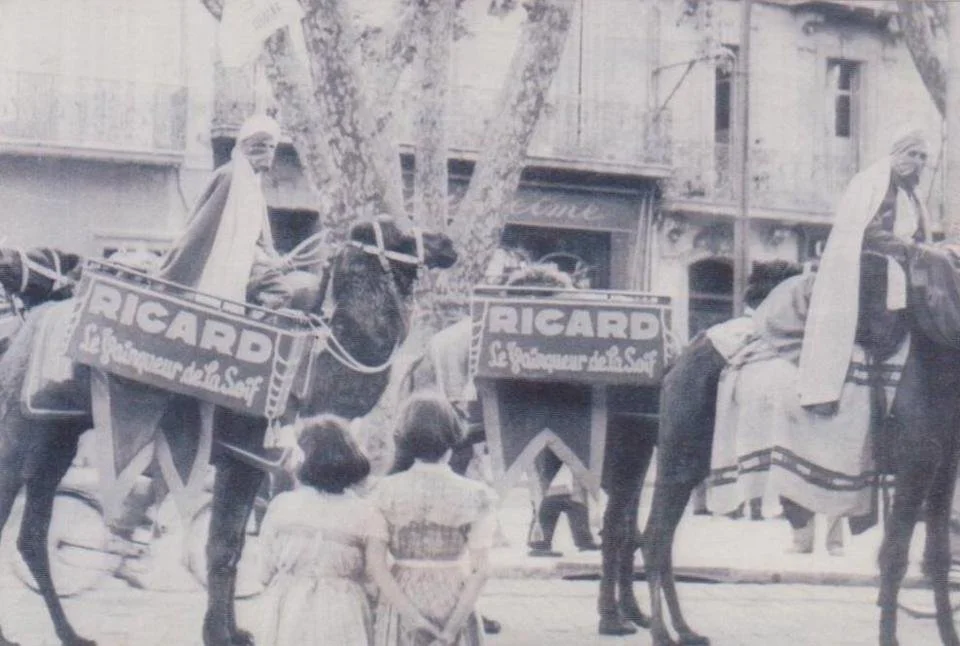
With recent events, triggered by the US-Israeli attack on Iran, I was reminded a scenario workshop where a potential blockage of the Straight of Hormuz was discussed extensively in the context of alternatives provided through the “One Belt, One Road Initiative”. But let’s not go into that now. We all had enough geopolitical ignorance Made in America, by now. Instead, looking into Mediterranean travel and crossing Île de Bendor, I recalled “La Caravane de la Soif” masterminded by Paul Ricard’s during the Suez Crisis. This was a masterpiece of turning challenge into opportunity. Paul Ricard had built his pastis empire not just on a unique recipe, but on an aggressive, direct-distribution model. Since launching “Ricard, the true Pastis of Marseille” in 1932, he had relied heavily on a fleet of branded delivery trucks to supply bistros and cafés across France.
The Suez Crisis began in July 1956 when Egyptian President Gamal Abdel Nasser nationalized the Suez Canal Company, a joint British-French enterprise. In response, Britain, France, and Israel launched a coordinated military operation in October and November 1956 to regain control of the canal. The conflict resulted in the canal being blocked by sunken ships for several months, severely disrupting global trade routes, particularly the flow of oil from the Middle East to Europe. This disruption led to an acute fuel shortage in France and Britain. By late 1956, petrol rationing was introduced, forcing businesses and citizens to drastically alter their daily operations and transportation methods.
For Paul Ricard’s company the petrol rationing threatened to paralyze this distribution network, potentially cutting off the supply of his highly popular aniseed spirit to the crucial Parisian market. Faced with the inability to use his delivery trucks, Paul Ricard devised a brilliant and audacious solution. He decided to bypass the fuel shortage entirely by using an ancient mode of transport: the camel. Ricard organized a caravan of camels to deliver his pastis directly to the bars and cafés of Paris. This initiative was famously dubbed the “Caravane de la Soif” (Caravan of Thirst).
Paul Ricard must have been quite a character and reminds me of figures like Jim Thompson, reviving the Thai silk industry after WWII and mysteriously disappearing in the jungle. Ricard tested his recipes first illegally in bars and restaurants, and by that gained a unique edge during prohibition. Ricard, a passionate painter, was also a significant figure in motorsports, notably constructing his own racing facility, the Circuit Paul Ricard, in Le Castellet in 1969. When it opened in 1970, the track was considered one of the safest in the world and featured advanced facilities that made it a premier destination for Formula 1 testing and the French Grand Prix. Beyond racing, he was a dedicated developer and philanthropist, donating several Mediterranean islands, including Île de Bendor, to the French government to promote tourism. Further, appalled by industrial pollution in the Mediterranean, he founded the Observatoire de la Mer in 1966, which evolved into the Paul Ricard Oceanographic Institute to research and raise awareness about marine health.
Paul Ricard published his autobiography, La Passion de Créer in 1983. I have to admit, I did not read it yet. But when the time has come that I start to read other people’s autobiographies, it’s on my list