
Kalkara Festa
From May to September, the Maltese villages proudly celebrate their Festas to honour their patron saints. It’s quite competitive among villages: decorating with flags and statues, traditional music bands parading the streets, sweets and food, and amazing fireworks …
From May to September, the Maltese villages proudly celebrate their Festas to honour their patron saints. It’s quite competitive among villages: decorating with flags and statues, traditional music bands parading the streets, sweets and food, and amazing fireworks. And you better clean up your house before the festa and decorate your windows at least. Processions will follow, and church bells will keep going. However you stand to the religious aspects, the Festas are just nice and happy.
Kalkara got a new waterside promenade. It isn’t completely finished yet, but it’s for sure a construction project upgrading the whole village. Whether finished or not, it is already an integral part of the party in front of the Kalkara church.
There is no sign that the “heatwave” will stop people from having a good time. It is the hottest time of the year, and in August, there will likely be additional humidity kicking in. But that’s how it has been every year, and there maybe, of course, a trend that things get hotter. But nobody complains here, but just switch activities to before and after sunset.

Luxury revisited
I have been recently volunteering at the Academy of Fashion and Design (AMD). Neither fashion nor design is my field, but I filled some gaps in necessary management disciplines. To my surprise, a student of fashion management, Ms Mia Just, chose me as a second reader for her thesis on the ambiguity between creativity and commerce in fashion …
I have been recently volunteering at the Academy of Fashion and Design (AMD). Neither fashion nor design is my field, but I filled some gaps in necessary management disciplines. To my surprise, a student of fashion management, Ms Mia Just, chose me as a second reader for her thesis on the ambiguity between creativity and commerce in fashion. It led me back to many of the thoughts I had when looking closer at the contemporary art space, but it also brought me back to the time the Volkswagen Group bought Rolls-Royce - Bentley. We were the “Beetle-people” now owning the holy grail of luxury cars and thinking of what to do with them. To prepare myself for reading the thesis, I also revisited my notes on the exhibition “What is Luxury?” at the Victoria and Albert Museum in 2015. And I took two books out from the shelf again: Soetsu Yanagi’s The Beauty of Everyday Things and Junichiro Tanizaki’s In Praise of Shadows.
With all the definitions of Luxury given, I found that I have my own one, which is about the people’s view on the object. I don’t mean that luxury is in the eyes of the beholder and that everything can be luxury—quite the opposite. Luxury products are defined for me by the “connaisseur”, meaning the one who knows what he looks at and recognises its qualities in material, design, craftsmanship or symbolic value. This is why, for example, Porsche is not a luxury car anymore, because it’s a Volkswagen. This is why many luxury fashion brands are not luxury, as most buyers have no clue what they look at and only see the logo. Recently, a colleague of mine told me that she lost a diamond bracelet in a Sauna in the Netherlands, but that “these people”, for sure, can not distinguish diamonds from glass.
Contemporary luxury branding, I find, often has more of the task of explaining to ignorant people that the thing they look at may be something special. In the better cases, it really is. In many, it isn’t. I was recently looking at “luxury apartments” in Toronto. What’s “luxury” about a concrete frame building with triple glazing and an expensive toilet?
That also changes what a status symbol is. Many years ago, as a young manager at Volkswagen in the German headquarters, I had a new boss for a short period of time. He was a European Business School (EPS) graduate who gained significant corporate experience in the US before returning to Germany to run the group’s strategic marketing unit. Joining a meeting once, he educated me that the first thing he looks at in a person is the watch, then the shoes, then the suit (it wasn’t the same sequence for women, by the way). Then he knows what person he has in front of him! I looked at his pocket calculator on the meeting table, which did not even have trigonometric functions. So, I knew what kind of person I had in front of me! I picked up the calculator and looked at it, then at him, then at the calculator, put it in front of him and asked: “Yours?” This meeting did not end up being very productive.
Fortunately, we live in a world where money is only one of a number of factors defining status. So, also, the symbols change.
If luxury products and the connoisseur come together, then my understanding of luxury has a strategic disadvantage. With education levels plummeting in the Western world and people interacting less and less intensely with things, the degree of understanding and appreciation also will disappear. Who can pull an old Ferrari into a barn and restore it step by step with a glass of wine and classical music as evening entertainment? Who can even repair his home appliances without “service”? So, if nobody is willing to interact with things, then also nobody will know the quirks, and nobody will appreciate their qualities and beauty. And it maybe even the same dealing not with things, but with people.

“Anyone who isn't confused really doesn't understand the situation”
Recently, reading the news this quote by the American Journalist Edward Roscoe Murrow came to my mind: “Anyone who isn't confused really doesn't understand the situation”. If I remember right, he coined it as a war correspondent in Vietnam …
Recently, reading the news this quote by the American Journalist Edward Roscoe Murrow came to my mind: “Anyone who isn't confused really doesn't understand the situation”. If I remember right, he coined it as a war correspondent in Vietnam. Who thought a few years ago in Europe that the world would come back to these times? Did we have an attempted coup in Russia yesterday? … I guess it may be getting more chaotic.
I returned from a field trip to Germany and France with a group of MBA students from the University of Hong Kong. Then I was working on the construction site in Hundsrück, where the little house gets anything from praise to “it looks like an alcoholic’s family took half of their inheritance and built a dog shed.” People in Germany are not very kind to each other. The new German National Trinity is: “Schlagloch, Funkloch, Arschloch”. Now I am mooring in Tilburg after moving the boat from Biesbosch a little down South. I even received a welcome pack when entering Piushaven. It’s funny to be on a boat in an urban setting. It’s a very friendly place. Temperatures are a little high, reaching 32°C. But that’s supposed to change by tomorrow.

Weatherproof built up
My construction in Hundsrück is going forward, even though a lot of obstacles have not been anticipated and now cause additional steps and delay. But given the fact that the first one and a half years, it was all just paper pushing, now I can see progress nearly every day …
My construction in Hundsrück is going forward, even though a lot of obstacles have not been anticipated and now cause additional steps and delay. But given the fact that the first one and a half years, it was all just paper pushing, now I can see progress nearly every day. The house is now built up weatherproof, painted from outside and doors and windows are fitted. Luckily the weather is getting better. Heavy machinery is hard to move on muddy rounds. Now, the major part is to connect the house to utilities. This needs first an about 70 m trench of 1.20 m depth to make it frost proof. And also, because the land is not flat there needs to be a pump installed. There is quite a cost explosion compared with the original plans. But I consider it better to fix up everything in a very solid manner, instead of having to deal with issues in the next few years. If all goes well, then it will be finished by this summer.

Land of Ice and Fire
Iceland does not feel like changing scenery - it is like changing planet. Going for a week off road in Iceland’s South is a good thing to do, while on my construction site the house foundation went through the finish line. April is a little to late for a good chance to see Northern lights. But Iceland has a lot to offer: glaciers, volcanos, waterfalls, geysers and all you need to push a 4x4 to the limit …
Iceland does not feel like changing scenery - it is like changing planet. Going for a week off road in Iceland’s South is a good thing to do, while on my construction site the house foundation went through the finish line. April is a little to late for a good chance to see Northern lights. But Iceland has a lot to offer: glaciers, volcanos, waterfalls, geysers and all you need to push a 4x4 to the limit. Equipped with a 2022 version of the Suzuki Jimny. This car is like a gecko. It goes up everything. With a curb weight of just above a ton, crossing rivers it has a bit of a handicap though. But with anything else, this is a perfect car to go quite extreme. And that’s what Iceland is - extreme.


Driving around the whole island in a week, is a little too much behind the wheel. That’s why I focused on South Iceland, took more stops. Walking towards the glacier lagoons gave me the opportunity to see the effects of climate change and to recall my University lectures in glaciology. From the most recent end moraine you walk around to 2 km to the lagoon. Then it’s another 500 - 800 meters to the glacier itself. This looks like the retreat of ice in the last about 100 years. And that’s a lot. I have seen similar scales in New Zealand a few years ago - maybe even more. I do appreciate all the effort to curb greenhouse gas emissions. But it does look to me, that we better also start to also prepare coping with what’s coming anyways. And then there is the whole field of climate engineering, which I studied quite intensively during my PhD time. I am pretty sure, that the whole topic of global warming is too serious to keep it to the hippies trying to fix it by drinking oat milk and soy beans. And anyway the concept is known at least since I started studying in 1986. It’s a little late for voodoo, right?
The last two days I spent in Reykjavik to give the trip an urban ending and troll around with humpback whales and dolphins in the Reykjavik Bay, which was fun.

The last dirty mile (is really dirty)
The last stretch is actually less than a mile. But getting the building material on the construction turned out to be quite complicated. The truck came with amounted crane and a trailer with a trailer. So the procedure was …
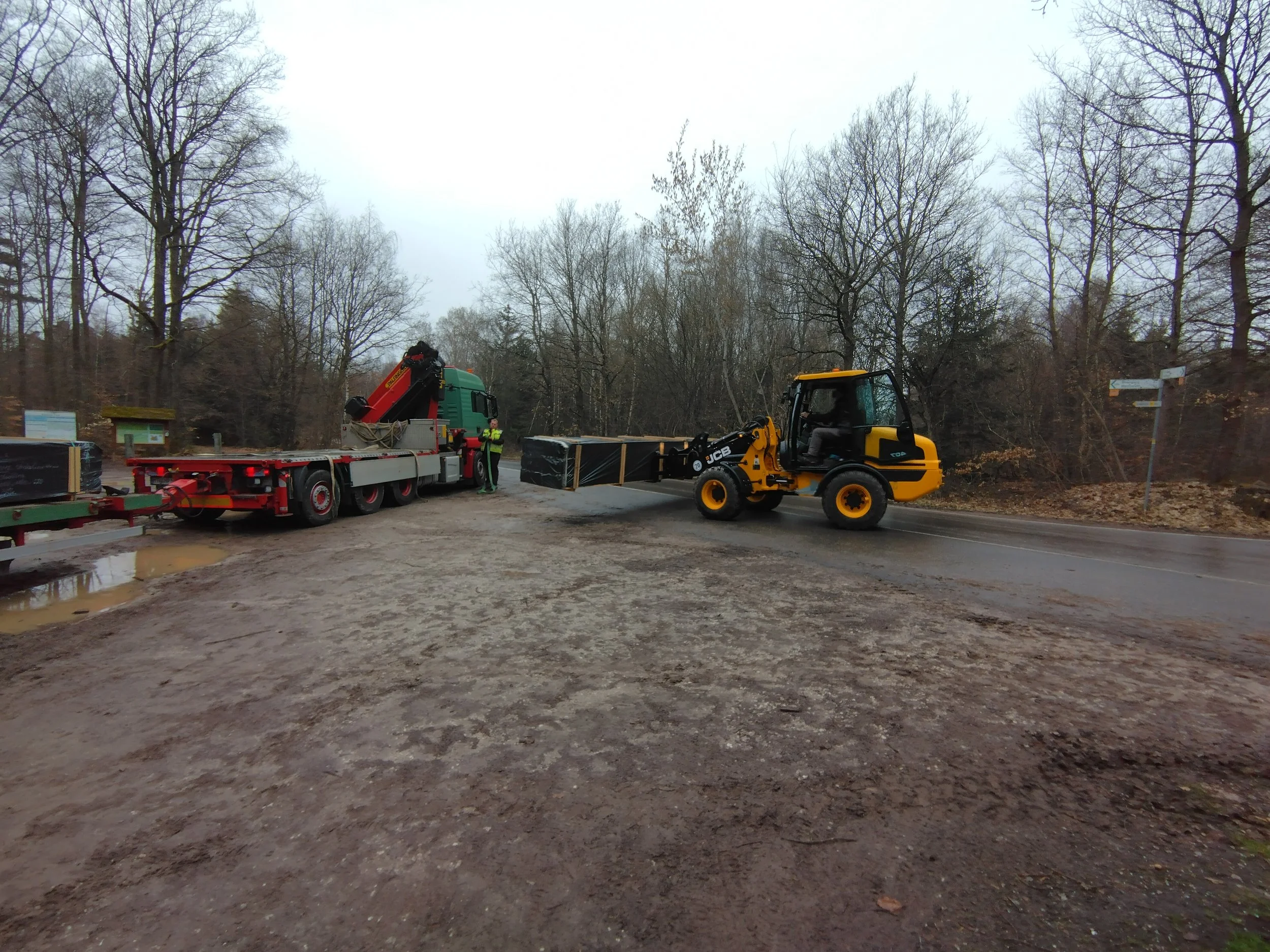
The last stretch is actually less than a mile. But getting the building material on the construction turned out to be quite complicated. The truck came with amounted crane and a trailer with a trailer. So the procedure was to park the trailer, and first lift the parts like insolation material, windows, doors and roofing in. Then reload the 4 packs of cladding from the trailer on the truck and repeat. However, one pack has slightly under 2 tons and as the access road is narrow, it was not possible to stabilize the truck. The alternative was to drive a small bulldozer in first, mount a fork, and then lift the packages off from the side. Just after the first pack was off the truck, it started raining and the dozer sank in the mud. Stuck. So, the other 3 packs had to be placed on a parking place close and stay there a few days, until the surface can be covered with gravel. Not perfect, but no other way possible.

With all these heavy machines running in his forest, somebody seems to meditate on “tell me where the flowers are”. It will need a bit of gardening after.

Construction begins
Besides work, quite a few things are keeping me busy at the moment: 1) building a wooden weekend house in a forest region up the Upper Middle Rhine Valley and 2) moving my house boat away from Lathum (Netherlands) south through the canals …
Besides work, quite a few things are keeping me busy at the moment: 1) building a wooden weekend house in a forest region up the Upper Middle Rhine Valley and 2) moving my houseboat away from Lathum (Netherlands) south through the canals. In both, I am learning quite a bit each day, and for those who may plan to do something similar, I thought I share some experience. It may sometimes be quite brief because the first lesson learned is: I am very, very busy.
Let’s start with the house. It’s an assembly kit made in Lithuania and provided by the company Pineca. The model is called “Adaline” and has 50 m² with a tilted roof. It’s an insulated version to make sure it can be used in winter. It also comes with an optional 24 m² Terrasse, which I had to shorten a little, as the land title only allows 70 m² max built surface.

Perhaps it’s worth mentioning that the administrative process until construction could start was quite lengthy. First came a one-year legal battle with the seller of the land. I was not aware that the sales were in the context of an inheritance settlement between two daughters, one of which was a (very nasty) lawyer. What I learned here is that just by claiming nonsense and writing idiotic letters, people can slow you down forever. It does not matter to be right when somebody knows to play the game of throwing roadblocks into the process. Luckily, I was able to settle after a year. Then came the building permit. The first application was rejected because my architect filed for a “holiday house” (Ferienhaus) instead of a “weekend house” (Wochenendhaus). It’s the same house, but a “holiday house” is a “touristic installation” which can not be granted in that region. So, now you think: fust change the word. No, not in Germany. Here it would be best if you reapplied from the start. Another half year passed, including a necessary re-drawing of plans because the fond used was too small for the micro-fiche archiving. Yes, Germany in the year 2023 - micro-fiche. The lesson learned here was to take an architect who knows people at the local building administration (Bauamt) instead of the building. You may also ask why you need an architect to apply for building an assembly kit house, anyways. Well, you need.
Luckily the company Pineca was super tolerant, coping with these delays. At some point, they wanted to deliver quickly, after the suggested date when the building permit was expected. So, they started production and things needed to stay in the warehouse for over half a year. But finally, clearance came at the beginning of March, after over 2 years of paper pushing on my side.
The land is slightly tilted and my plan to build close to a small road, where sewage, fresh water and electricity is available had to be revised, due to some building regulations. So now, it’s getting a little more complicated with getting utilities connected. Also, the delivery was outsourced to a logistics company and they did not make any enquires on the conditions, turning up with a 40 ton truck and a stapler. The German driver was completely un-inspired and a rather rude fellow, refusing to even give it a try to deliver the last few 100 meters and unload. On top of that one hail storm after the next came down. So, I called a friend who luckily knew a friend about 1 hour drive away with a large timber company and space to unload and store material for a short time. If he would not have agreed to help me, I would have really been in a fix.
Now the material is at MS-Holz in Wiesbaden and the owner helped me to find a local logistics company called Pauly with a truck, having a crane mounted and a trailer. That should do. It’s about 9 m load and the heaviest pack is 1,8 tons. 4 large packages are each 6 m long.
Another chapter is the foundation. Here I had several offers, of which I decided for a local young entrepreneur contractor. It was by far not the cheapest offer, but fairly priced and competent.
The process is as follows: 1) the surveyor marks the building site roughly for the excavation, 2) the excavation is done and gravel to protect from frost is filled in. Then, 3) the surveyor marks the site precisely and the concrete is pored in and finished. The foundation itself is laid out by a static planning, including how much steel has to be in the concrete.
So, now things can really get started and I will continue sharing experiences. Of course, should you bump into this site online through a search engine, and have specific questions, please feel free getting in tough through the contact form.

TIAS and on to Zürich
Last week was the first time I taught my Strategy Course at TIAS (Tilburg Institute of Advanced Studies) in the EMBA Programme. And I really enjoyed it. Great participants from all kinds of industries and walks of life, which reflect the structure of the Dutch industry landscape …
Last week was the first time I taught my Strategy Course at TIAS (Tilburg Institute of Advanced Studies) in the EMBA Programme. And I really enjoyed it. Great participants from all kinds of industries and walks of life, which reflect the structure of the Dutch industry landscape. TIAS developed into a highly regarded business school, which Tilburg University and Eindhoven University own. Teaching this course gave me a really good insight into the current challenges of Dutch companies, which are different from what we experience in Germany. For the future, I will also restructure my course a bit to reflect these differences.
After driving back from Tilburg, with a quick stopover in Germany, I flew from Frankfurt to Zürich to work the next week. Normally, I would have taken the train for such a small distance. But the German railway is currently in such a desolate condition that I took the plane. The flight time was just 35 minutes. With the German Railway, such a trip is completely unpredictable and can take you a whole day, if you arrive at all.
Arriving in Zürich is nice: friendly, quiet, efficient, clean and safe. Switzerland appears to be everything Germany is not anymore. So, I am looking forward to start my week here.

Carl Hahn
It was more than 26 years ago. As a young manager in Wolfsburg, I had the honor and privilege to be invited to Dr Carl Hahn’s 70th birthday. And when I say “honor and privilege”, I really mean it. This was a surprise invitation for me, …
It was more than 26 years ago. As a young manager in Wolfsburg, I had the honor and privilege to be invited to Dr Carl Hahn’s 70th birthday. And when I say “honor and privilege”, I really mean it. This was a surprise invitation for me, as my former girlfriend was his assistant, and she asked me to join her. So, I did, and we chatted, joked, and got to know Dr Hahn’s wonderful American-born Italian wife Marisa and his children, together with other guests. I remember that I borrowed a pen from him in the garden to note something down. It was a cheap one-way pen from the VW office supply, and he handed it with a smile, demanding to return it after use, as it “is valuable”. We had a few more meetings in his office at the Wolfsburg Art Museum, one when I was already in China and returned to HQ for a business trip. Once, he actually fell into a construction ditch the day before and hurt his leg. So, he asked me to hand him the wastepaper basket to put up the leg, and so I sat opposite a pioneer in globalisation talking about China. Carl Hahn initiated the joint venture between Volkswagen and SAIC in Shanghai, becoming operational in 1984. When we celebrated the 20th anniversary in Shanghai in 2004, the CEO of Volkswagen Group, Ferdinand Piëch, put us in a fix. His office informed us that should Hahn be invited, Piëch would not attend. I always avoided Piëch, because when he looked at you, it was so piercing that you may better take an Aspirin before. There were, and for sure still are, a few of these characters at VW. It was the time I learned that organisations are not run through an org chart, but warlords run them. Still, the 2004 celebration turned out to be like living in Martin Posth’s book “1000 days in Shanghai”, describing how the joint venture was set up. Many of the book’s characters became alive in front of me. And they were friends. Of course, I also read Daniel Goedevert’s book “Like a bird in an aquarium”, looking back at his time as CEO at Volkswagen. I never met Daniel Goedevert though.
Last year I was still in touch with Dr Hahn’s office to arrange a meeting. One point I wanted to convey was to thank him for being an inspiration and role model to me. Even sometimes during my travels, when it became tough, I thought of him in his 80s going somewhere in rural Tajikistan to negotiate setting up a shoe factory for Deichmann. Due to the Covid protocols, our meeting was postponed several times.
Yesterday, on January 14 2023, Dr Carl Hahn passed away in his home in Wolfsburg, aged 96. He follows his wife Marisa Traina Hahn. He leaves behind his children, grandchildren and friends. The world lost one of the great industrialists and visionary managers. And many lost their mentor and godfather of their careers. I regret, I could not thank him in person.

Winter 2022/23 is over
The time of my birthday is usually the coldest time in the Middle-European winter. But not this year. I made the boat winterproof in December, when there were actually some minus degrees. But now it is at times + 14 °C, while -14 °C would be seasonally possible …
The time of my birthday is usually the coldest time in the Middle-European winter. But not this year. I made the boat winterproof in December, when there were actually some minus degrees. But now it is at times + 14 °C, while -14 °C would be seasonally possible. The next 10 days forecast also stays above zero. So then, if no cold snap surprises us, winter here is over. Well, it helps the gas bills as also the heating season is mild like I cannot remember it from before.
My birthday, this year, I went to my birth town and visited the hospital in which it all started back in 1966, during a snow storm. It’s the Brüderhaus St. Josef in Koblenz located in Kardinal-Krementz-Straße. This hospital was founded in 1899 by Brother Peter Friedhofen, who before started the Catholic congregation of Barmherzigen Brüder von Maria Hilf in 1850. My short visit this year was on a rainy day, not a snowstorm at all.
Of course, people debate whether this weather change is in the context of man made climate change. Seems very likely, yes. But in any case, I decided, perhaps prematurely, to wave winter goodbye and start spring time. After Covid and war in Ukraine, with all it’s implications, it’s good to have some light in 2023.

Brüderhaus Koblenz

Boat on the river
I returned to the Netherlands. It’s raining, 6° Celsius, and it gets dark at about 17:00 (5 p.m.). But I am staying on my boat, and it’s cosy inside. The gas heating is doing a good job …
I returned to the Netherlands. It’s raining, 6° Celsius, and it gets dark at about 17:00 (5 p.m.). But I am staying on my boat, and it’s cosy inside. The gas heating is doing a good job. I was going out with a thermal camera to spot some weak spots in terms of insolation potentially. But there are non. Also, I ran the engine for some hours, put more air into the fenders and tightened things up for potential autumn storms to come. There is now no wind at all, and the water is like a mirror. That’s a little uncommon for the season, definitely when compared with last year, when heavy storms swept over this land.
This is the second winter on the boat. The marina is nearly empty, as many took their boats on land for maintenance. I will do so only briefly before I am planning to take the boat through Belgium to France in the coming spring and find a harbour in Alsace.
A boat is a lot of work. And they have a character. You better learn about it. It took me 2 hours to figure out a problem with the DC/AC-Inverter. Then many hours small maintenance items and cleaning. Finally, also the dingy had a problem. I pumped out the rainwater and slipped on the wooden plans, smashing my knee. But all okay.

My favorite Social Media: Postcrossing
Recently, I enjoyed “Postcrossing” after I heard about it on a German radio station. It is a global platform organizing the exchange of postcards among enthusiasts. As I buy postcards in most places I go, …
Recently, I enjoyed “Postcrossing” after I heard about it on a German radio station. It is a global platform organizing the exchange of postcards among enthusiasts. As I buy postcards in most places I go, I do have quite a collection. But I am not really a collector, and enjoy sending and receiving them much more. So “Postcrossing” is for people like me and me. Like every medium, there is a self-selection of people who choose it. And this group is a very nice and interesting one. Today, after coming home from a morning lecture at the Wiesbaden Academy of Fashion and Design, I found a card from the Russian city Sarov (Саро́в) in my mailbox. I knew it was a closed city as it contains a Russian Nuclear Research Centre and Rosatom. Previously it was also called Gorkiy-130 (Горький-130), Arzamas-16 (Арзама́с-16) and Kremlyov (Кремлёв). So, I started to read more and it is fascinating.

Genuinely entered the 21st Century: got a Tablet Computer
On my way out, I picked up a 5G tablet computer. It’s running on Android, and one of the beauties is that I can really write with a “pen” on it. While many predecessors felt more like writing with a banana in the sand, this one is really (!) good. I also considered e-ink tablets like, for example, the …
On my way out, I picked up a 5G tablet computer. It’s running on Android, and one of the beauties is that I can really write with a “pen” on it. While many predecessors felt more like writing with a banana in the sand, this one is really (!) good. I also considered e-ink tablets like, for example, the “Remarkable 2”. But I had this Samsung T8 5G and the Remarkable side-by-side, and clearly, in a world of video calls, the Samsung is far more of a versatile tool - even I do like the e-ink display for reading. In terms of price, the weakness of the Euro was compensated by having no silly things, like VAT, in Hong Kong.
On a side note: I never quite understood why value creation is taxed in Germany (Value added Tax) while value destruction receives subsidies. I guess that's “Communism with German Characteristics”. Hope one day, some economist can explain this to me. Till then, I am also not planning to buy anything made in Germany, except perhaps food. That also helps them with energy conservation and deindustrialisation. I heard the plan is that the German economy will be run by 2030 on yoga teachers, civil servants and child book illustrators, like their current economic minister (seriously !). Perhaps that is also why I am not quite optimistic that I will have a 5G network available for my new toy in Germany. Wasn’t 5G killing the penguins in Antarctica? No, it caused COVID? Only Huawei 5G causes COVID, right? I am not an expert, so forgive me if I got this wrong. I would have to ask, for example, Greta Thunberg or Annalena Baerbock. But don’t know where to find them. I was too busy to go to Sharm El Sheik (by bicycle).
With this tablet computer, I can also publish blog articles on the fly, which I am trying for the first time. Please be patient should it go wrong on the first few attempts. So, I think this will also help maintain this website better and more frequently. There are big plans for the new year, and sharing some may interest others. I will move my boat to France, for example. And, given that the permit will come through one day, I will build a wood cabin on a piece of forest land. Another thing with “German characteristics” - is getting a building permit. Just try getting a permit for a solar panel in the “lands of poets and philosophers”. No, don’t. I was joking.
But I will keep you posted.

Hong Kong's Year to Rebuild
As I continued coming to Hong Kong, even during the pandemic lockdowns, I could now feel the optimism of an awakening city after hard years. Troubles started in 2019 with violent riots on the streets and then two years of being literally cut off. Still, crossing over to the Mainland, has some quarantine regulations in place, …
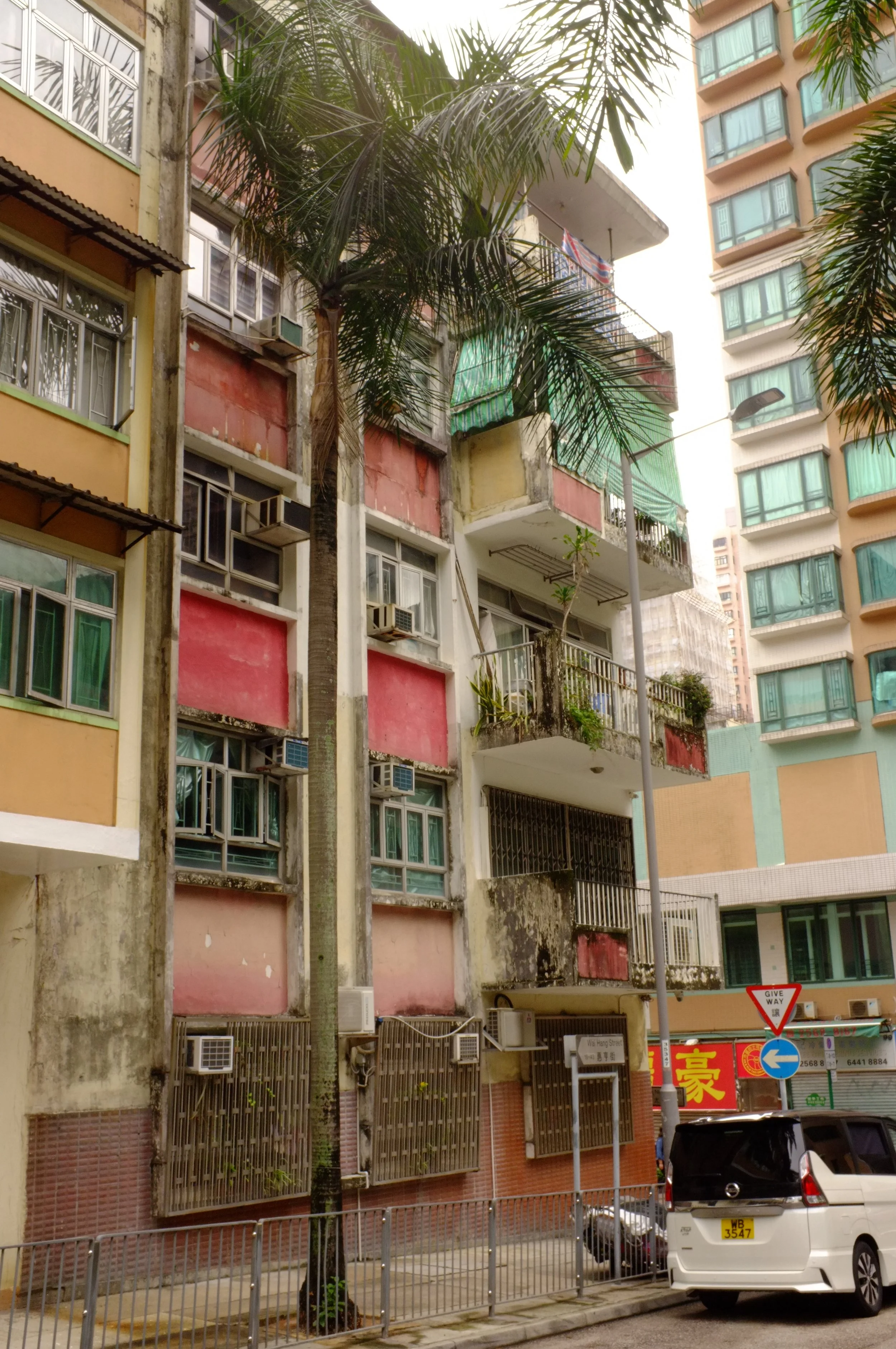
As I continued coming to Hong Kong, even during the pandemic lockdowns, I could now feel the optimism of an awakening city after hard years. Troubles started in 2019 with violent riots on the streets and then two years of being literally cut off. Still, crossing over to the Mainland, has some quarantine regulations in place, as the situation there is different due to the sheer size of the population and structure of the medical system. It is, of course, still hard for Hong Kong not to be fully connected to the mother province Guandong. But at least for travellers arriving from other parts of the world, arrangements for testing have substituted the quarantine requirements. I personally found this very well organized. Still, shopkeepers told me that with the Euro and the British Pound down against the US$-pegged HK$, European visitors don’t spend. US-Americans are rare these days. So, it will still need Mainland tourists to come. Even they may actually choose to travel elsewhere once this is possible again.
Also, the troubles of 2019, where protests escalated into full-blown riots, disappeared. This is partly because of recent changes in security laws. Some say they are now too strict. But having been here during the peak of rioting in 2019, I am not surprised by such a legal tightening. Also, many have been lured away by the British offer to extend some of their rights in the UK if they hold a British Oversea Passport. I think this is really difficult and mainly plays into the British playbook of getting a (cheap) workforce and money into the country. Still, I wish those who went all the best. In any case, Hong Kong has become stable and safe again, and I am convinced the “Year of Rebuild” will show once again the resilience this city has. Perhaps I even made a small contribution by teaching a skill-based MBA course on Turnaround Management and Corporate Resilience at the University of Hong Kong Business School.
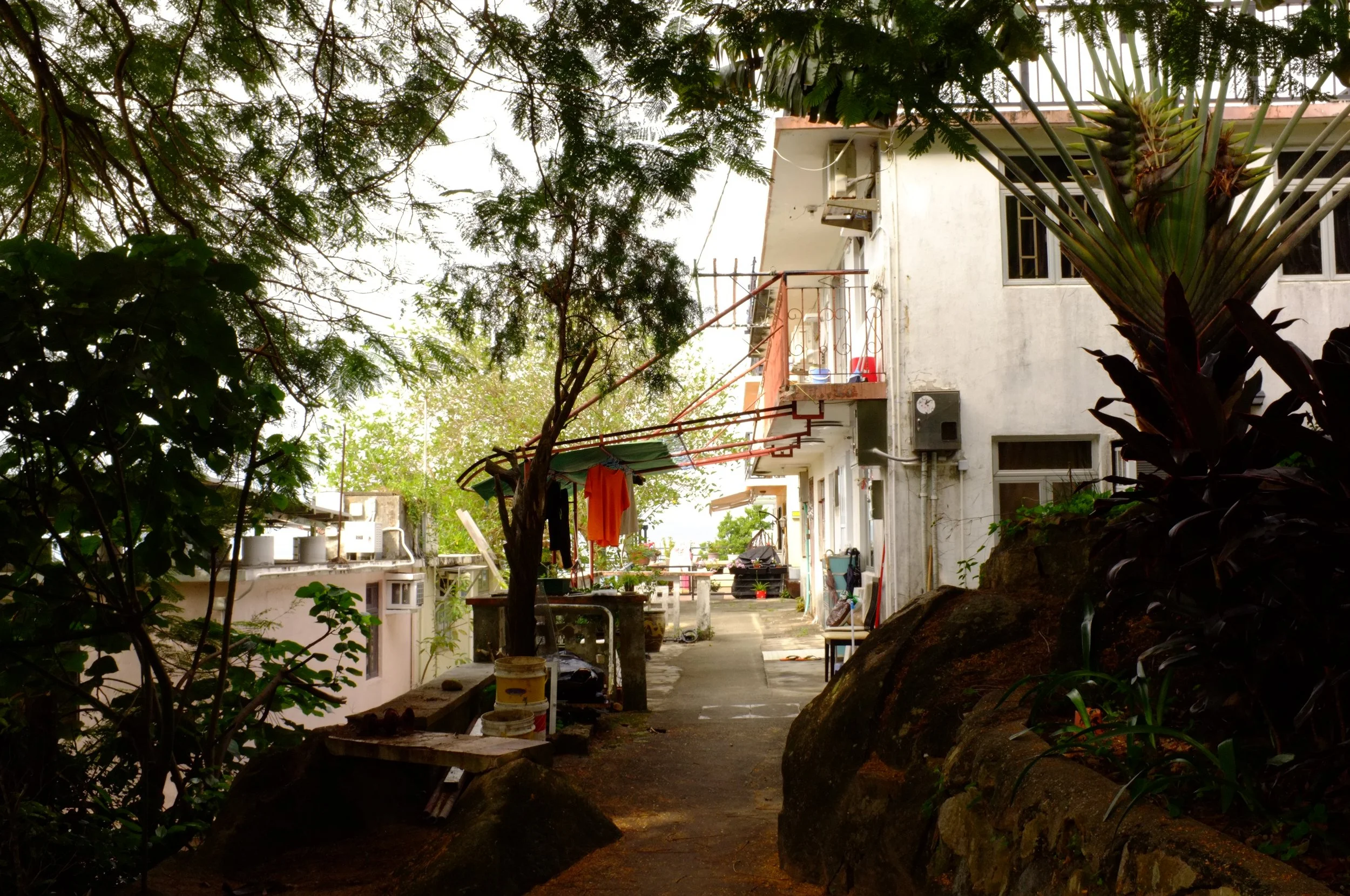
As I have to scale down my own University engagements, this year’s hike on Lamma Island also marked the end of my academic decade. It all started in 2006 when I set foot for the first time on the Island and immediately loved it. For five years, the island became my home in the South China Sea. I should perhaps have never left it. Of course, I will continue teaching Masterclasses and Executive Education also in the future. But it’s now time, again, to get back to business.






Frankfurt-Riga-Tallinn-St Petersburg-Moscow … and back
Since my last scheduled trip to Moscow was diverted to Armenia, I decided to catch up on my Moscow plans. Adjusting to the current travel restrictions, I flew from Germany into Tallinn via Riga, took a bus to St. Petersburg, and continued by the Sapsan high-speed train …
Since my last scheduled trip to Moscow was diverted to Armenia, I decided to catch up on my Moscow plans. Adjusting to the current travel restrictions, I flew from Germany into Tallinn via Riga, took a bus to St. Petersburg, and continued by the Sapsan high-speed train.
For those of you who might be wondering what life looks like in Moscow at the moment, it appeared perfectly normal to me. Prices have risen slightly, but everything is available. Russian investors have mainly acquired the assets of Western companies which have left Russia, and where possible, they continue the operation. That’s, of course a little easier with McDonald’s, Zara, or IKEA than with a car factory. And, of course, stronger effects will be seen after stockpiles of components are depleted, and it is more difficult to replenish them. Still, my guess is that Russia will be able to get more independent from Western sources, the same way as Europe will manage to get more independent from Russian commodities. Whether this will make the world a better place or shorten the conflict in Ukraine, I doubt.
A highlight of my visit to Moscow was the Morosow-Exhibition in the Pushkin Museum. It is astonishing how the art collector Iwan Abramowitsch Morosow had a very good hand at picking artworks and artists that were back then but not broadly popular yet. This includes 18 paintings by Paul Cézanne. By the Russian Revolution, his collection stopped inevitably, and he left Russia. The artworks were nationalised and split between Moscow and the Hermitage in St. Petersburg. So, it was a rare opportunity to see all the collections in one venue before being divided to their host museums again. The show was returned from previously being presented in Paris. And, of course, there were some hick-ups on the French side, whether it could be returned to Russia in the context of current sanctions. Luckily, it did.
One unfortunate incident was that I may have caught COVID-19 in the museum. I just before added SPUTNIK V to my broad collection of vaccinations, and a few hours after visiting the exhibition, I felt exhausted. So, I blamed it on potential side effects, or even the heat, while strolling over the Red Square later, having ice cream from the Gum. But it turned out to be COVID. Never mind, it was not very bad, and symptoms disappeared completely, even before the first negative test result cleared me off restrictions.

"Solar flares" in the grid
Malta’s communities have added a lot of solar panels recently. So, did my neighborhood in Kalkara. In principle that’s good of course. But with the Maltese electric grid, not being the most sophisticated, it struggles to keep the current within range …
Malta’s communities have added a lot of solar panels recently. So, did my neighborhood in Kalkara. In principle that’s good of course. But with the Maltese electric grid, not being the most sophisticated, it struggles to keep the current within range. I had local surge protectors to keep harm away from small appliances. But with friends, working at Enemalta and telling me about monitoring the very unstable currents in Kalkara, I started to get worried about for example the aircon motherboard being harmed by a surge. To protect that, I looked around and got hold of an AOELEC AURV2 36T over- and undercurrent protector switch from Wenzhou (China). It can take 40 Amps and like that you can just install it in a row with the main house fuses. Then you set the maximum voltage at which it switches off, the minimum, the response time and the recovery time when it switches on again. With my settings, I followed the recommendation by Enemalta: max. 255 V, min., 205 V, switch off delay 2 sec and back on after 18. The only way to know whether it works is to wait and see. So, let’s do that.

AOELEC AURV2 - 36T over- and undercurrent switch

"Wanderlust" Riverboat

t’Eiland Marina near Lathum, Netherlands
With some patches of summer arriving, I am using the time, not just to stay on the boat, but also to get it ready for a move. It is a Campi 320 made by the Polish shipbuilder Rivo. With 9,60 meters long and a displacement of 4,5 tons, it is rather handy. The 320 version is a bit special, because, compared with the 300er, as it allows for a 1.40 m x 2.00 m bed in a separate room. The boat has a living room with a spacious front terrace and a bathroom with a shower. A small back terrace can be reached through an extra door, and here is where also fuel, gas and electrical infrastructure is in closed compartments. The engine is mounted on the frame and it allows up to 25 PHP motorization. Given that I want to start moving it from town to town, probably starting next year, I currently test the Yamaha 9.9 High Thrust. It is a very efficient engine, and because of the flat propeller mounted, equivalent to about 15 BHP. Given the high wind drag of such a “houseboat” though, I am not sure how it will be able to cope with strong winds. It is a riverboat. But even in that category, it goes more for the canals than anything with strong currents.
The current location is in Geldersee (Netherlands") and faces a beautiful lake connected to the Ijssel, which is a distributary of the Rhine and, for the Netherlands, a rather fast waterway. To test the waters there a little bit last weekend, I took me and my dog on a Talmarex 3 m dinghy, powered by a small 4 BHP outboard, to the Rhine connection. On my GPS, I measured about 4 m/s currents at a low water level. So, it took me about 2 hours to travel upstream and 6 litres of petrol for the return trip, staying at 3500 RPM (measured by sound, not instrument).
The houseboat in the current motorization would probably cope with the Ijssel. But I consider it unwise, because of the waves caused by cargo ships. For some of these “guys” time is money, and being overtaken a few times at high speed, where the ship literally sucks 1/3 of the whole river’s water through its system, I don’t think the riverboat copes well with the waves. The maximum specs are at 2 feet. But, I would not like to try.
Pour toi Arménie

In memory of the three heroes of the 1977 movie Mimino, set in Dilijan (trailer, see below).
My first introduction to the Armenian diaspora was in the early 1990s through Hasmik Papian, who was performing at the Bonn Opera. I also had the privilege of meeting some of her friends and family gathering in her home in “Weststadt” of the city with late “Gründerzeit” architecture. Back then, being a young science student, this was a formative introduction to an interesting and new genre. Since then Armenia stayed in my mind, and with the many tragedies and disasters, it faced since 1915, which probably have still not ended with the 2021 ceasefire agreement. Of course, I remember “Pour toi Arménie”, a charity song by the Franco-Armenian Charles Aznavour performed by a group of French singers, to gather relief after the earthquake in December 1988. Even though, I have to say this is a little too cheesy for my taste. For long car drives to the Netherlands recently, I do have some other songs sung by Charles Aznavour in my playlist, for example, “La Bohème” and others of his early chansons.
It took more than 30 years until I set my feet into Armenia for the first time, and I remain being impressed by the country and its people. I was originally planning to go to Moscow last week, but with recent events in Ukraine and the implications this has on logistics, activities have been diverted to Dilijan, a small town two hours drive from Yerevan. With a very tight schedule, I did not have the chance to travel around. But Armenia will be one of my coming destinations, to explore more. What surprised me very much to find in Dilijan was the United World College. Inspired by the UWC in Maastricht, Ruben Vardanyan together with his wife Veronica Zonabend, founded this very impressive initiative and I am happy to see it flourishing and alive.
Mimino (1977). The story of a big dream in Dilijan.
5 years UWC. Another story of a big dream in Dilijan.

B&B (Boat and Bicycle)
It is always a nice and special perspective to approach a countryside or city by boat. It is a detached world from the buzz. Living on a boat, is even a step beyond, specially in the Netherlands. And then there is the second Dutch mode of transport: the bicycle. As my Marina is close to Arnhem, I explored the ride on my folding bike to the city. One objective is also to take the bike to the train station and then fold it up and take the train to Tilburg University. This sounds like a nice commute. The best mode of commuting, I ever had was taking ice skates in winter from my home to the office in Beijing. But also, now boat-bike and train sound like a good option.


Where are all the Superyachts gone?
Malta’s communities have added a lot of solar panels recently. So, did my neighborhood in Kalkara. In principle that’s good of course. But with the Maltese electric grid, not being the most sophisticated, it struggles to keep the current within range …
Even my favourite ship in Cospicua Bay is gone: the U-Boat navigator of the Russian Geographic Society. So are many of the Superyachts in front of Fort Saint Angelo. This is an uncommon time to go to sea for the fun of it. Russian shareholders may want to avoid freezing or seizing their yachts and taking them into international waters. But that’s just a speculation of mine. Honestly, I don’t quite understand how it works legally to “freeze” an asset of a private person who has not even been prosecuted personally. And to seize it, as far as I understand the legal framework, there needs to be public interest and adequate compensation.
Well, please don’t think I am cynical, but with the current money flowing into a relatively corrupt Ukrainian government, we may see other Superyachts returning soon. For all those who help now, please watch your partners carefully. I send my support to the civilian victims, for example, to the Polish Red Cross, and there are also many others who are reliable and transparent. Anyway, the main corruption will just start later, when EU money flows in to rebuild Ukraine. Then is also the time when some of the weapons which are distributed now may end up on the black market and will fuel more instability and terror, perhaps in the Middle East and Central Asia. These mistakes have been made before, right? … “when will they ever learn?” to say it with Marlene Dietrich. So, I will now get milk powder and drinking water sanitiser. That can’t go wrong because any hands this will fall into are for sure innocent.