
Flying is easy, landing is hard
There were a few nice events since returning to Toronto: Eugene Onegin directed by Robert Carsen performed by the Canadian Opera Company for example. Even, I am more and more bored by love stories - as they are so predictable - this was a well done interpretation. But the biggest heartbreak I had, was Eddie, the dog, …
There were a few nice events since returning to Toronto: Eugene Onegin directed by Robert Carsen performed by the Canadian Opera Company for example. Even, I am more and more bored by love stories - as they are so predictable - this was a well done interpretation. But the biggest heartbreak I had, was Eddie, the dog, making a big jump down the stair case and hurting himself quite seriously. At the emergency vet in Scarborough, it did not look like a fracture, as he put weight on the left paw. So he (33 kg) got 300 mg Gabapentin, a sedating pain killer three times daily, and Metacam, an anti-inflammatory, at the highest dose possible, every 24 hours. Australian shepherds are very active dogs and here this is not helpful. It was the left paw in question, and even I did not feel any swelling, when I saw no improvement the next few days I thought bandaging it to support an immobilize would be a good idea. A friend from the Netherlands, whose wife is a vet, indicated that I did it the wrong way and I also did not see any improvement, so I took it off after a day. Time to see a vet again and determine what is actually happening. My neighbor suggested to see the Shoreview Vet Clinic in Scarborough. I got an appointment immediately and saw Dr. Janice Wozniak and team. Great experience: super organized, competent and friendly. I first was confused that I had to sign a document, not to harass them. Why would anybody harass them ever? But they must have their reasons. After a thorough examination, Janice suspected it must be the left shoulder, not the leg. It reminded me of a friend who was a doctor on an emergency helicopter in Germany for some time in his career and had the ability to understand the condition of a body without any imaging diagnostics: just sit down, use your hands and feel with what’s going on (he told me, I had two broken ribs once, but that’s a different story). So, Eddie, the dog, was up for x-ray pictures to see what’s going on in the shoulder. For that, they need to turn the leg into weird positions, and that needs anesthesia. Honestly, I was quite hesitating. Eddie has a genetic mutation called MDR -/- and a wrong deworming medication by the breeder, nearly killed him when he was 8 weeks old (again, that’s a different story). But here they were aware of that and the technician suggested that I give him a preparation drug 2 hours before sedation. We scheduled for 8:30 in the morning, but I was early to be sure I won’t get stuck in the traffic and find parking. All went well, pictures taken, and I got a call around 11:00, that Eddie is up and I can get him home. He was very shaky and miserable, I think he had a hang over. We doubled the Gabapentin dose to 600 mg x 3 daily. But I did not give him any that day, so he has a chance to get everything else (what ever it was) out of the system first. The result was good: no fracture and also no indication that a surgery is needed. Suggestion: continue the medication and rest. Trying to keep an Australian Shepherd rested, is not that easy though. Only very short walks, okay. But then there is the staircase. And when I come back, this guy dashes down to greet me, ouch! So I block the staircase. Still, when I come back, he jumps up to greet me, ouch! This is actually a very smart dog, and I am puzzled, he has no memory of what will happen when he does that.

Moving since 3 years
I am maintaining a journal in the format of noting down the days in a tabular way, having always the same day on one page, just for the current year. Like this, I see what happened exactly that day the years before. Such has a capacity of 5 years. There are also versions with 10 years, but then the daily space for writing gets quite compressed. This is a very nice way of keeping a journal. Now I realized that exactly a year ago, I packed a “Movecube” which is an OSB box available in different sizes …
I am maintaining a journal in the format of noting down the events of the days in a tabular way, having always the same day on one page, just for the current year. Like this, I see what happened exactly that day the years before. Such has a capacity of 5 years. There are also versions with 10 years, but then the daily space for writing gets quite compressed. This is a very nice way of keeping a journal. Now I realized that exactly a year ago, I packed a “Movecube” which is an OSB box available in different sizes offered by the Seven Seas Worldwide shipping company. They are very well and transparently priced, and all worked very reliably. They obviously don’t have all locations in their programme, but Wiesbaden-Toronto was available. Wiesbaden-Malta wasn’t. So this required moving thing into a local storage and then shipping by sea freight. I used Transpak Malta for that and again I was very lucky that all went very well and reliable. These things just arrived last week. All this building, moving, packing started actually in March 2023, now lasting the third year, when I started building a cabin. I called my blogpost back then “The last dirty mile is really dirty”. It stayed that way. Also unloading the houseboat. Over time, I asked for more help. But still, it’s tough. On the other hand, you have a built in gym in your life by design.
I am happy to wind all this down now. Most things are kind of in the place they should be, in a global network of accommodations, spanning over continents. Even this sounds exciting, getting there is actually a very inefficient period of life. Sure, you can go everywhere with hand luggage. But you have 3 washing machines, 4 wardrobes, multiple vehicles, all needing to be maintained. But of course, once all is set up, it is a very interesting way to see the world.
With all the moving, one of the most annoying things was to get out of Germany, when it comes to administration. I don’t think, they try to make it difficult to leave the country. They just make it difficult for everybody. And because when you emigrate there are so many admin touchpoints in a short period of time, that it really it really appears absurd sometimes. But now also this comes to an end. This time, I did not have Frankfurt airport as a touch point on the way from Tallinn to Malta, but flew through the Netherlands. It is so much better to stay away from the chaos of Frankfurt and all these grumpy people. Germany kaput! Heading back to Toronto through Warsaw, with a little stop over in town.

Nordic
This week I am leading a study tour of Hong Kong University MBA students and we all met up in Helsinki. I enjoy these trips, not just because we visit interesting companies and institutions, but also it is extremely rewarding to make a contribution to these very smart, interested and open minded students. All this would not be possible of course, without hosts and guest speakers …
This week I am leading a study tour of Hong Kong University MBA students and we all met up in Helsinki. I enjoy these trips, not just because we visit interesting companies and institutions, but also it is extremely rewarding to make a contribution to these very smart, interested and open minded students. All this would not be possible of course, without hosts and guest speakers. We had the privilege to visit Nokia in Espoo first and get great insights into the company’s development, turn around and current developments. On the same day we got an overview on Vaisala’s data company xWeather and finally learned at Enter Espoo on the Aalto University Campus the concept behind the City of Dep Tech, ranging from Quantum computing to promising software startups. The Finish-Hong Kong Chamber and the Hong Kong Trade and Development council were our next stops, showing the scope and ways of collaboration between Hong Kong SAR and Finland. Then Alec Arho Havrén, a former race driver, joined us with his wife Tzvetelina Havrén, a former professional tennis player, and gave a fascinating insight into the work he is doing at the Gotland Ring and beyond. Alec is passionate about the de-carbonization of traffic and founder of the World Ecological Forum. Both honored us by accepting my invitation to join our side trip to Porvoo, a finish medieval town, about an hours time from Helsinki. The final day in Helsinki we started with a tour in the Central Library in Helskinki. Here I pressed a bit my own passion of libraries on the students. This is such a fascinating place, far beyond just books, but having the mission to turn readers into doers. Then a short trip to the Bank of Finland and an introduction on the role of a National Central Bank in the Eurozone, and finally NASDAQ Nordic Helsinki. Especially in the last visit, I personally learned a lot. For example, I somehow had the concept that NASDAQ is a stock exchange for tech companies. But that’s not the case. It is an exchange for companies of any industry, and just happens to be the “new kid on the block” in comparison with New York Stock exchange and so got the listings of newer companies, but not exclusively.
Of course, April 2nd, the “Liberation Day”, and the tariff announcement of the US President Trump were a topic on the way. I tried to get my head around the way his administration calculated reciprocal tariffs. I am not an economist, but it’s easy to see that this calculation does not have much to do with determining tarifs elsewhere to define what the US defines as “countermeasures”. I just hope has to be understood as a staring point for a discussion and it is “just a number”, because that’s what it is. A spiral of counter-tariffs could be potentially quite devastating. Even the situation is different from the 1930s, sure, we get a déjà vu. And we know where that ended. In any case, there is one thing I believe the US president: we will remember April 2nd for a long time.
Tomorrow we will board the ship to Estonia, and continue our journey there.

Hockey, doughnuts and death
Tim Hortens is more than just a doughnut place for every Canadian. It is a community center and has a place in Canadian identity. The first “restaurant” being started in May 1964 Hamilton (Ontario) at the crossing Ottawa Street North and Dunsmure Road by the the ice hockey player Miles Gilbert “Tim” Hortens, playing for the Toronto Maple Leaves, and his partner Jim Charade to provide an income in off season. Hortens later played for the Pittsburgh Penguins, …
Tim Hortens is more than just a doughnut place for every Canadian. It is a community center and has a place in Canadian identity. The first “restaurant” being started in May 1964 Hamilton (Ontario) at the crossing Ottawa Street North and Dunsmure Road by the the ice hockey player Miles Gilbert “Tim” Hortens, playing for the Toronto Maple Leaves, and his partner Jim Charade to provide an income in off season. Hortens later played for the Pittsburgh Penguins, the New York Rangers, and finally the Buffalo Sabres. The restaurant chain was expanded with the investor Ron Joyce and grew into a multinational business with nearly 6000 restaurants in 13 countries. In 2014 Burger King and Tim Hortens merges in an US$ 11.4 billion deal.
For the 1973/74 hockey season Hortens played for the Buffalo Sabres and received a De Tomaso Pantera as a sign up bonus. Driving back from Buffalo on February 21st, 1977, he lost control of the sports car at high speed and fatally crashed. Tim Hortens became 44 years old.
The restaurant chain, unlike Starbucks, became never quite so successful in the USA. It does not have the “Starbucks chique”, if there is something like that. But in Canada, nearly no settlement is without one. And in the cities, definitely in Toronto, if you want a doughnut, coffee or sandwich, the next one is definely just a few steps away.
The original location on Ottawa Street North in Hamilton, seems to be just starting again some gentrification. There are some design stores and even an art gallery. But nothing really special yet. Of course, I am wondering how it looked like back in 1964.

The first Tim Hortens Franchise in 1964 (photo Creative Commons)

Tim Hortens at the same location in Hamilton in 2025


Toronto Spring 2025
Arriving in Toronto at the beginning of the week, spring wasn’t that advanced. But also here the snow melted away within a week and I took the chance catching up with my favorite hangouts: the Norma Ridley Lounge at the Art Gallery of Ontario and the Toronto Reference Library. The Lounge is in The Grange, which was the first home of the gallery, in a Georgian manor. It also has also a small and cosy library. The reference library of Toronto though, …
Arriving in Toronto at the beginning of the week, spring wasn’t that advanced. But also here the snow melted away within a week and I took the chance catching up with my favorite hangouts: the Norma Ridley Lounge at the Art Gallery of Ontario and the Toronto Reference Library. The Lounge is in The Grange, which was the first home of the gallery, in a Georgian manor. It also has also a small and cosy library. The reference library of Toronto though, is modern by contrast, and has all a modern library needs. The whole network of public libraries in Toronto is quite outstanding. The collections, but also the buildings they are in.
By contrast to the previous winter, this one brought some snow. Quite enjoyable, but also time for spring now. In another 2 weeks time, I will be heading over the Atlantic again, stopping over in Reykjavik briefly and then continuing to Helsinki. When I am back to Toronto, spring will have caught up. There is still a lot of logistics ahead, with having sea shipments on the way from Germany to Malta. That’s also something coming next. If I continue like this, I don’t need even a wardrobe, because I can just leave things in the dry clean until I arrive back to the place. Managing this sounds like an idea for another useless App.

Our neighborhood this winter.

Digging out the driveway in our street at The Beaches.

The cradle of Teletubbies
When Wilhelm Kattwinkel visites the Olduvai Gorge in 1911 to research sleeping sickness , he observed humanoid archeological remains, in 1913 identified by the German Geologist to be probably the “cradle of mankind”. I visited Germany, also for a different purpose, but now sitting at Frankfurt Airport waiting for my flight out, I am convinced, I discovered “the cradle of Teletubbies” …
When Wilhelm Kattwinkel visited the Olduvai Gorge in 1911 to research sleeping sickness , he observed humanoid archeological remains, in 1913 identified by the German Geologist to be probably the “cradle of mankind”. I visited Germany, also for a different purpose, but now sitting at Frankfurt Airport waiting for my flight out. Now, thinking back I am convinced, I discovered “the cradle of Teletubbies” (Teletubbies - Wikipedia). It is amazing resemblance in shape, vocabulary, grammatical proficiency, everyday activities and outlook on life. Yesterday I took first a local train from Bingen to Frankfurt Main station, packed with them. My plan was to extend my expedition with a walk through Frankfurt. But the station is cordoned my a non-penetrable ring of “Zombie Proto-Teletubbies”. Before they had the chance to bite me, so I may become one of them, I jumped on an Uber and escaped to my airport hotel. There was not much around there, but I went for a little walk to discover a store selling organic produce. So, I went in to get myself some dinner ration, to discover the “Mindful Proto-Teletubbies”. It is a tribe where body and mind are one, which seems to be manifested by the IQ and the Body Mass Index (BMI) being the same number. They are so “mindful”, introverted and slow, that the main outside difference to the “Zombie Proto-Teletubbies is, that they have better teeth, and they look more peaceful, and you can communicate with them easily with the vocabulary: “Oh, oh, ey”. It’s a super efficient language, because you can express a lot of different things using these three words in a different intonation. It can be surprise, confirmation, anger, educational … anything. I guess, that’s what they call “German efficiency”. Well, I am out of here.

Fast and furious
My last means of transportation in Germany is running on fossile fuel. It’s a red Vespa Primavera, and it’s a fast and furious little machine. I had an intense week in Germany, which ended with a scenic ride along the Rhine River and crossing it eventually by ferry. Among other things to manage, I have sent personal effects and furniture by sea freight, first forwarded to Frankfurt, further to Berlin and from there to some exit port. There is only an estimate, when they will arrive. It highly depends on how smooth the land transport to the port will go …
My last means of transportation in Germany is running on fossile fuel. It’s a red Vespa Primavera, and it’s a fast and furious little machine. I had an intense week in Germany, which ended with a scenic ride along the Rhine River and crossing it eventually by ferry. Among other things to manage, I have sent personal effects and furniture by sea freight, first forwarded to Frankfurt, further to Berlin and from there to some exit port. There is only an estimate, when they will arrive. It highly depends on how smooth the land transport to the port will go. And not much runs smooth anymore in Germany, unfortunately. I was here for the federal elections, and the country is in a fix. Then followed the traditional Carnival, which this time maybe more of a funeral feast after clearly burying what some call the “good old times”. Then Trump clashed with Zelensky on TV, the EU is in disarray, and Germany literally disappeared from the international stage in this debacle. Well, perhaps that’s not the worst position to be in. I am just guessing that soon there could be European troops policing a cease fire in parts of Ukraine, securing not just “peace”, but also US FDI. And there are no good memories on German soldiers in Ukraine. The incident in September 2023 when the the Ukrainian-Canadian Yaroslav Hunka received standing ovations in the House of Commons of Canada, being praised as a freedom fighter, may have refreshed some history awareness. Hunka was not just a normal Nazi collaborator in Ukraine, but served in the notorious SS Devision Galicia, an extremely ruthless part of the military wing of the Nazi Party. Somebody did not do his homework, before inviting him into the Canadian parliament.
On the other hand the presumably “naive” American way of doing things, reminds me of the scene in Oscar Wilde’s The Canterville ghost, when the American Mr. Otis meets the ghost, Sir Simon, at night and offers him the American made Tammany Rising Sun Lubricator to oil his chains and reduce the noise made by them. For centuries, the ghost had prided himself on his ability to terrify the inhabitants of Canterville. But these new family's pragmatic and unflappable reactions to his hauntings completely undermined his sense of purpose as a ghost. And you know what? I like it. Not sure, whether you can build a Riviera in Gaza like that. But some ghosts clearly have to loose their purpose. Especially, when the purpose is to bring misery.
Spring is coming, and this is another good reason to dash around with the Primavera, until I will again board a plane over the Atlantic.

A Streetcar named 501 QUEEN
Toronto’s Streetcar 501 QUEEN is the world’s longest streetcar line. It spans Toronto’s East and West by reaching from Neville Park Loop to Humber Loop, and taking the 24.8 km (15.4 miles) ride along Queen Street is a good way to get an impression of the city along this profile. Today I did it, starting from the East, passing through The Beaches first, which is the nice and lively residential area we live. From Leslieville …
Toronto’s Streetcar 501 QUEEN is the world’s longest streetcar line. It spans Toronto’s East and West by reaching from Neville Park Loop to Humber Loop, and taking the 24.8 km (15.4 miles) ride along Queen Street is a good way to get an impression of the city along this profile. Today I did it, starting from the East, passing through The Beaches first, which is the nice and lively residential area we live. From Leslieville to crossing the Don River (not the Russian) looking out of the window on a rainy day, always reminds me of the opening scene of the Jim Jarmusch Movie “Down by Law”, just in a Nordic Climate. Then approaching Church there is unfortunately a lot of drug abuse on display, and the travel companions change until the stop close to the Salvation Army. Further, there is a little detour due to construction, passing through the CBD and then some nice and busy shopping parts with an impact of Chinatown up to Spadina. The following Western lag, starts with a lot of broken windows and run down shops. About a month ago, there was a large fire fight between gangs here in a recording studio. Over 100 shots were fired, an unmarked police vehicle was hit, but nobody was hurt. I frequently mentioned that I perceive Canadians as very friendly. And I even extend this compliment now to the mafia, for the unexpected act of kindness having a major gun battle and hurting nobody. After leaving the area still attached and shaped by the city, comes a residential area again, High Park and then the final stretch to Humber Loop. Just before that the streetcar gets an extra track, separated from the car traffic and moves a little faster. The average speed of the ride was 10.1 km/h. That’s half the speed of a bicycle, but double the experience.

Queens Road West. A lot of broken windows.
In summer of 1875 the Kensington Road Tramway service was opened to carry gravel and building materials on horse drawn carriages by the TRC (Toronto Railway company). The extension went stepwise and was first containing two stretches: one from downtown to Woodbine and another connection along Queens Street to Muro Park. There were various phases marked by conflict between different stakeholders and in 1921 the Toronto Transport Commission (TTC) took over the responsibilities of TRC and operated a line similar to today’s 501 QUEEN. The line has a long history of unreliable service. Of course the longer a streetcar line gets, and with all uncertainties of an urban environment (e.g. parking on the tracks or any kind of technical failure), these problems get amplified to the ends of the line. So, there were attempts to split the line into smaller, overlapping units, and experimentation until 2019. In any case, if you ever get nostalgic about the 1970s, come to Toronto. And that’s not just the streetcars. I personally like it. It’s style. You can’t afford being in a hurry. Because it won’t work. So, where ever you get stranded: just go to the next Tim Hortens, get your Double Double and see what happens.

GPS Plot of 501 Queen. Pretty much a straight line.

Speed plot of 501 Queen, averaging 10.1 km/h.
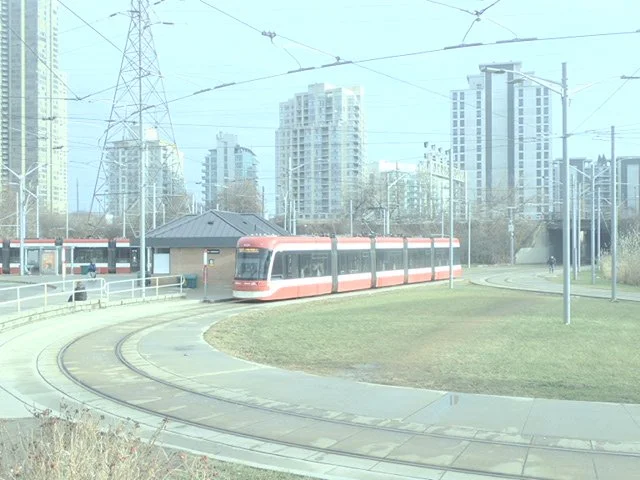
Humber Loop Terminal of 501 QUEEN. My Olympus Though camera had a problem with the lighting. I think it needs a software update. But like this, it looks vintage and is a good bridge to older photos below.


À la recherche du temps perdu
As you may have read in the news, the German automotive industry is under unprecedented pressure. It is the result of a mix of internal factors, changing geopolitics, new technologies, new competitors and last but not least a dysfunctional German government. Volkswagen Group, the company I have been associated with for decades, has been hit exceptionally hard. It is not the first crisis we see in the company, …
As you may have read in the news, the German automotive industry is under unprecedented pressure. It is the result of a mix of internal factors, changing geopolitics, new technologies, new competitors and last but not least a dysfunctional German government. Volkswagen Group, the company I have been associated with for decades, has been hit exceptionally hard. It is not the first crisis we see in the company, but this time it is different. A lot of what is happening now, and the internal shortcoming that lead to failing to confront it, have been visible for a long time. And I don’t say this in hindsight. A tragic mix of inertia, complacency, arrogance, governance issues and political interference have veiled the realities of a new world order of the auto industry. Volkswagen, especially in Germany, is in many aspects not so much managed like a company but it is more of a “brotherhood” (with only very few “sisters”).
Naturally, when I sent out my recent seasonal greetings, it reached a lot of these “brothers” and some “sisters”. I left 2015, but bonds remain strong. And there followed dozens of calls, to catch up. In the last decade, as I was the youngest back then, I have seen many retiring, and some sadly even died - sometimes just months after their corporate farewell. But this time, it is different. This time, it’s my direct former peers which quit or are pushed into early retirement. It’s those who remember their first working day in the passive Wolfsburg plant, and how they walked into the HR Department to report duty. It’s my fellows from the high potential development programs shaping the “leaders of the future”. And that future now is past. For many of them, it has been 30 years or more with the firm. And most of them think, where is the time gone, since I walked through “Tor Sandkamp” (Gate Sandkamp) for the first time. Don’t get me wrong, all of them had amazing careers and explored the world. All of them made the fortunes you can make working in the management of a true global player in that industry. But still, the time now seems lost to them. And with it some of the skills, they could now use perfectly, for example playing an instrument, the patience of reading a book, and distinguishing between friends and network.
Luckily, I never had this. I think, I was quite a free spirit during my times in any company, but very loyal to the people I work with. All I wanted, was to work on exciting topics and I never really pursued a career. Career, what ever that actually is, was just a result of the work I did. My career is the thing HR figures out, somewhere in their dusty corner. They don’t need me for that, right? I was not even aware I had a career, like I am also not really aware that I am approaching 60. Sure, sometimes you need a big title to get things done. A big name card opens bigger doors. It’s like in a computer game. There they call it tools, weapons, or assets, don’t they? It’s about the size of the toys they give you. It’s not about your size.
I have been discussing with a friend whether this attitude maybe the result of coming from a refugee family. Once you learn, that all can be taken away from you by “the system” - for sure your home, and even your life - you may stay more of a free agent. But I also know decedents of refugees, which put all into rebuilding their old life, just in a different place, where they gain trust into institutions. We had this twice: once fleeing from East Prussia and then from the Soviet occupied East Germany into the West. This part of the family never regained trust into any “system” and for sure not into any government. And then there was my father, running away from a steel worker’s apprenticeship in Differdange (Luxembourg) as a teenager looking for adventure and a better future. And then, for myself, there maybe perhaps an influence of what is called the (notorious) “Generation-X”, the latchkey kids brought up on garden hose water and neglect. Back then, we called it freedom.
In any case, I can remember anything I every did. Perhaps not the years, but the projects. There are no gaps and no time lost in my memory, even though I don’t think much about it. Thinking back to the beginning of my time in Volkswagen in the Wolfsburg headquarter, I found the picture of my view on the powerplant on an early winter morning. It was the time the factory was alive and running, workers changing shifts and many of the “office guys” did not wake up yet. That’s the golden hour in which the world is still in some kind of harmony.

Toronto and Ottawa
Since returning to Toronto, I have experienced some highlights. For instance, we celebrated a birthday dinner at the 360 Degree Restaurant in the CN Tower. We were advised to go early to enjoy the view starting in daylight, and it was a fantastic recommendation. The most impressive sight was the view of Billy Bishop Airport from the top. This regional airport serves routes to Canadian destinations as well as cities like Boston and New York …
Since returning to Toronto, I have experienced some highlights. For instance, we celebrated a birthday dinner at the 360 Degree Restaurant in the CN Tower. We were advised to go early to enjoy the view starting in daylight, and it was a fantastic recommendation. The most impressive sight was the view of Billy Bishop Airport from the top. This regional airport serves routes to Canadian destinations as well as cities like Boston and New York. The main airline is Porter, and due to the relatively short runway, it primarily accommodates turboprop planes. From above, the airport looks like a toy, and watching the runway operations feels like observing an animation.
Another highlight was attending the “Art and Architecture” event at the Toronto Parliament Building. The building houses a sizeable collection, and it was fascinating to learn about how Ontario governs itself. While I didn't know many of the political figures, some were quite some characters. This impression was sustained during a trip to Ottawa, where, among other meetings, I attended the Thomas d’Aquino 2024 Lecture on Leadership presented by Ivey, and delivered by Steve Paikin. Thomas Paul d’Aquino -an entrepreneur, policy innovator, author, educator, philanthropist, art patron, and lover of early music, medieval and modern architecture, great gardens, fly fishing, and world history - provided an the context to the challenges Canada faces today. Steve Paikin, known as an anchor at TV Ontario, drew on his extensive knowledge from interviewing world leaders as a journalist and author. It was a truly interesting event at the Canadian National Gallery.
I traveled to Ottawa by VIA Rail. Train travel in Canada feels like the 1980s in Germany, though the trains are higher and have more clearance - I guess to have the ability to plough through high snow. You nedd to reserve a seat and check in 15 minutes before departure, with stewards assisting at every door. Large luggage needs to be booked and checked in separately. Train travel in Canada is slow and a little backward. But for a train enthusiast like me, it's cool. In many ways, "cool and backward" describes various aspects of Canada. I recall Mr. d’Aquino's quote, “Canada is not broken, but dangerously complacent,” which I wholeheartedly agree with.

Via the North Pole to Hong Kong
Luckily Chinese Airlines continue flying over Russia, and so I was able to take the short cut from Toronto over the North Pole to Hong Kong. It is interesting watching the flight map, diving into Asia from that perspective. Still the 12 hour time difference, made me a little trouble this time. Then I also caught a fever and still had to flag pole over Macao due to a delayed visa process ...
Luckily Chinese Airlines continue flying over Russia, and so I was able to take the short cut from Toronto over the North Pole to Hong Kong. It is interesting watching the flight map, diving into Asia from that perspective. Still the 12 hour time difference, made me a little trouble this time. Then I also caught a fever and still had to flag pole over Macao due to a delayed visa process. So, everything became very tightly scheduled and there was only very little time for anything extra. I did not even go over to Lamma Island: no hike, no seafood, no nothing really. I apologize to all the friends I did not see this time.
Hong Kong is slowly digging itself out of the Covid-recession. It’s not easy. It helps to be closer connected to Shenzhen and the Pearl River Delta. But you can feel, the city is in a bit of an identity crisis. But at least it’s peaceful, unlike it was in 2029. That’s partly a result of the National Security Law implemented, and also because economic pressures start biting. There were celebrations for the 75th anniversary of the foundation of the People’s Republic of China. And as usual, an amazing fireworks lit up the skyline. 75 years. That’s a lifetime, and a period of tremendous development in China - including ups and downs.
Just after finishing my course at Hong Kong University, I drove to the airport and travelled to Turkey. This time over India with a little detour. I like Turkey a lot, and I can only imagine that it must have a great economic future. There is no real reason why for example many German companies should not move production capacities into Turkey. The country has a young, well trained and motivated workforce. There are some unwise economic policies, I think. But that should not be hard to fix.
Finally, my trip also brought me to Germany, in a plane from Antalya full with German tourists. Luckily it was just a 3 hour flight, and manageable. But when landing in Germany, still with this preparation, it came to me like a shock how agressive the environment has become. Germans lives in the frustration of the second year of self inflicted recession, and meaningless government slogans like “Doppelwums”, “Wachstumsturbo”, “Bauturbo”, “Zeitenwende” … The socialist past socialist GDR-Slogans at least were not baby speak, and you could understand the words, if not the intended meaning. The effect though is the same: nobody listens anymore. Instead they start blaming random groups for their misery. Sometimes they even blame me. Today I parked my Vespa motorcycle (orderly) in front of a shop to get some food and somebody just kicked it over to the ground, while yelling something about immigrants. Luckily, actually an immigrant, helped me to put it back on its wheels, so I could continue my ride. Let’s see how this stopover in Germany is going to continue.

The Day that Google died
The original Google search algorithm, PageRank, assigned a weight to websites to determine their importance. The more frequently a page was viewed, the more likely it was to appear in a Google search. Over time, this method has evolved into a more complex system, likely influenced by financial incentives and amplified by techniques ranging from search engine optimization to the amplification of semantic clusters through clickbait. Despite these changes, the algorithm worked well for me until I moved to North America ...
The original Google search algorithm, PageRank, assigned a weight to websites to determine their importance. The more frequently a page was viewed, the more likely it was to appear in a Google search. Over time, this method has evolved into a more complex system, likely influenced by financial incentives and amplified by techniques ranging from search engine optimization to the amplification of semantic clusters through clickbait. Despite these changes, the algorithm worked well for me until I moved to North America.
Now, I struggle to find “my stuff” anymore. For instance, when I search for a specific spare part, I am bombarded with “sponsored results” that only vaguely relate to what I am looking for. Today, I wanted to read about a wonderful movie we watched (in something like an extended lunch break) at the Toronto International Film Festival (TIFF) before casting my vote for the People’s Choice Award. The film was “The Penguin Lessons,” directed by Peter Cattaneo. However, my search results were dominated by the book by Tom Michell and various Hollywood productions featuring penguins, including some Disney content that I don’t particularly enjoy. Not even any zoological documentary turned up, which I would have expected.
Here I am in Toronto, the host city of the great festival, and I find myself needing to activate my VPN through Estonia—not to evade an autocratic government or protect my privacy, but simply to access a more civilized browsing experience and find relevant information on Canadian festival content. On the other hand it is easy to google the Toronto Jazz Festival without VPN. So, that would have put me at ease, until I witnessed the Jazz Festival in my neighborhood recently. I was expecting great things, given that we are in America and somehow not exactly in but close to the cradle of Jazz. I am sure many people enjoyed it, but t was more “Jazz folklore”, if this genre exists. Again switching on the Estonian VPN, the Toronto Jazz Festival becomes thwarted to a tourist attraction. And that’s what it is.
I agree, any search engine must have a hard time filtering relevant and quality results. It is constantly up to external manipulation on the one hand, then it needs to reflect the masses and not some special interest group. And last but not least it needs to make money. So my respect for coming up with anything useful at all. Perhaps also the web has just become too big and we need stochastic parrots to break it down. I am joking. What I find interesting about the google search results, is, that it tells you a lot about the culture you are searching in. And thankfully through a VPN, you can switch these “search cultures” easily. It reminds me if an anecdote I heard about a chatbot which was designed to learn from it’s conversations with the public. The Chinese version of the bot started to recite Chinese poetry, while the US-American became a racist. I hope that’s not true. There is wonderful American poetry, which should not get wasted.
And yes, of course the title of this post is “stolen” here:

Aga Khan Museum Toronto
In 1979/’80 I was thrown out of Catholic religious studies in my high school for the offense of marking major oil and gas fields in the back part of the school bible, where there were maps of the holy land. Soon kids joined me in the school library during these hours. Their offence was, that they had been displaced by terror from a cradle of civilization into a run down 5th tier city in Germany called Neuwied ...
In 1979/’80 I was thrown out of Catholic religious studies in my high school for the offense of marking major oil and gas fields in the back part of the school bible, where there were maps of the holy land. Soon kids joined me in the school library during these hours. Their offence was, that they had been displaced by terror from a cradle of civilization into a run down 5th tier city in Germany called Neuwied. Of course they became my friends and well, they were among the best students in town, which I wasn’t.
I kept my affection for Muslim cultures through the decades and it even grew by travels, starting from the Alhambra, then North Africa, the Middle East, Central, East and South East Asia. Don’t get me wrong, I am more of a secular type. I am talking about culture. It’s like Christmas, which I like. But I won’t forget my mom crying after work in her Catholic hospital and being bullied by nuns for being pretty. And not the priests and their subordinates having other things in mind with small boys than leading them to the right path. And even I like Christmas, I hate Christmas trees. Such a stupid concept!
I did not know what to expect when visiting the Aga Khan Museum Toronto. It is located a little outside of town, probably in a neighborhood you would not expect such a wonderful place. While most museums in Toronto are mere (and quite thin) collections, this one is really outstandingly designed and curated. It holds a collection of 1200 pieces representing a large variety of Islam cultures, and combines this with changing and carefully selected contemporary arts exhibitions, events and more. It has an amazing garden and is connected to The Ismali Center, where also guided tours are offered. The Aga Kahn Museum has the mission of “Through the arts, the Aga Khan Museum sparks wonder, curiosity, and understanding of Muslim cultures and their connection with other cultures”. And I think, it does that like no other. There was a book I liked, among many, while sitting in the sofas. It’s A companion to Muslim cultures (2011) by Amyn B. Sajoo. It was sold out at the (excellent) museum shop, unfortunately. So, I went to Amazon (not the river in Brasil, but the online book seller), and typed in something like “Muslim cultures …”. I found it somewhere on place 25 behind a string of books on Muslim terrorism. Yes, we need more museums like the Aga Khan Museum in Toronto. Many more.

Re-surfacing on the other side of the Atlantic
After some time packed with logistics in Europe, I am resurfacing in Toronto. Nothing against Europe. I really cherish the cultural richness and complexity, from the Mediterranean to Scandinavia and Eastern Europe. But no place there is as relaxed and friendly as Canada. It appears to be hard wired, somehow. Recently, I was downtown Toronto, waiting for the streetcar (tramway) at Church station …
After some time packed with logistics in Europe, I am resurfacing in Toronto. Nothing against Europe. I really cherish the cultural richness and complexity, from the Mediterranean to Scandinavia and Eastern Europe. But no place there is as relaxed and friendly as Canada. It appears to be hard wired, somehow. Recently, I was downtown Toronto, waiting for the streetcar (tramway) at Church station. It is a bit of a problem area with drug addicts loitering in the streets and a Salvation Army post near by. So, after some time of waiting, a man, clearly under the heavy influence of narcotics approached me. I was bracing for trouble. But this fellow, who could barely walk and was literally falling to pieces, made it over the street just to tell me: “Excuse me sir, you are at the wrong stop. There is a construction site over there and you need to wait over there”. Then he turned around, tumbled a few times on the way back over until he sat down on a bench and fell into “coma”. This incident reminded me of early research of brain structure where subjects with certain brain injuries were examined and then seen what capabilities remained. This poor fellow, was completely smashed, but he remained super friendly and polite. My conclusion is, that Canadians are friendly down to the reptile parts of the brain, and they remain friendly no matter what. It’s like the opposite of a German.
After technically settling in Canada, now the time has come to explore it more. Toronto has a few good museums, an opera house and a number of small theatres. I am of course very interested in finding out more about the indigenous people of Canada. Access to that is not that easy, especially because the discourse appears to be sensitive. Two things are always important for me, when I come to a new place: the public library and the post office. Toronto has an amazing public library. Not just the physical collection, but also the digital resources and the events and courses they offer. The central post office, I still need to see. But the postal service appears reliable, and supports my habit of sending postcards.
It’s also time to get some intellectual stimulus besides work. So, I am very happy to start teaching in the evenings at the Toronto Metropolitan University. I will expand on this also in other Universities in Canada, but also in the US.
The days already turn chilly now and I can’t believe, I have not explored the Canadian forests yet. I do hang out with my dog at the Northern shore of Lake Ontario, which is beautiful. By the way, even the dogs are more friendly here. One or two small incidents, but for having a male dog, who is “in tact” as they call it here, I was expecting more tension among piers. But no. All good.

Alternative Housing
In 2021 I decided to spend more time in the Netherlands and took a part time teaching position at Tilburg University. Immediately the question of housing came up. Tilburg in itself is a small university town and it is fair to say it has a housing crisis, which I did not want to add to. So when thinking through options, I started to look for boats. And this is how a three year semi-holiday in the Netherlands started …
In 2021 I decided to spend more time in the Netherlands and took a part time teaching position at Tilburg University. Immediately the question of housing came up. Tilburg in itself is a small university town and it is fair to say it has a housing crisis, which I did not want to add to. So when thinking through options, I started to look for boats. And this is how a three year semi-holiday in the Netherlands started. I have published frequently posts on this website about it.
A good friend introduced me to the Dutch waterways before and I always enjoyed seeing the world from the water side. Considering different boat types, and given I needed it mostly for staying and not for travelling, I opted for a motorized Houseboat, a Campi 320 Long Roof, and bought it from Golliath in Sneek. As a second home, it turned out to be perfect, being able to change the scenery from urban to rural and back, cruising the canals and having all the comforts of a little swimming house. The motorization proved sufficient for that with a Yamaha 9,9 High Thrust, which allows travelling at around 6 km/h with a fuel consumption of about 2,5 l / hour. And even winter was cozy, with a gas central heating.
Sure, there are some adjustments. For example, if you don’t attach the boat to land water, you have 250 l fresh water before you need a refill. That’s about a week for one person. You can get water easily in any marina though. The same for “black water” (sewage). In the Netherlands “grey water” (shower, kitchen, sink) can go into the river. That also meant, I took it strict on how much and what kind of detergent I used. Then during stormy nights, even in sheltered waters, it can get a little bumpy. The body shapes of these type boats, are catering to comfort, but it does make them hard to maneuver in strong winds. I never took it to one of the house boat settlements, which I heard is great to be. I had plans to bring it to the French Canals later, but then moving to Canada came around the corner. So, I made investigations on whether it would be feasible to move the boat to Ontario, or take it up the Mississippi River. But going into technical details, I finally decided, not to follow that plan. While in Europe the infrastructure, services and spare parts are available and easy to obtain, this is different in North America. Especially, as my boat has been built to European standards and I would not even find a 250 Volt electric fuse in Canada or the USA. Also the distances are so much larger, that it is probably not feasible to take the boat for a ride in summer, which is short anyways. Plus, there is the Canadian winter, which has a reputation.
So, a little heart broken, I put my boat on the market for sale. It’s like always when you sell something you like, you want to find somebody who appreciated it the same way. Let’s see how I can manage that. Now it’s online for a start here.

Boston revisited
The Charles River (Quinobequin) separates Boston from Cambridge Massachusetts and, given the number and quality of Universities on its banks, is dubbed “the most educated river”. There are Harvard, MIT, Boston University and many more. I have been to Boston before to visit the office of my former employer, The Boston Consulting Group (BCG) …
The Charles River (Quinobequin) separates Boston from Cambridge Massachusetts and, given the number and quality of Universities on its banks, is dubbed “the most educated river”. There are Harvard, MIT, Boston University and many more. I have been to Boston before to visit the office of my former employer, The Boston Consulting Group (BCG). But they have now moved to a very modern and spacious location at the southern bank of the redeveloped harbor, just across Logan International Airport. Boston as a major trading port, became the center of the American Revolution, and subsequently the independence war. This was triggered by the English heavily taxing many goods imported to their colonies without offering political representation. The “Tea Party” were not just crazy people throwing tea into the port.
Today Boston is a very friendly, walkable and clean city. Unlike in other US and Canadian cities you rarely see drug addicts in the streets. The Boston mayor, Michelle Wu (吳弭), recently added policies to make it easier for law enforcement to remove tents and at the same time expanded the number of shelters in critical areas. She also pushed the Boston Green New Deal, proposed free public transport (there is not much public transport though) and other progressive policies. There seem to be no big public budget worries, or perhaps since the “great dig”, a major move to put infrastructure under ground from 1991 to 2007 (!), which overshot the budget by factor 10, the Bostonians maybe used to it. In any case, Boston is a very livable city today and among other initiatives this is also a result of the “great dig”.
There are great museums, libraries and galleries, which in itself justify to return to Boston soon. What I really enjoyed was a musical performance in the Boston Citizen Opera. An amazing building, which was originally a movie theatre and converted under Sarah Caldwell to an opera house and acquired by the Opera Company of Boston. However, it did not achieve financial viability. It was renovated and reopened in 2004 under new leadership with the Broadway production of The Lion King, and it is kept busy with concerts and pop concerts. We saw the musical “Come from Away”, which was great. It is based on the story of Gander, a small city in Newfoundland, which gave shelter to 7000 stranded passengers in the days after September 11 in 2001 when US airspace was closed in response to the terrorist attacks. It is a very American story, and nobody can help remembering these terrible days. But the musical does not leave its audience dwell on that for too long and quickly switches to individual stories and of course to the great people of Gander coming together to help. The theatre was cracking full, standing ovations, and people had a great evening. I can well imagine though, what the German purists would say to musical in an opera house. But Germany is a social angina pectoris anyways. And it’s why German theatres are more of a highly subsidized mortuary, instead of reaching all generations.
We had the very kind opportunity to stay as a guest in the The Country Club in Brookline, Massachusetts. It was founded as the Philadelphia Cricket Club in 1854 as the first country club for any sports. Today it is mostly about golf, and even I don’t play that, it is a marvelous place. Honestly, in a world where it becomes more and more acceptable to have loose manners, such a club feels like a beacon of civilisation. But I can actually expand this to the whole of the Boston area. Sure, some say, this is a bubble with Harvard, MIT and all the rest of it. It does not represent the USA. That’s right. But people are luckily free these days to choose the environment they want to live in, and contribute to improve it. And Boston I find a great place to exactly do that.

Toronto’s Palace of Purification
Toronto offers once a year the opportunity to enter a large number of sites and buildings in Doors Open Toronto. This time it was the weekend of May 25th-26th. The sheer number of buildings listed is overwhelming. But there was one I had in focus, because I caught myself already a few times pressing my nose to the windows …
Toronto offers once a year the opportunity to enter a large number of sites and buildings in Doors Open Toronto. This time it was the weekend of May 25th-26th. The sheer number of buildings listed is overwhelming. But there was one I had in focus, because I caught myself already a few times pressing my nose to the windows of the R.C. Harris Water Treatment Plant at the end of our beach at Lake Ontario. It is a wonderful complex consisting mainly of two buildings: the pumping station and the filter building. Its grand 1930s architecture and Art Deco elements, made people dub it “The Palace of Purification”. There are three recommended readings which are John Bentley Mays (1992): A Masterwork of Art Deco and in the Market gallery of the City of Toronto Archives (1982), The Architecture of Public Works: R.C. Harris, Comissioner, 1912-1945. I could not find them online. But that’s just one more reason to also explore the Central Library of Toronto soon. Toronto’s 3 million people have an annual drinking water demand of 400 billion liters, and the R.C. Harris plant provides about 1/3 of it. Tap water is actually chlorinated in Toronto, which made me buy a domestic water filter to run it through first. But I can imagine, that given the over 6000 km of piping in town, chlorination is necessary to keep it safe until reaching the last corner.

Nordics and Baltics
We assembled a group of MBA students from the University of Hong Kong in Helsinki, which became our starting point for a study trip in the Finland and Estonia. Again this was a great group: curious, disciplined and open minded …
We assembled a group of MBA students from the University of Hong Kong in Helsinki, which became our starting point for a study trip in the Finland and Estonia. Again this was a great group: curious, disciplined and open minded. There was strong corporate aspect to the trip, but also some cultural time and a small trip to Porvoo’s old village and also cruising the canals. We experienced great hosts at Nokia, learned about it’s changes, explored Espoo and it’s startup and investment landscape, as well as the Finland-Hong Kong trade relations. We took the ship to Tallinn on a sunny day, where we learned more about e-Estonia, the e-residency, Wise, the port of Tallinn, CARIAD Estonia and made a day trip to Tartu experiencing it as 2024 European Culture Capital. Estonia always shows what is possible when digital tools are put to service, and the whole little country feels like an incubator for ideas. But what I admire even more is, that they “just do it” and are very successful. No “agility bullshit”, but plain smart management principles, technical knowledge and hard work.
It’s great such trips are possible again, since Covid is history (for now). But really at the core of such a journey stand our hosts, which go far beyond “the corporate presentation”, with passion to share their insights and experiences. After this trip, it was time for me to return to Canada, where early summer has arrived.

The Bay of Broken Promises
On December 2nd and 3rd 1989 Michael Gorbatchev and George H.W. Bush met on the Soviet ship TS Maksim Gorkiy south of Malta, mooring in the Bay of Marsaxlokk. The sea was choppy, which brought the meeting the name “Seasickness Summit”. It is often described as one of the most important summits since the Yalta Conference in 1945, …
On December 2nd and 3rd 1989 Michael Gorbatchev and George H.W. Bush met on the Soviet ship TS Maksim Gorkiy South of Malta, mooring in the Bay of Marsaxlokk. The sea was choppy, which brought the meeting the name “Seasickness Summit”. It is often described as one of the most important summits since the Yalta Conference in 1945, as it marked the end of the Cold War, just about a month after the fall of the Berlin Wall. There was no treaty signed, but a core message by Gorbatchev was: “[…] The world is leaving one epoch and entering another. We are at the beginning of a long road to a lasting, peaceful era. The threat of force, mistrust, psychological and ideological struggle should all be things of the past […]”. Bush’s response was: “[…] We can realize a lasting peace and transform the East-West relationship to one of enduring co-operation. That is the future that Chairman Gorbachev and I began right here in Malta.”
The rest of the story we all know, with different interpretations. The TS Maksim Gorkiy had a dramatic story in the same year, when it hit ice near Norway and began sinking quickly. The Norwegian ship Senja took on 700 people from the ship and managed to stop it from further sinking. More were rescued by helicopter from life boats and ice. Perhaps that was a bad omen for the Malta Summit. Or a good one, given that the ship was rescued, repaired and put back to service. History will tell.
Marsaxlokk Bay, or also Kalafrana Bay in Birżebbuġa, is framed by the power plant with its LPG tanker to the East and the Freeport to the West. But it is still a very pretty area with its turquoise waters and the traditional fishing boats. It was also a set for the award winning Maltese movie Simshar (trailer also below). There is a fish market on Sundays which became a tourist attraction. What I enjoy is a hike along the Maltese West coast, along the cliffs and then going to the place where you get the world’s best Octopus in Garlic. It’s a family business. I am not an “Influenza” and don’t make promotions of my favorite places. But if you write to me in the contact section, and describe why you think you qualify to go there, I may tell you.
I have walked to this bay many times, and always like it as a day’s outing. This time I saw it though a little different, perhaps being overwhelmed by recent events which’s historical trail also crossed this little bay, back in 1989.


"Feldpost" from de-industrializing Germany
Last week, I had the chance to present the industrial and economic facets of Germany to MBA students from The University of Hong Kong. Our journey began in Berlin, then proceeded to Wolfsburg, Dortmund, Duisburg, Hannover, and concluded back in Berlin. I extend my heartfelt gratitude to our hosts …
Last week, I had the chance to present the industrial and economic facets of Germany to MBA students from The University of Hong Kong. Our journey began in Berlin, then proceeded to Wolfsburg, Dortmund, Duisburg, Hannover, and concluded back in Berlin. I extend my heartfelt gratitude to our hosts for their generous insights: Volkswagen AG, TU Dortmund, the City of Duisburg, Future Car Lab, Neoxphere Technology, and Bundesverband Musikindustrie (Federal Association of the Music Industry). This broad array of industries and subjects was enhanced by cultural excursions to Potsdam's Sanssouci, the former Sachsenhausen Concentration Camp in Oranienburg, and several sites that depict the process and impact of Germany's reunification.
This trip occurred against the backdrop of Germany's struggling economy. Since the Greens and Socialists were ushered into power with the support of a small liberal party in December 2021, the nation has grappled with erratic and ideological policies. These are often portrayed to the populace as investments in future competitiveness or as efforts to catch up with the previous government's developmental shortcomings. From being Europe's economic powerhouse, Germany has become the OECD's underperformer in just a few years. To counter the demographic trend of an aging population and a shortage of skilled labor, Germany has opened its doors to immigration. Yet, skilled individuals often opt for regions with lower taxes and simpler bureaucracy, finding better opportunities elsewhere. Nevertheless, immigration remains high, consisting of refugees and migrants, many of whom face challenges integrating into the labor market.
Still there are many things to learn in Germany. Many capabilities have not vanished immediately, but are just getting unfeasible in the country. Also, assets of privately owned SMEs are getting cheap to acquire. And of course, Germany is a lesson on a new kind of political risk, where technocratic political leadership is succeeded by a new class of politicians which are genuinely ideologic, but does not even have the skills, education and character to follow through their own agenda.